
Glossary
SOC 2 Compliance
 ChatGPT
 Perplexity
 Gemini
 Claude
What is SOC 2 compliance?
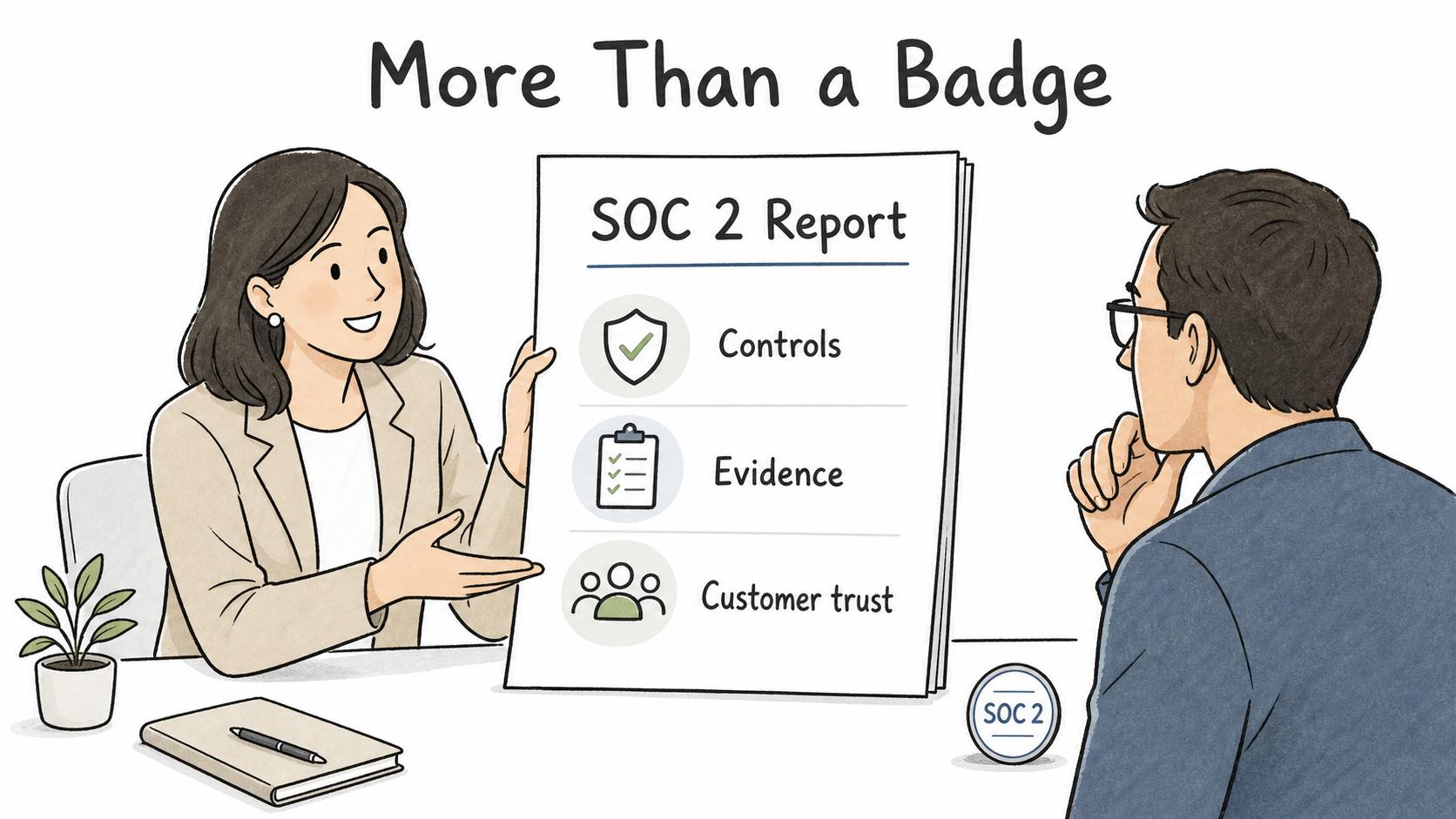
SOC 2 compliance is the work a service organization does to prepare for and support a SOC 2 examination of controls related to security, availability, processing integrity, confidentiality, or privacy. In plain business language, it means the company can show how its controls support the trust commitments it makes to customers.
SOC 2 is often described casually as a certification. More precisely, the output is a SOC 2 report from an attestation process performed by a CPA firm. AICPA describes SOC as a suite of services CPAs may provide for system-level or entity-level controls.1
What SOC 2 compliance covers
SOC 2 examinations use the AICPA Trust Services Criteria. The current AICPA resource describes criteria for security, availability, processing integrity, confidentiality, and privacy.2
Those categories shape the controls, evidence, and documentation the auditor will evaluate.
| Trust Services category | What it generally concerns | Example documentation |
|---|---|---|
| Security | Protection against unauthorized access, misuse, or damage | Access reviews, incident response SOPs, change management records |
| Availability | System availability for operation and use | Backup procedures, uptime monitoring, disaster recovery runbooks |
| Processing integrity | Complete, valid, accurate, timely processing | QA checks, data-processing controls, reconciliation procedures |
| Confidentiality | Protection of confidential information | Data classification, encryption procedures, vendor access rules |
| Privacy | Personal information collection, use, retention, and disclosure | Privacy workflows, data deletion procedures, consent handling records |
Security is the category most teams associate with SOC 2, but scope should come from the organization's services, customer commitments, system boundaries, and audit objectives. Adding criteria because they sound impressive creates evidence obligations the team may not be ready to maintain.
SOC 2 Type 1 vs Type 2
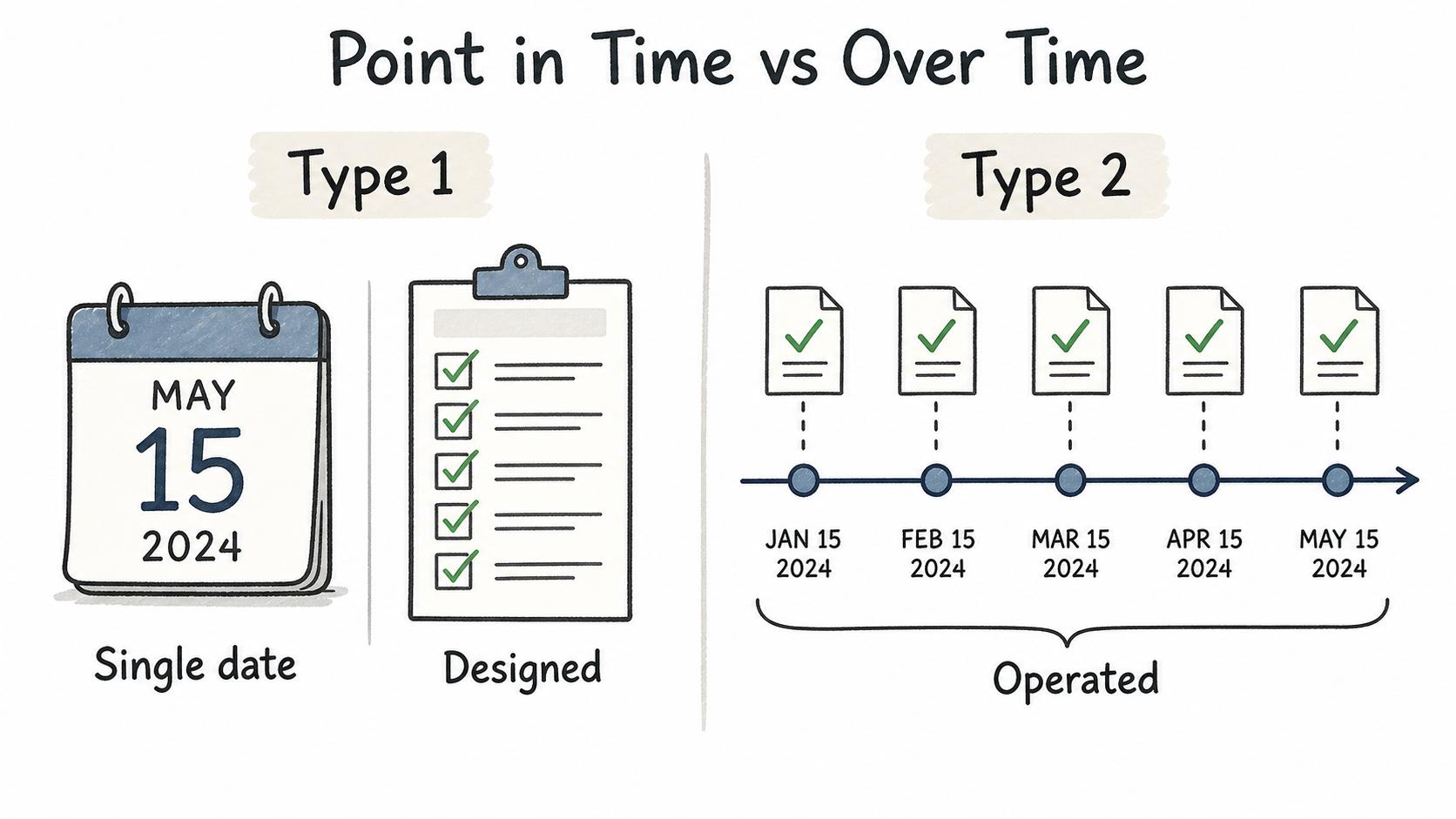
SOC 2 reports are commonly discussed as Type 1 or Type 2. A Type 1 report focuses on control design at a point in time. A Type 2 report covers design and operating effectiveness over a period.
The practical difference is evidence. A Type 1 review may examine whether an access review control is designed. A Type 2 review may look for proof that access reviews actually happened during the audit period.
AICPA's illustrative SOC 2 Type 2 materials include management's assertion, the system description, the service auditor's report, and tests of controls with results.3 That structure is a useful reminder: policies are only part of the story. The organization also has to describe the system, operate controls, and produce evidence that supports the auditor's work.
Why documentation matters for SOC 2
SOC 2 depends on controls, but controls are hard to evaluate when the work is undocumented. Auditors and customers need evidence that the organization does what it says it does.
Useful documentation often includes security policies, change management SOPs, incident response procedures, access request and removal workflows, vendor review procedures, backup and recovery runbooks, employee onboarding and offboarding procedures, risk assessment records, and recurring review or approval evidence.
AICPA's SOC 2 description criteria are used when preparing and evaluating the description of a service organization's system in a SOC 2 examination.4 Documentation helps the organization explain what the system is, what commitments it makes, and how controls support those commitments.
A practical SOC 2 documentation workflow
A team preparing for SOC 2 should avoid a last-minute evidence scramble. Start by mapping controls to real workflows, then make evidence collection part of the workflow itself.
- Define scope: services, systems, teams, locations, and Trust Services categories.
- Identify controls: what must be true to meet the organization's commitments.
- Assign owners: each control needs someone responsible for operation and evidence.
- Document procedures: write or update SOPs for repeatable control activities.
- Collect evidence: save proof that procedures were followed.
- Review gaps: find controls that are designed but not consistently operated.
- Keep evidence current: collect throughout the period, not only before the audit.
The strongest SOC 2 programs collect evidence during normal operations. If employees have to reconstruct months of access reviews, incident notes, or approvals after the fact, the control probably is not operating cleanly.
Common SOC 2 compliance mistakes
One common mistake is treating SOC 2 as a checklist of tools. Compliance software can help, but it does not replace control ownership. Someone still needs to understand the workflow, operate the control, and keep evidence current.
Another mistake is writing policies that are more mature than the business. If a small team writes enterprise-grade procedures but does not follow them, the documentation becomes a liability. Accurate, clear, maintainable documentation is stronger than impressive language nobody can defend.
A third mistake is forgetting scope. A SOC 2 report does not automatically cover every product, team, system, location, or data type. Buyers and auditors care about what was actually in scope.
Documentation takeaway
SOC 2 compliance is an operating discipline, not only a security project. Teams need clear procedures for access, change management, incident response, onboarding, offboarding, vendor reviews, backups, and other recurring controls.
The documents should match how the company actually works, then improve as the control environment matures.
How Trails helps
Trails can help teams capture repeatable control workflows as they are performed, then turn them into step-by-step guides and AI-narrated videos for training or evidence readiness. That is useful for procedures like user access reviews, employee offboarding, vendor review, release approvals, and incident follow-up.
Trails does not replace a CPA firm, legal counsel, or a compliance platform. It helps teams document the operational workflows that support a stronger SOC 2 readiness process.
- Regulatory compliance
- Software development SOP
- SOP software
- Runbook
- Process documentation software
- Access control
- Incident management SOP
- Change management SOP
Sources
- 1
AICPA & CIMA. System and Organization Controls: SOC Suite of Services. AICPA & CIMA. www.aicpa-cima.com/resources/landing/system-and-organization-controls-soc-suite-of-services. Accessed July 6, 2026.
- 2
AICPA & CIMA. 2017 Trust Services Criteria with Revised Points of Focus 2022. AICPA & CIMA. www.aicpa-cima.com/resources/download/2017-trust-services-criteria-with-revised-points-of-focus-2022. Accessed July 6, 2026.
- 3
AICPA & CIMA. Illustrative SOC 2 Report with Illustrative System Description. AICPA & CIMA. www.aicpa-cima.com/resources/download/illustrative-soc-2-r-report-with-description-and-assertion. Accessed July 6, 2026.
- 4
AICPA & CIMA. 2018 SOC 2 Description Criteria with Revised Implementation Guidance 2022. AICPA & CIMA. www.aicpa-cima.com/resources/download/get-description-criteria-for-your-organizations-soc-2-r-report. Accessed July 6, 2026.