
Glossary
ISO 27001
 ChatGPT
 Perplexity
 Gemini
 Claude
What is ISO 27001?
ISO 27001, formally ISO/IEC 27001, is the international standard for information security management systems. It defines requirements for building, maintaining, and continually improving a management system that protects information based on risk, business context, and assigned responsibilities.
ISO 27001 asks whether the organization can identify information-security risks, choose appropriate controls, assign ownership, document security work, and improve the system over time. ISO lists ISO/IEC 27001:2022 as the current standard, with a 2024 amendment for climate action changes. 12
Why ISO 27001 matters
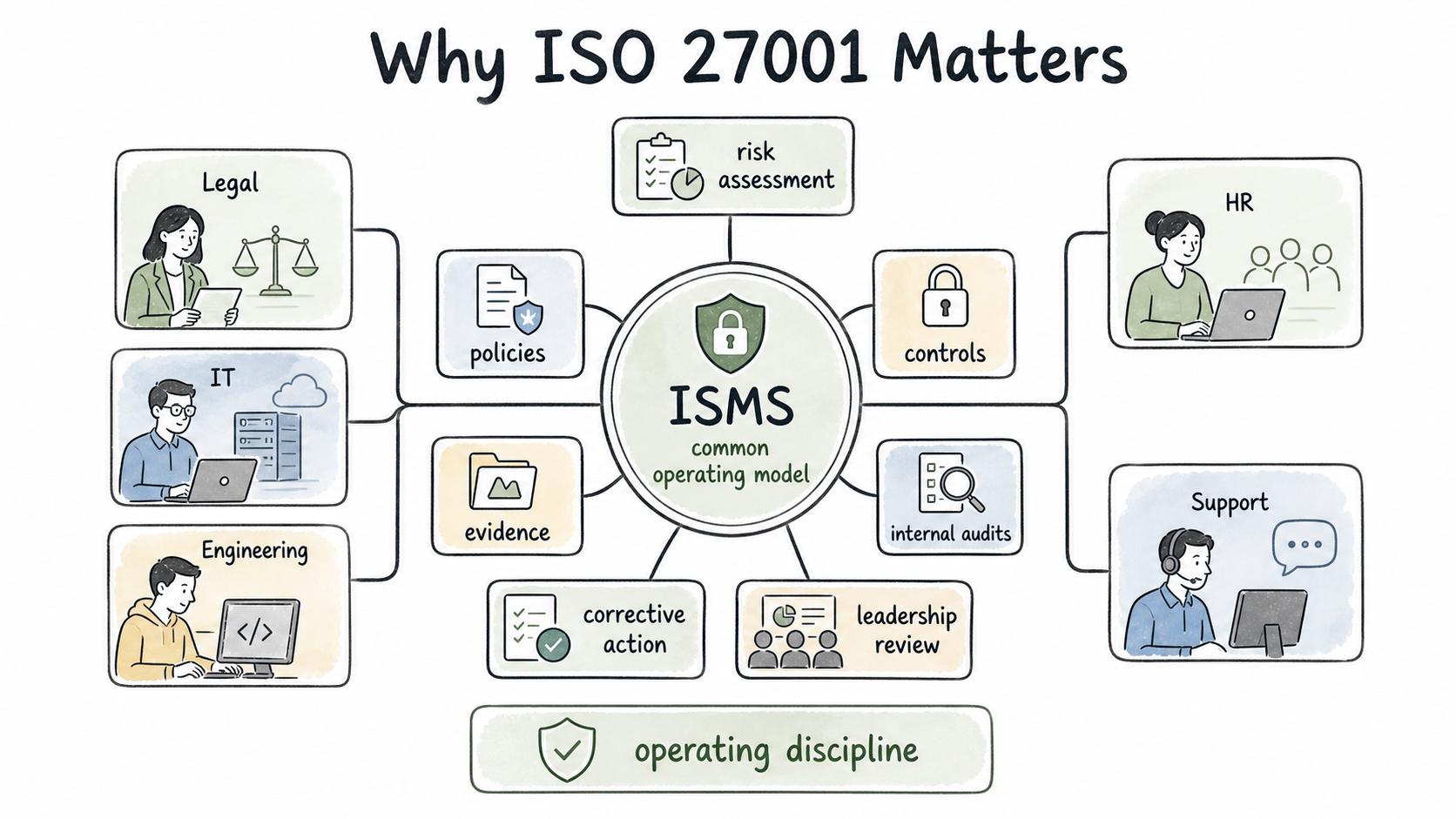
Information security fragments quickly. Legal owns vendor contracts, IT owns access, engineering owns production systems, HR owns onboarding and offboarding, and support handles customer data in daily work. Without a management system, each team can make reasonable local choices while the overall security posture stays inconsistent.
An information security management system, or ISMS, gives that work a common operating model. It connects risk assessment, policies, controls, evidence, internal audits, corrective action, and leadership review. 3
How ISO 27001 works
ISO 27001 starts with context and risk. The organization defines the scope of its ISMS, identifies what information needs protection, assesses risks to confidentiality, integrity, and availability, and decides how those risks will be treated.
If a customer success team exports account data for onboarding, ISO 27001 thinking asks who can export it, where it can be stored, how access is removed, what record proves the process happened correctly, and what happens if the data goes to the wrong place.
- Security policies that state intent and requirements.
- Risk assessment and risk treatment records.
- Controls selected for real risks.
- Procedures for recurring security work.
- Evidence that the procedures are followed.
- Internal audit and management review.
- Corrective actions when the system fails.
A policy without a working procedure is wishful. A procedure without evidence is fragile. Evidence without review becomes storage. ISO 27001 pulls those artifacts into one accountable system.
ISO 27001 vs ordinary security documentation
| Security artifact | What it should do | Where it often fails |
|---|---|---|
| Security policy | Set expectations and boundaries | Too broad to guide daily decisions |
| Access review procedure | Define who reviews access and how often | Reviewers approve lists they don't understand |
| Incident response guide | Clarify roles, timing, and escalation | The guide assumes everyone is available and calm |
| Risk register | Show evaluated risks and treatment choices | It becomes a stale spreadsheet detached from work |
| Vendor review checklist | Standardize third-party risk decisions | It treats all vendors as equally risky |
| Audit evidence folder | Prove controls operated | Evidence is collected after the fact and lacks context |
The documentation trap in ISO 27001 is collecting artifacts for an audit while leaving daily security work ambiguous. Strong security documentation tells a trained employee what to do, what judgment to apply, and what evidence to leave behind.
Common misconception: ISO 27001 is a control checklist
Controls matter, but the standard is about the management system that chooses, operates, reviews, and improves them. 4
A better question than ‘Do we have an access control policy?’ is whether access decisions match risk, the review process happens, exceptions are handled, and failures lead to corrective action.
How to apply ISO 27001 in internal documentation
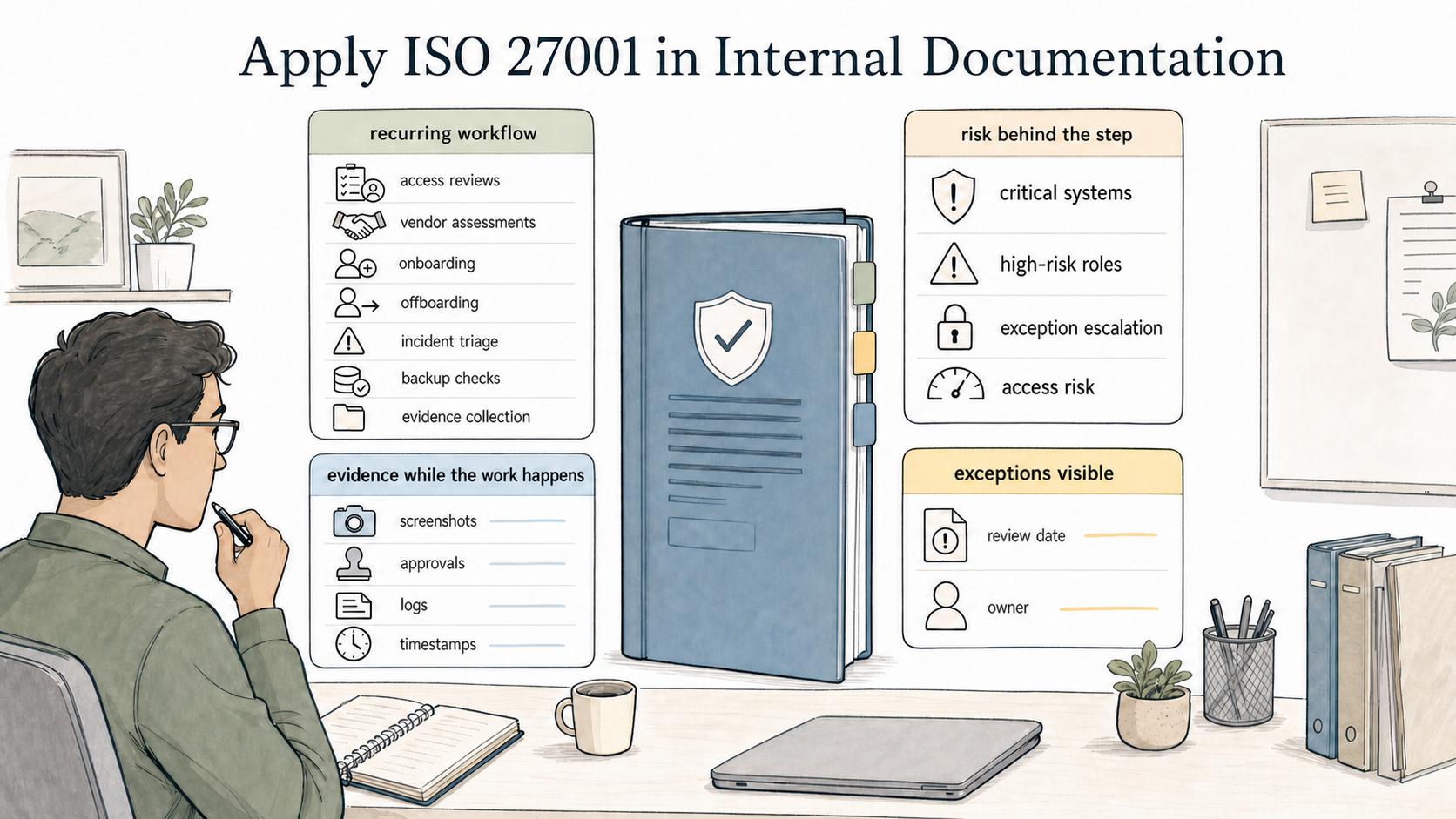
- Start with recurring workflows such as access reviews, vendor assessments, onboarding, offboarding, incident triage, backup checks, and evidence collection.
- Name the risk behind the step and the exception that requires escalation.
- Design for evidence while the work happens: screenshots, approvals, logs, timestamps, and review notes.
- Keep exceptions visible with a review date and owner.
How Trails helps
Trails helps teams document the operational side of ISO 27001. A security, IT, support, or operations teammate can capture a workflow while performing it, turn that capture into a polished step-by-step guide, and create an AI-narrated video version for training or sharing.
That is useful for recurring security processes where precision matters: onboarding access, removing access, handling support data, gathering audit evidence, or reviewing vendor intake.
- Process documentation
- Standard operating procedure
- Knowledge base
- Documentation software
- Information security management system
- Risk assessment
- Access control
- Security policy
Sources
- 1
ISO. ISO/IEC 27001:2022 Information security management systems. www.iso.org/standard/27001.
- 2
ISO. ISO/IEC 27001:2022/Amd 1:2024. www.iso.org/standard/88435.html.
- 3
ISO. ISO/IEC 27000 family - Information security management. www.iso.org/standard/iso-iec-27000-family.
- 4
ISO. ISO/IEC 27002:2022 Information security controls. www.iso.org/standard/75652.html.