
Glossary
Accounts Receivable SOP
 ChatGPT
 Perplexity
 Gemini
 Claude
What an accounts receivable SOP should cover
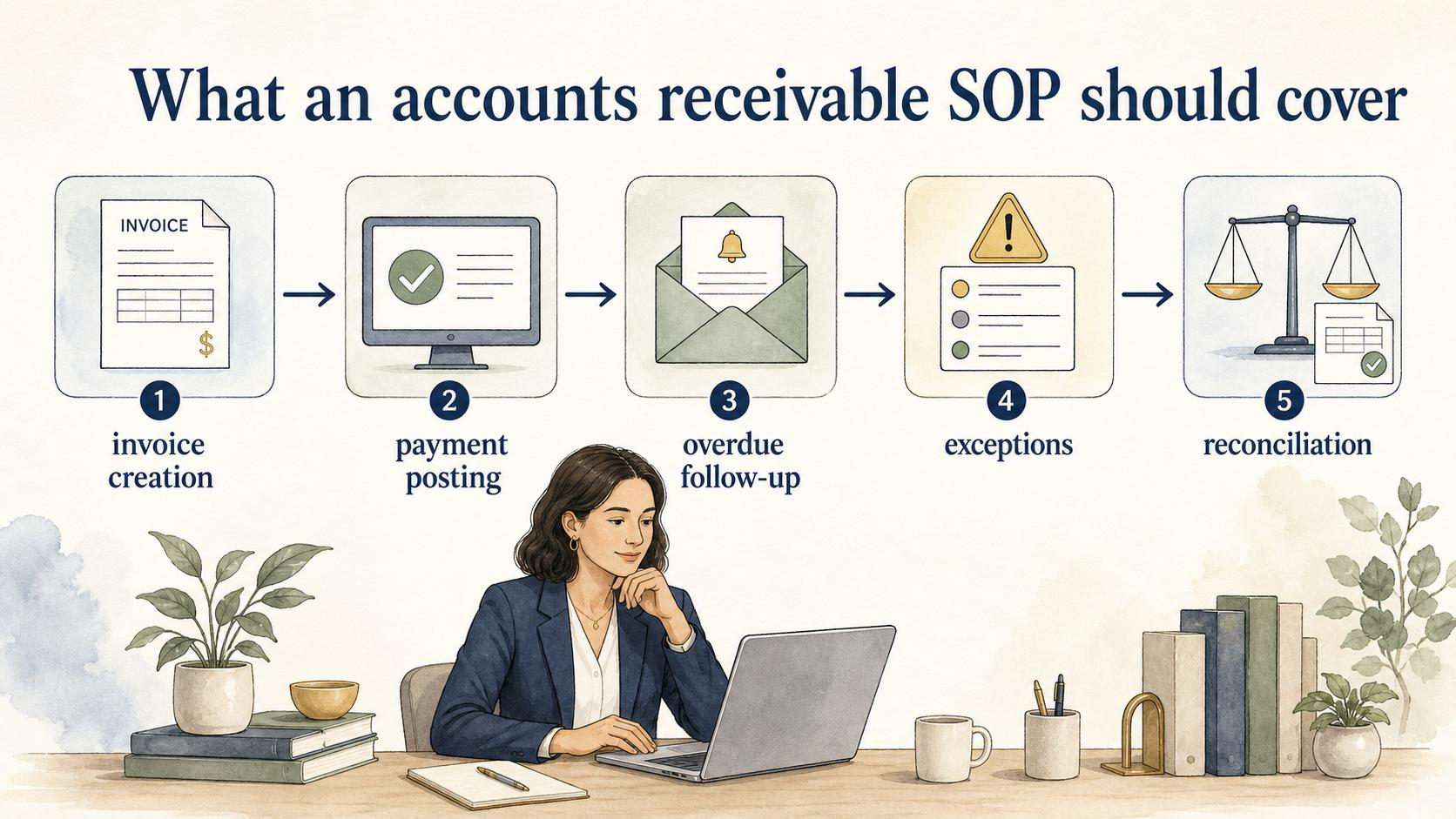
An accounts receivable SOP is a documented procedure for how a business issues invoices, records customer payments, follows up on overdue balances, resolves AR exceptions, and reconciles receivables. It keeps money-owed workflows from depending on memory, inbox habits, or one person's private spreadsheet. 1
A good AR SOP makes the routine path repeatable and the risky exceptions visible. It should tell the team when the normal process stops, what evidence is required, and who owns the next decision.
A useful accounts receivable SOP follows the invoice-to-cash lifecycle. It should explain what happens from the moment revenue is ready to bill through payment posting, exception handling, and reconciliation.
At minimum, the SOP should define:
- When an invoice can be created and who approves it.
- What information must be checked before the invoice is sent.
- How payments are received, matched, and posted.
- How overdue accounts are identified and escalated.
- How credits, refunds, disputes, write-offs, and short payments are handled.
- How AR balances are reconciled at month end.
The difference between a task list and an SOP is the decision rule. A task list says "send invoice" and "follow up." An SOP says which system to use, which fields must match, what evidence to keep, which exceptions stop the process, and who owns the next decision.
Why accounts receivable SOPs matter
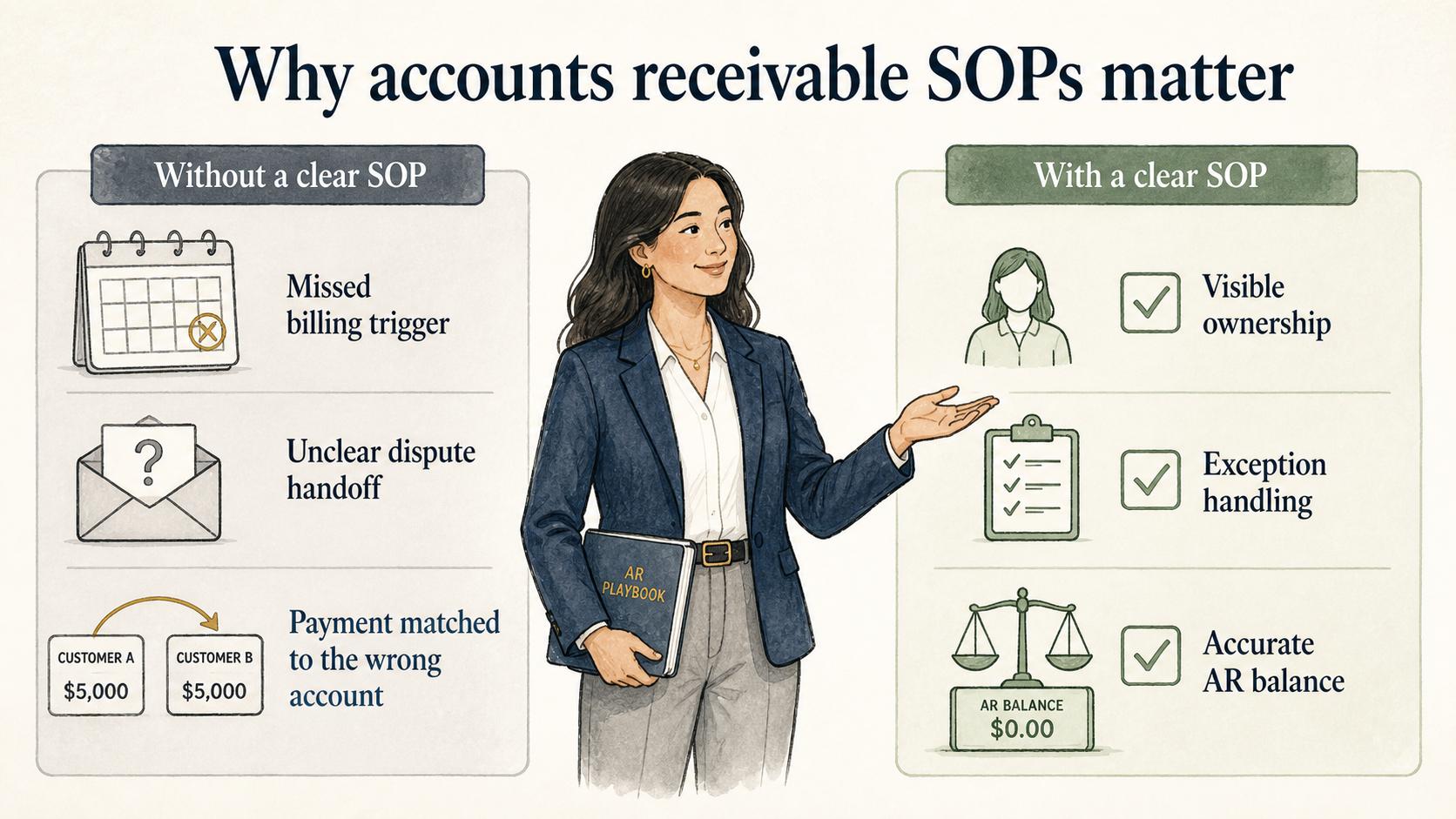
Accounts receivable is a back-office process where small documentation gaps can create visible business pain. A missed billing trigger delays cash, and payment friction is common enough that one Federal Reserve survey found many small businesses reporting challenges in how they send and receive payments. 2 An unclear dispute path leaves customer success and finance arguing over ownership. A payment posted to the wrong account creates reporting noise someone has to unwind later.
The best AR SOPs reduce these risks by making the process observable. They cover what to do when everything goes right, but they also cover what to do when a customer disputes an invoice, pays the wrong amount, sends payment without remittance detail, asks for a credit, or needs a billing contact changed.
That exception layer is where the SOP earns its keep. Routine AR work is usually easy to teach. Exceptions are where teams quietly build tribal knowledge.
Example accounts receivable SOP sections
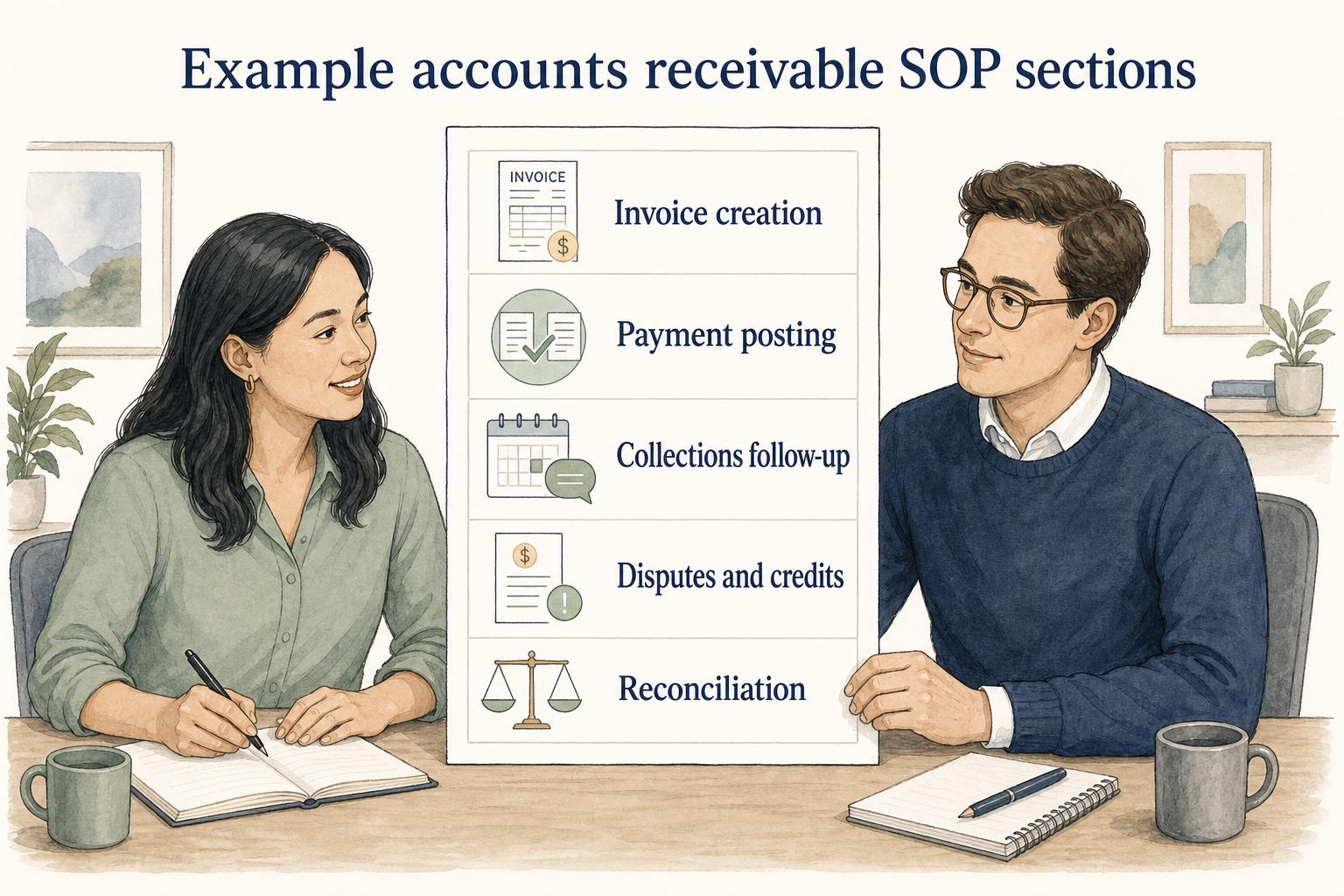
| SOP area | What to document | Failure mode it prevents |
|---|---|---|
| Invoice creation | Required billing data, approval trigger, invoice numbering, tax or discount checks | Invoices sent with wrong amounts, missing terms, or unclear ownership |
| Payment posting | Accepted payment methods, matching rules, remittance evidence, unmatched payment queue | Cash applied to the wrong customer or left unresolved |
| Collections follow-up | Aging thresholds, tone guidelines, escalation owner, pause rules for disputes | Inconsistent customer follow-up or duplicate outreach |
| Disputes and credits | Who investigates, what evidence is required, when credits are approved | Informal promises that never reach accounting records |
| Reconciliation | Month-end checks, open item review, write-off rules, reporting owner | AR balances that look clean but contain unresolved exceptions |
This structure keeps the SOP tied to real control points. PCAOB guidance describes control activities as policies and procedures that help ensure management directives are carried out, including information processing and segregation of duties. 3 It also helps a reviewer see whether the procedure covers the work as it actually happens, not just the clean version of the process.
How to write an accounts receivable SOP
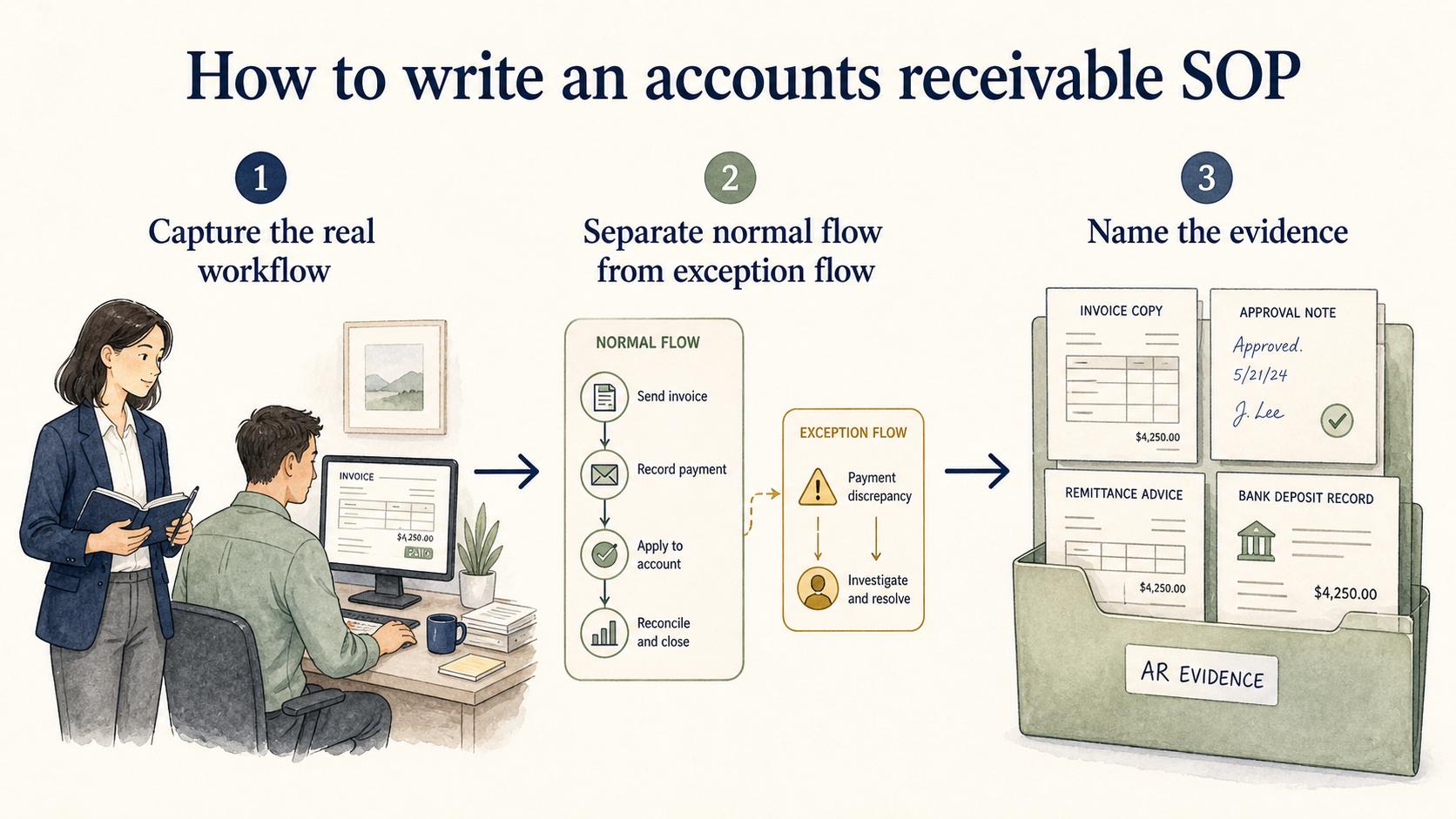
Start with the real workflow, not the accounting system menu. Watch or interview the person who performs the work and capture the sequence: what they check first, where they get customer data, what makes them pause, who they message, and what they do when the system doesn't match the customer's payment.
Then separate normal flow from exception flow. SOPs become hard to use when every edge case is mixed into the main procedure. Keep the standard path simple, then add short sections for common exceptions such as partial payments, duplicate payments, billing disputes, credit memos, tax corrections, and missing remittance information.
Finally, name the evidence. AR work often needs a defensible trail: invoice copy, customer contract, purchase order, approval note, remittance advice, bank deposit record, dispute resolution, or write-off approval. Public-sector AR reconciliation guidance similarly emphasizes reconciling subsidiary amounts to general ledger totals, reconciling cash receipt postings, and retaining invoices, collection documentation, payment history, and adjustments. 4 If the SOP doesn't say where that evidence lives, the team will recreate the logic later during close, audit prep, or customer escalation.
Common mistakes
One common mistake is documenting accounting software clicks but not the decision rules. Screenshots can help, but they don't explain when a disputed invoice should pause collection outreach or when a short payment becomes an escalation.
Another mistake is leaving ownership vague between finance and customer-facing teams. If customer success owns the relationship and finance owns the receivable, the SOP should make the handoff explicit: who contacts the customer, who approves a credit, and who decides an account is on hold.
A third mistake is treating collections as a single step. Collections work changes by aging bucket, customer segment, contract terms, dispute status, and relationship context. The SOP should prevent inconsistent follow-up without forcing people into language that damages the customer relationship.
How Trails helps
Accounts receivable processes are easier to document when someone captures the workflow while doing the work. Trails can record the AR workflow as it happens, turn it into a polished step-by-step guide, and create an AI-narrated video version for training new finance team members. That is especially useful for tasks with system screens, handoffs, and exceptions that are easy to miss in a written interview.
FAQ
Who owns an accounts receivable SOP?
Finance or accounting usually owns the SOP, but customer success, sales operations, and operations teams may own parts of the customer communication or billing-data handoff.
How often should an AR SOP be reviewed?
Review it whenever billing systems, payment methods, approval thresholds, collection rules, or month-end close requirements change. For active teams, a quarterly review is a practical rhythm.
What is the difference between an AR SOP and an AR policy?
A policy sets rules such as payment terms, credit limits, or write-off authority. The SOP explains how the team applies those rules in daily work.
- Accounts payable SOP
- Accounting SOP
- Finance SOP
- Standard operating procedure
- Approval workflow
- Audit trail
- Invoice processing
- Cash application
- Collections process
- Month-end close
Sources
- 1
AFP. Accounts Receivable. www.financialprofessionals.org/glossary/accounts-receivable.
- 2
Federal Reserve Bank of Boston. Small business survey: Firms report payments challenges. www.bostonfed.org/publications/six-hundred-atlantic/interviews/small-business-survey-payments-challenges.aspx.
- 3
PCAOB. AU 319: Consideration of Internal Control in a Financial Statement Audit. pcaobus.org/oversight/standards/archived-standards/details/AU319.
- 4
California Department of Finance. Accounts Receivable and Reimbursement Reconciliation. dof.ca.gov/media/docs/accounting/fiscal-resources-for-accounting/Accounts-Receivable-and-Reimbursement-Reconciliation.pdf.