
Glossary
Finance SOP
 ChatGPT
 Perplexity
 Gemini
 Claude
What is a finance SOP?
A finance SOP is a standard operating procedure for a finance or accounting workflow. It documents how a recurring financial task should be performed, who owns each step, what evidence is required, and how exceptions should be handled. 1
Finance SOPs matter because financial work depends on timing, accuracy, approvals, and clean handoffs. A vague process may work when one experienced person owns it, but becomes fragile when the team grows, an audit asks for evidence, or a deadline compresses the work.
What a finance SOP covers
A finance SOP should describe the real workflow, not just the ideal policy. An accounts payable SOP might explain how invoices are received, matched to purchase orders, routed for approval, coded, paid, and archived. A month-end close SOP might cover reconciliations, review steps, dependencies, deadlines, and escalation paths.
The best finance SOPs make invisible judgment visible: what a reviewer checks, what counts as acceptable evidence, what should trigger a question, and where final approval is recorded. PCAOB guidance highlights policies and procedures around records, authorizations, and transaction recording as part of reliable financial reporting. 2
Why finance SOPs matter
SOPs make a process explicit enough that another qualified person can follow it without rebuilding its logic from memory. They protect teams from hero work when only one person knows how vendor payments are reviewed or deferred revenue is reconciled. COSO treats monitoring as a core component of effective control. 3
Capture the steps, evidence, decisions, and controls that would be painful or risky to rediscover under pressure.
What to include in a finance SOP
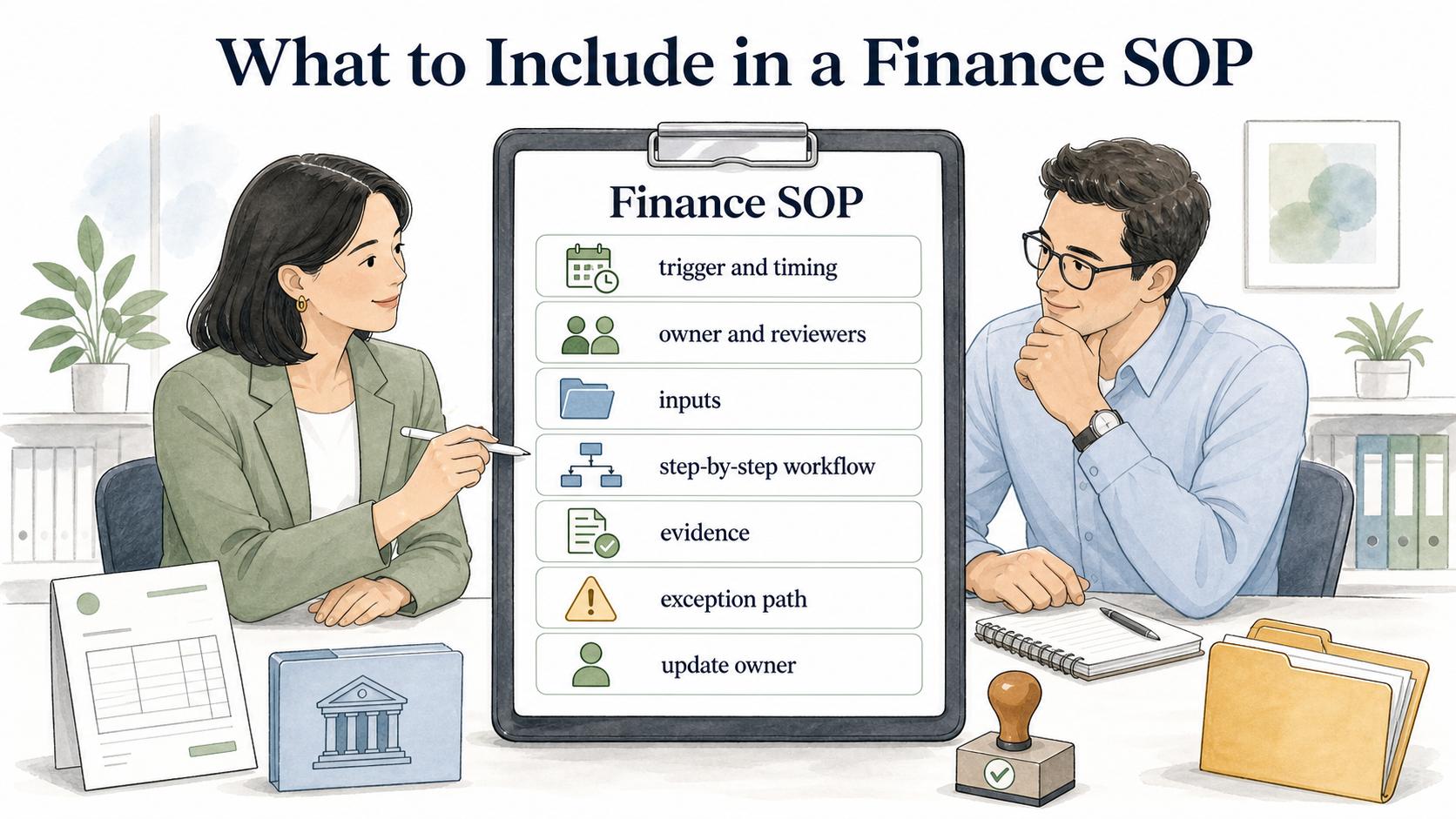
- Trigger and timing: when the process starts, how often it runs, and the deadline.
- Owner and reviewers: who performs, approves, and handles exceptions.
- Inputs: invoices, reports, bank files, system exports, contracts, and approvals.
- Step-by-step workflow: the actual sequence, systems, and handoffs.
- Evidence: what must be saved and where it lives.
- Exception path: what to do when amounts, approvals, deadlines, or transactions do not match.
- Update owner: who keeps the SOP current when tools, accounts, thresholds, or rules change.
The exception path is often the most valuable part. Smooth cases are easy to document; edge cases reveal whether the process is controlled or merely familiar.
Example of a finance SOP
A weak vendor invoice approval SOP might say: receive invoice, get approval, enter it into the accounting system, and pay the vendor. A stronger SOP answers where invoices arrive, what happens without a purchase order, who can approve over a threshold, what evidence is attached before payment, how changed banking details are handled, and where the final record is stored.
That version prevents rework because the next person does not have to infer rules from Slack messages, old emails, or naming conventions. SEC ICFR guidance reinforces the need for reliable transaction records and evidence that receipts and expenditures follow authorization. 4
Finance SOP template
Use this as a starting point for a finance workflow; the finance owner should review it before use.
## Finance SOP template

**Glossary term:** Finance SOP
**Source:** Trails Glossary — trails.so/glossary/finance-sop

---

### 01. Create a finance SOP

"Create a finance SOP for [workflow name], used by [team or role].

Include: purpose; trigger and cadence; owner, reviewer, backup owner, and escalation contact; required inputs; an ordered procedure with system, owner, output, and evidence for each step; review and approval requirements; exception handling for missing information, mismatches, delayed approvals, unavailable access, or deadline risk; records location; and maintenance owner and update triggers."
Common mistakes
Do not write the SOP around the system instead of the process. Teams also need to know why a step exists, what evidence it creates, and what to do when the system state is unexpected.
Do not document only the happy path. Missing approvals, timing differences, changed vendor details, unclear thresholds, and reconciliation mismatches need explicit handling.
Finance processes change with systems, vendors, approval rules, account structures, and reporting deadlines. The SOP needs an owner or it becomes a historical artifact.
How Trails helps
Trails helps finance teams capture a workflow while someone performs it, then turn it into a polished step-by-step guide or AI-narrated training video for training and backup coverage.
FAQ
Is a finance SOP the same as an accounting policy?
No. A policy explains the rule or standard; a finance SOP explains how a recurring finance task is performed in practice.
Who should own finance SOPs?
The process owner should own the SOP, with review from the finance leader or controller when it affects approvals, reporting, payments, or close activities.
How detailed should a finance SOP be?
Detailed enough that a qualified backup can complete the work, save the right evidence, and handle common exceptions without private knowledge.
- Accounting SOP
- Standard operating procedure
- Approval workflow
- Process documentation
- Workflow
Sources
- 1
GAO. Standards for Internal Control in the Federal Government. www.gao.gov/products/gao-25-107721.
- 2
PCAOB. AS 2201 guidance on ICFR. pcaobus.org/oversight/standards/auditing-standards/details/AS_2201_ARM_Amendment.
- 3
COSO. Internal control guidance. www.coso.org/guidance-on-ic.
- 4
SEC. Management report on internal control over financial reporting. www.sec.gov/rules-regulations/2003/03/managements-report-internal-control-over-financial-reporting-certification-disclosure-exchange-act.