
Glossary
Accounts Payable SOP
 ChatGPT
 Perplexity
 Gemini
 Claude
What an accounts payable SOP should cover
An accounts payable SOP is a documented procedure for how a business receives invoices, verifies what is owed, routes approvals, schedules payments, records transactions, and handles vendor exceptions. It gives finance and operations teams a consistent way to manage money leaving the company without turning each invoice into a one-off decision. 1
A strong AP SOP explains the control points that protect the business: who can approve spend, what evidence is required, what happens when an invoice doesn't match expectations, and when a payment should be paused.
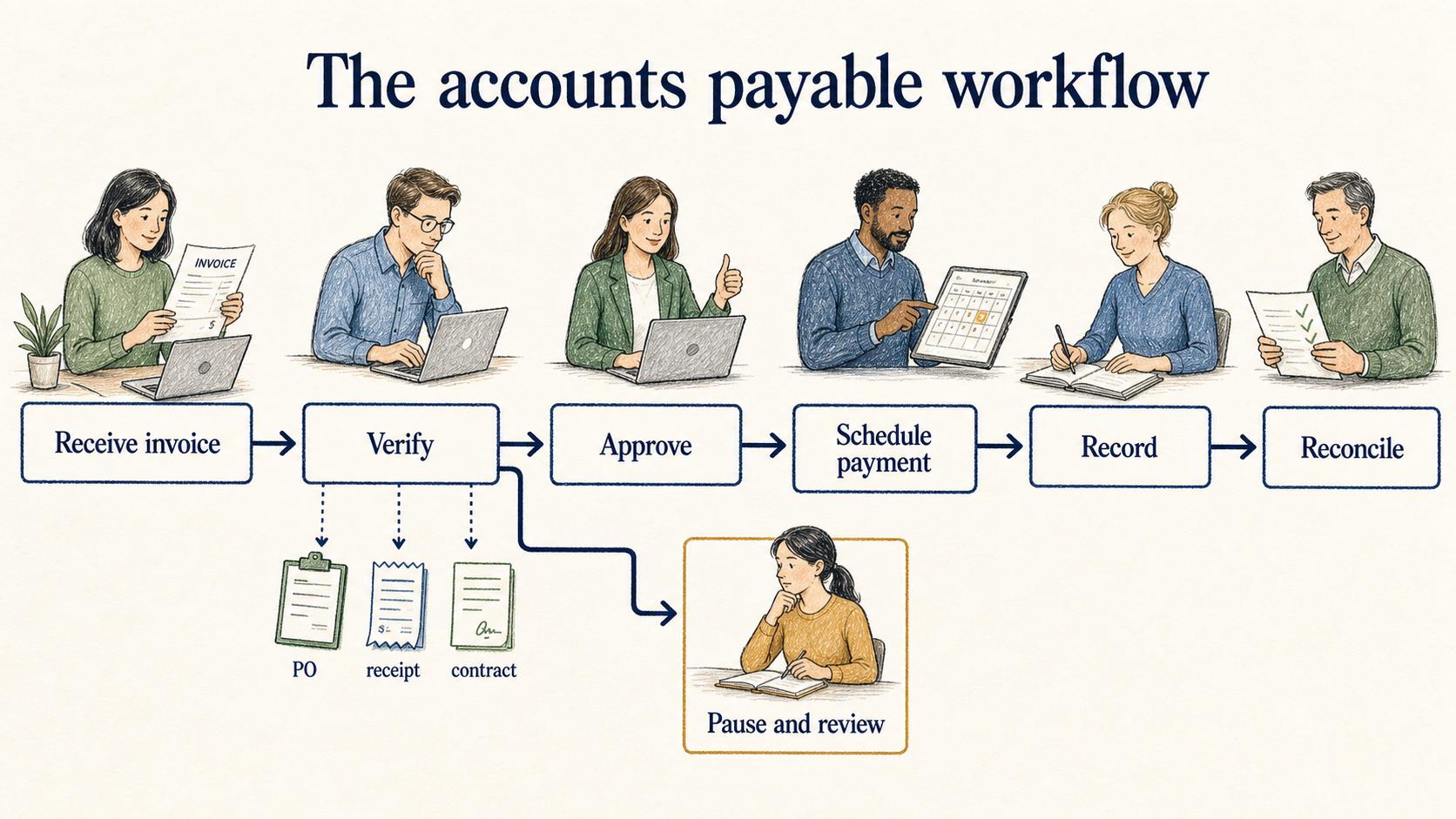
Accounts payable usually spans more teams than people expect. A vendor invoice may start with procurement, pass through a department owner, require finance review, and end with payment execution and reconciliation. The SOP should make those handoffs explicit.
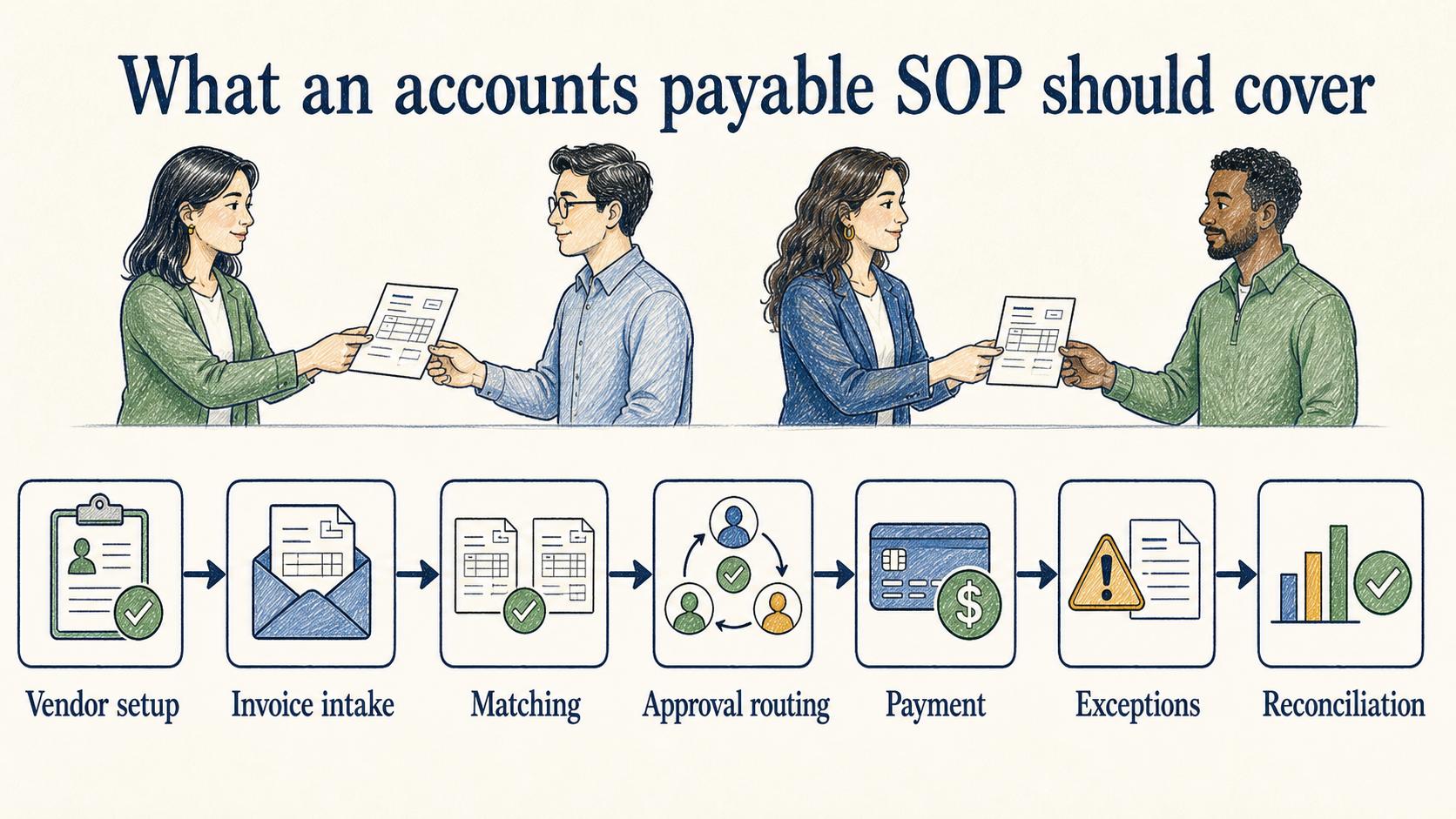
Common AP SOP coverage includes: 2
- Vendor setup and changes.
- Invoice receipt and intake channels.
- Purchase order, contract, or receipt matching.
- Approval routing and authority limits.
- Payment scheduling and payment method rules.
- Duplicate invoice checks.
- Dispute, credit, and refund handling.
- Month-end accruals and reconciliation.
The practical test is whether someone can process a normal invoice and recognize when an abnormal one should stop. That second half is where many AP procedures are thin.
Why accounts payable SOPs matter
Accounts payable has a quiet risk profile. When the process works, vendors get paid, records stay clean, and nobody notices. When it breaks, the result can be duplicate payments, late fees, strained vendor relationships, missed discounts, inaccurate expenses, or unauthorized spend.
The SOP creates consistency without removing judgment. A payment specialist still needs to decide whether an exception is safe to clear, but the SOP should show which checks are mandatory and which issues need escalation. For example, a changed bank account should not be treated like a routine invoice update; the FBI recommends verifying changes in account numbers or payment procedures with the requester. 3 A missing receipt should not be handled the same way as a price variance that an approver has already explained.
Example accounts payable SOP sections
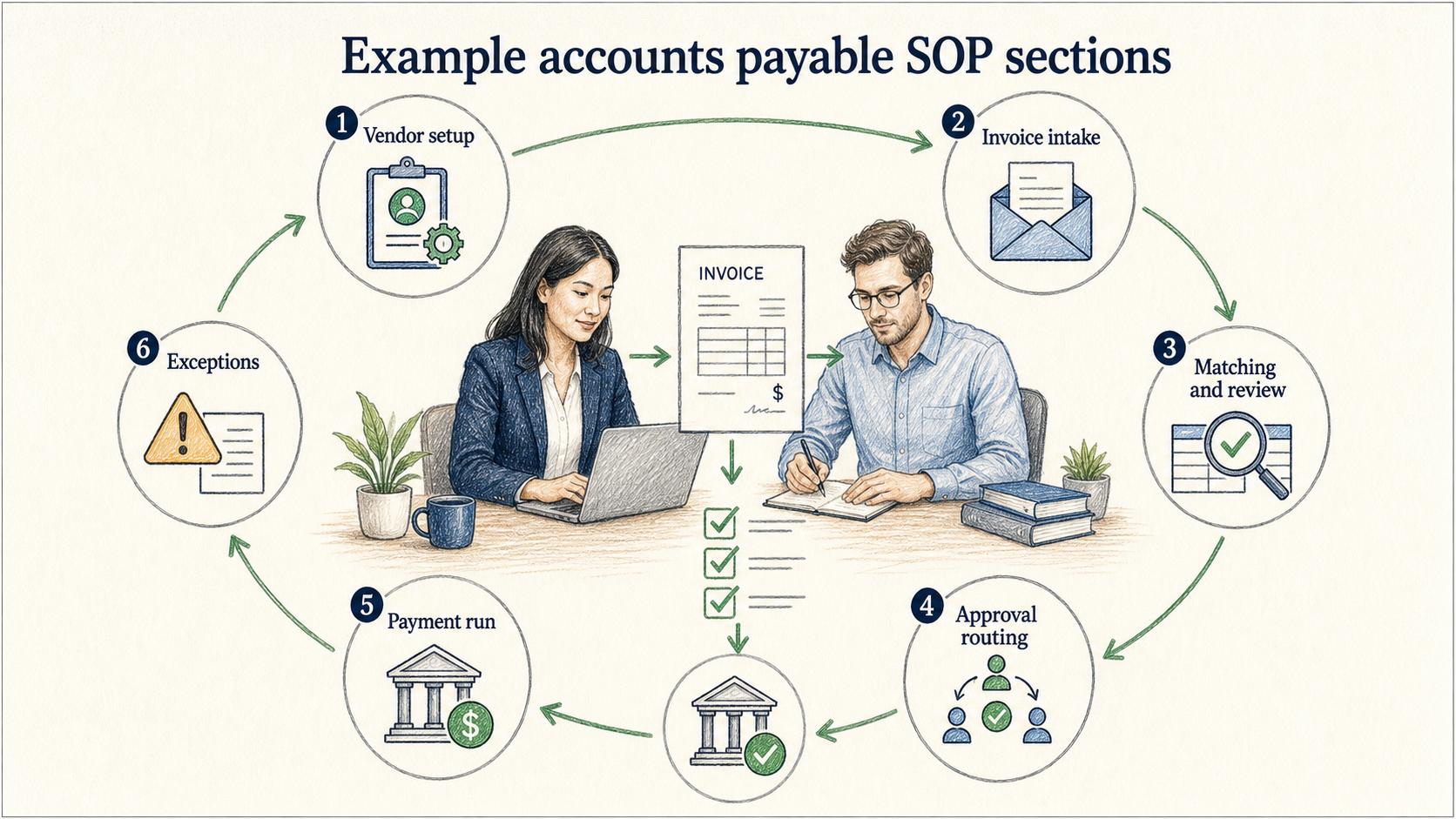
| SOP area | What to document | Failure mode it prevents |
|---|---|---|
| Vendor setup | Required tax, payment, contact, and banking information; change approval rules | Fraud risk, payment errors, and duplicate vendor records |
| Invoice intake | Approved channels, required invoice fields, naming conventions, intake owner | Lost invoices and inconsistent processing queues |
| Matching and review | PO, receipt, contract, or approval evidence required before payment | Paying for goods or services that were not approved or received |
| Approval routing | Authority limits, delegation rules, escalation path, timing expectations | Bottlenecks, shadow approvals, or unauthorized payments |
| Payment run | Payment cadence, method, release authority, confirmation evidence | Late payments, duplicate payments, or unclear release ownership |
| Exceptions | Disputes, credits, refunds, short pays, vendor changes, urgent payments | One-off decisions that become undocumented precedent |
This structure keeps the SOP useful for both training and control. PCAOB guidance describes control activities as policies and procedures that help ensure management directives are carried out and that necessary actions address risks to objectives. 4 The SOP should show the workflow and mark where the team needs proof before moving money.
How to write an accounts payable SOP
Start with the actual purchase-to-pay path. Trace a few recent invoices from arrival to payment and note every system, message, approval, and exception. The real workflow often differs from the official diagram, especially when departments send invoices directly to finance or vendors bypass the preferred intake channel.
Next, separate the normal path from the exception path. The normal path should be short enough that a new team member can follow it. Exceptions deserve their own section because they require judgment: missing purchase orders, price mismatches, urgent payments, vendor banking changes, duplicate invoices, disputed charges, and invoices from unapproved vendors.
Then define evidence. An AP SOP should tell the team what proof belongs with each transaction. That might include an invoice, purchase order, receipt confirmation, contract, approval note, vendor change request, payment confirmation, or dispute resolution. Without that evidence trail, the process may look complete in the accounting system while still being hard to defend later.
Common mistakes
One common mistake is treating approval as a checkbox. Approval is only meaningful if the SOP explains what the approver is confirming: budget, receipt of goods, contract terms, pricing, coding, business need, or some combination of those.
Another mistake is documenting the standard path while leaving urgent payments informal. Rush payments are exactly where teams need clarity. The SOP should say who can request one, what evidence is required, who releases funds, and how the exception is recorded.
A third mistake is treating vendor master data as an administrative side task. Vendor setup and change procedures are part of AP. If vendor records are wrong, the cleanest invoice workflow can still end with a bad payment.
How Trails helps
Accounts payable work often depends on system screens, approval handoffs, and small checks that are easy to skip in a written interview. Trails can capture the workflow as someone performs it, turn it into a polished step-by-step guide, and create an AI-narrated video version for onboarding or cross-training. That makes AP SOPs easier to create and maintain when systems, approvers, or payment rules change.
FAQ
Who owns an accounts payable SOP?
Finance or accounting usually owns the SOP, but procurement, department managers, and operations often own upstream approvals or vendor intake rules.
What is the difference between AP and AR SOPs?
An AP SOP covers money the business pays to vendors. An AR SOP covers money customers owe to the business. Both need clear evidence, approvals, exceptions, and reconciliation steps.
Should an AP SOP include screenshots?
Screenshots help when the workflow depends on specific software steps, but they should not replace decision rules. The SOP still needs to explain what to verify and when to escalate.
- Accounts receivable SOP
- Accounting SOP
- Finance SOP
- Procurement SOP
- Approval workflow
- Audit trail
- Standard operating procedure
- Invoice processing
- Purchase order
- Three-way match
- Vendor management
- Payment run
Sources
- 1
AFP. Accounts Payable. www.financialprofessionals.org/glossary/accounts-payable.
- 2
Washington State Auditor. Accounts Payable Guide. sao.wa.gov/sites/default/files/2023-05/Accounts-Payable-Guide.pdf.
- 3
FBI. Business Email Compromise. www.fbi.gov/how-we-can-help-you/scams-and-safety/common-frauds-and-scams/business-email-compromise.
- 4
PCAOB. AU 319: Consideration of Internal Control in a Financial Statement Audit. pcaobus.org/oversight/standards/archived-standards/details/AU319.