
Glossary
Accounting SOP
 ChatGPT
 Perplexity
 Gemini
 Claude
Accounting SOP overview
An accounting SOP is a standard operating procedure that documents how a finance or accounting team performs recurring accounting work. It explains the steps, owners, systems, evidence, approvals, and exceptions behind processes such as accounts payable, accounts receivable, reconciliations, journal entries, close tasks, reporting, and audit preparation.
Accounting judgment still matters. The SOP's job is to make routine work consistent enough that the team can trust the numbers, train new staff, and spot exceptions before they become reporting problems. Accounting SOPs often double as internal-control documentation: GAO describes effective internal control as a framework for operations, reporting, and compliance objectives. 1
What an accounting SOP should include
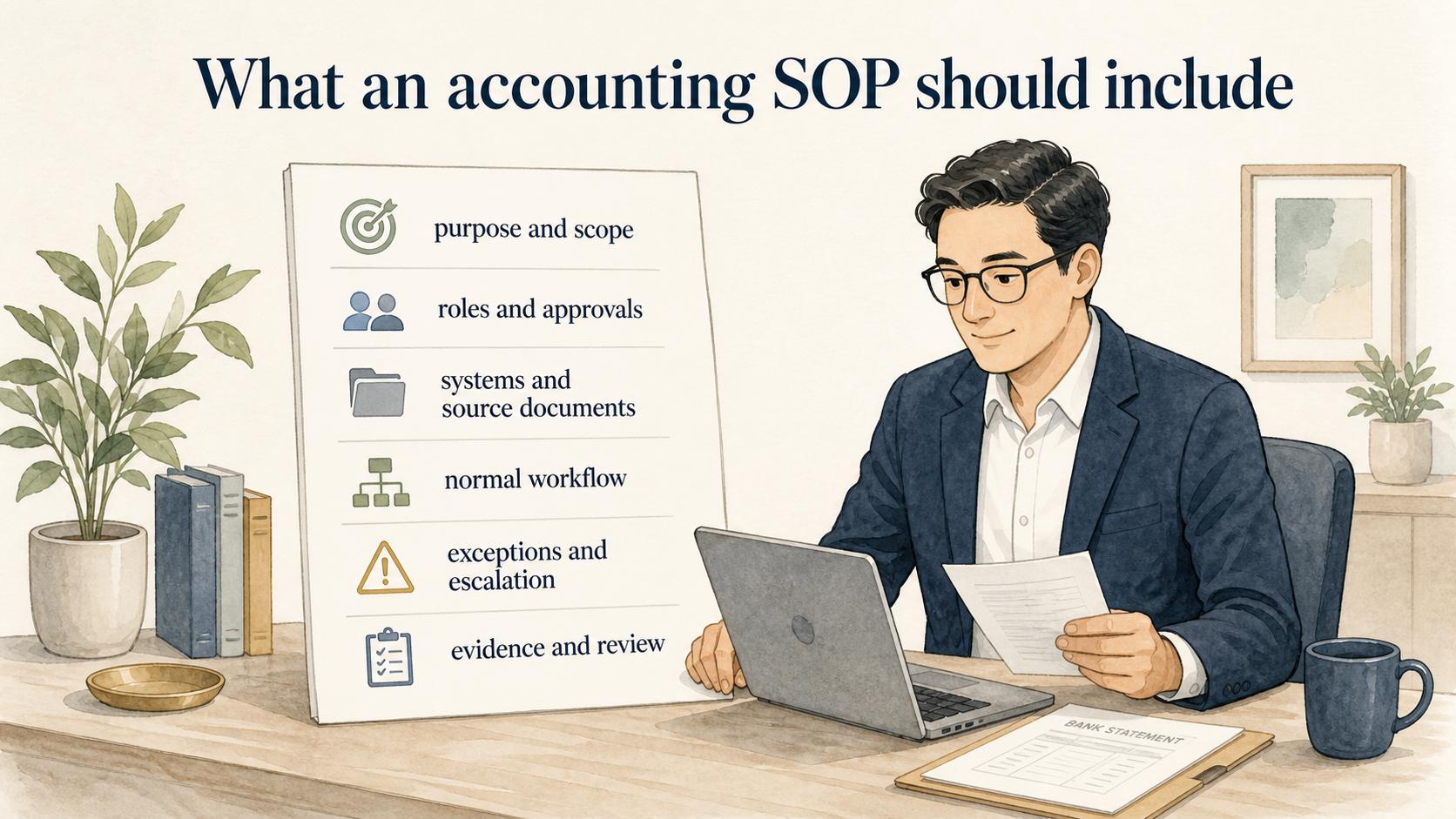
An accounting SOP should cover the parts of a workflow that affect accuracy, timing, ownership, and evidence. A procedure that only lists software clicks is incomplete because accounting work depends on decisions: which account to use, which approval is required, which document proves the transaction, and what to do when supporting detail doesn't match. Source-document guidance from the University of Toronto describes the audit trail as the ability to trace accounting records back to original source documents. 2
A strong accounting SOP usually includes:
- Purpose and scope of the procedure.
- Roles and approval responsibilities.
- Systems, files, and source documents used.
- Step-by-step workflow for the normal path.
- Exceptions and escalation rules.
- Required evidence or audit trail.
- Review cadence and owner.
- Related policies, templates, or checklists.
The best version is practical enough for daily use and precise enough for review. If the SOP reads like a generic policy, people won't use it during close. If it reads like one employee's private notes, it won't survive turnover.
Common accounting SOP examples
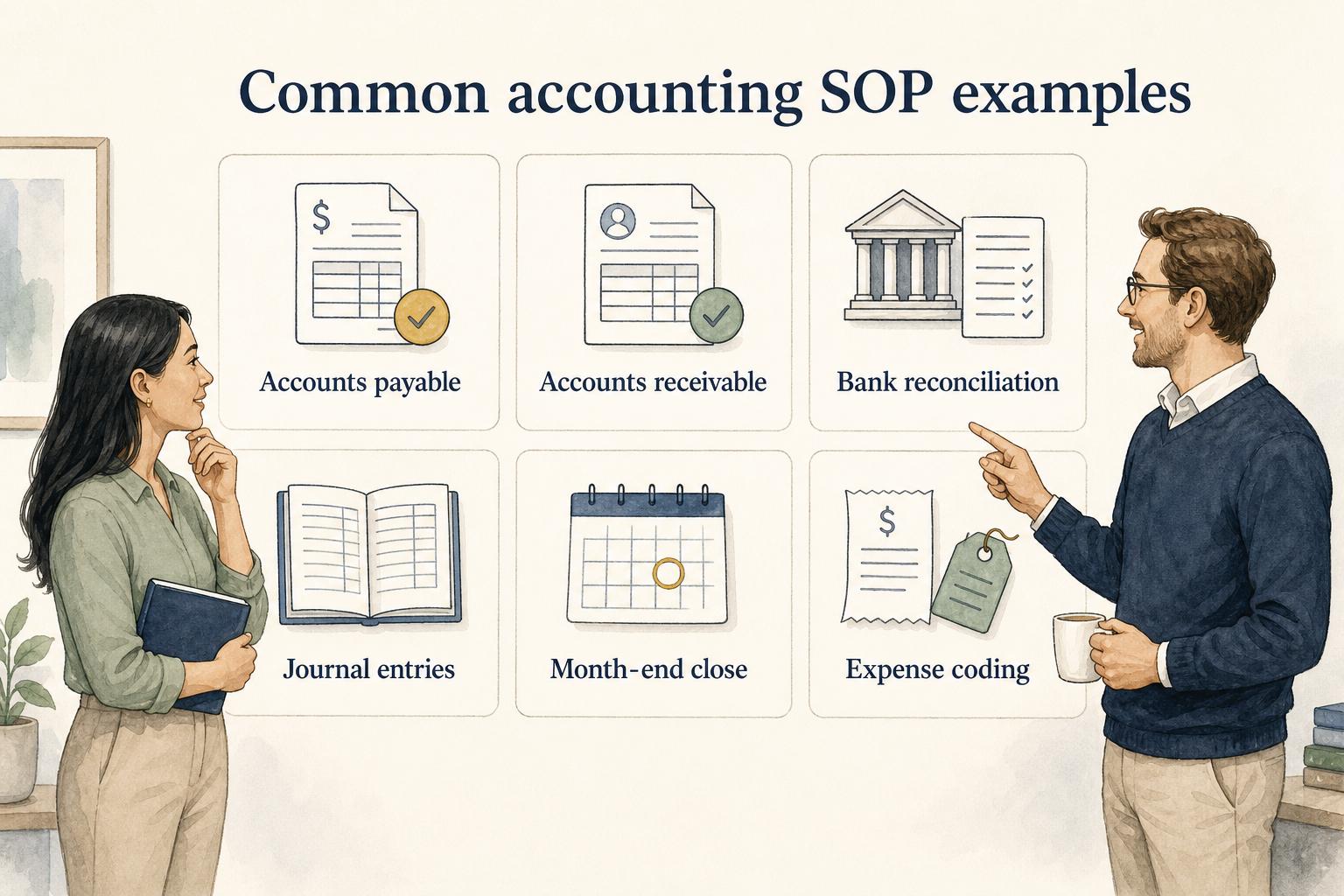
| Accounting area | What the SOP should clarify | Hidden risk if it is vague |
|---|---|---|
| Accounts payable | Invoice intake, matching, approvals, payment release, vendor exceptions | Duplicate payments, unauthorized spend, missed approvals |
| Accounts receivable | Billing triggers, payment posting, collections, disputes, reconciliation | Delayed cash, incorrect customer balances, inconsistent follow-up |
| Bank reconciliation | Source statements, matching rules, timing, unresolved items, review signoff | Stale reconciling items or unexplained cash differences |
| Journal entries | Preparer, reviewer, support, account coding, reversal rules | Unsupported adjustments or inconsistent close entries |
| Month-end close | Task owners, dependencies, deadlines, review sequence, reporting handoff | Close delays and last-minute rework |
| Expense coding | Account selection, department rules, approval requirements, correction path | Misclassified expenses and noisy reporting |
This table is not a complete accounting manual. It shows how SOPs should be scoped: each one needs a clear workflow, not a broad promise to "handle accounting correctly."
Why accounting SOPs matter
Accounting teams run on repeatable work, but repeatable does not mean simple. A month-end close can involve dozens of small dependencies. Vendor changes can look administrative but affect cash movement. A journal entry can be easy to enter while still requiring strong support and review; PCAOB staff guidance emphasizes understanding controls over journal entries and examining supporting evidence for selected entries. 3
Accounting SOPs reduce reliance on tribal knowledge. They help a team answer practical questions: Who owns this task? What evidence is required? What happens if the source data is missing? When does the reviewer step in? Where should the final support live?
They also make training more honest. New team members need more than steps. They need to understand which steps are controls, which are timing dependencies, and which exceptions should stop the workflow.
How to write an accounting SOP
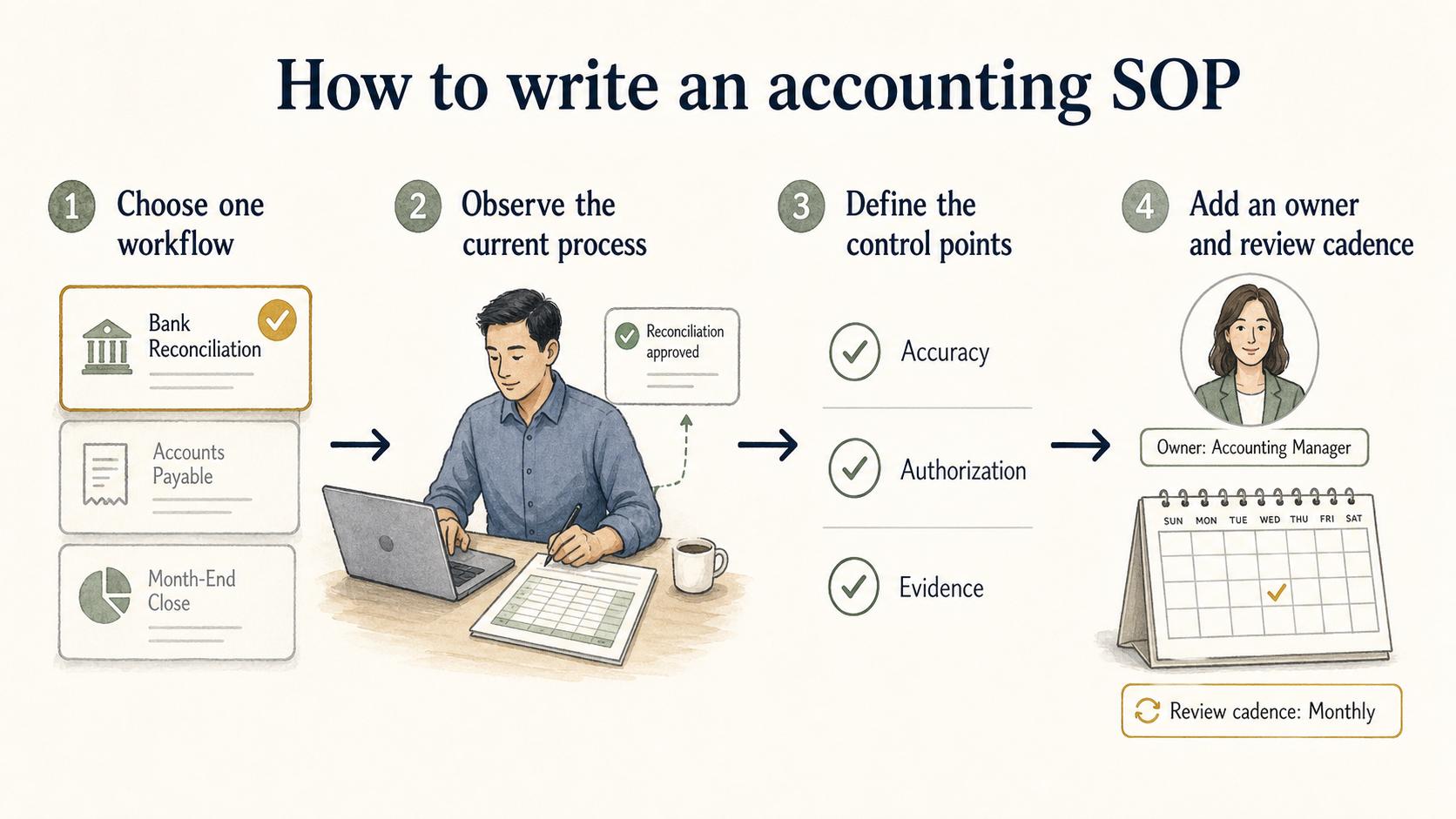
Start by choosing one accounting workflow. "Accounting SOP" is too broad to document in one pass. Pick a process such as bank reconciliation, invoice approval, revenue billing, journal entry posting, or close checklist review.
Then observe the current process. The documented workflow should reflect what actually happens, including spreadsheets, emails, approvals, shared drives, accounting-system screens, and informal checks. If people have built workarounds, capture them before deciding whether they belong in the official process.
Next, define the control points. These are the moments where accuracy, authorization, timing, or evidence matters. For example, a journal entry SOP should specify who prepares the entry, who reviews it, what supporting documentation is required, and what happens if support is incomplete. A reconciliation SOP should define what counts as an unresolved item and how long it can remain open; Cornell's reconciliation guidance calls for documented steps, sources, timeliness expectations, error-correction procedures, and review of reconciling items. 4
Finally, make the SOP maintainable. Accounting procedures change when systems, account structures, approval limits, reporting needs, or team responsibilities change. Add an owner and review cadence so the SOP doesn't become a stale artifact that people bypass.
Common mistakes
One mistake is trying to create one giant accounting SOP for the whole department. That usually produces a document too broad to guide real work. Use a short overview plus separate procedures for AP, AR, close, reconciliations, reporting, and other recurring workflows.
Another mistake is leaving exceptions outside the SOP. Exceptions are where accounting work gets risky: missing support, unusual payments, late approvals, manual adjustments, unclear account coding, or differences between a subledger and the general ledger. If the SOP only covers clean transactions, it is not ready for real operations.
A third mistake is confusing policy with procedure. A policy might say expenses need approval. The SOP should say how approval is requested, who can approve, what evidence is stored, which system is updated, and what happens when the approver is unavailable.
How Trails helps
Accounting SOPs often depend on exact sequences across systems, files, approvals, and review steps. Trails can capture a workflow as someone performs it, turn that workflow into a polished step-by-step guide, and create an AI-narrated video version for training or handoff. That helps finance teams document procedures that are otherwise trapped in screen habits and private notes.
FAQ
Who should own accounting SOPs?
The accounting or finance leader should own the SOP system, while individual process owners maintain the procedures for their workflows.
How detailed should an accounting SOP be?
Detailed enough that a trained team member can perform the task consistently and know when to escalate. It should include decisions and evidence requirements, not just clicks.
Is an accounting SOP the same as an accounting policy?
No. A policy defines rules and standards. An SOP explains how the team applies those rules in a specific recurring workflow.
Sources
- 1
GAO. Standards for Internal Control in the Federal Government. www.gao.gov/products/gao-25-107721.
- 2
University of Toronto. Source Documents and the Audit Trail. finance.utoronto.ca/policies/gtfm/financial-management/source-documents-and-the-audit-trail/.
- 3
PCAOB. Audit Focus: Journal Entries. pcaobus.org/resources/staff-publications/audit-focus/audit-focus-journal-entries.
- 4
Cornell University. Reconciliation. finance.cornell.edu/controller/internalcontrols/unitlevelactivities/reconciliation.