
Glossary
Training ROI
 ChatGPT
 Perplexity
 Gemini
 Claude
What is training ROI?
Training ROI is the return a company gets from money and time spent on employee training. It compares the cost of a training effort with the value created when people perform work faster, more consistently, or with fewer costly mistakes.
A good training ROI calculation should help a team decide whether a program should be kept, redesigned, scaled, or retired. If the number only makes the program look impressive, it is not doing useful work.1
When training ROI is worth calculating
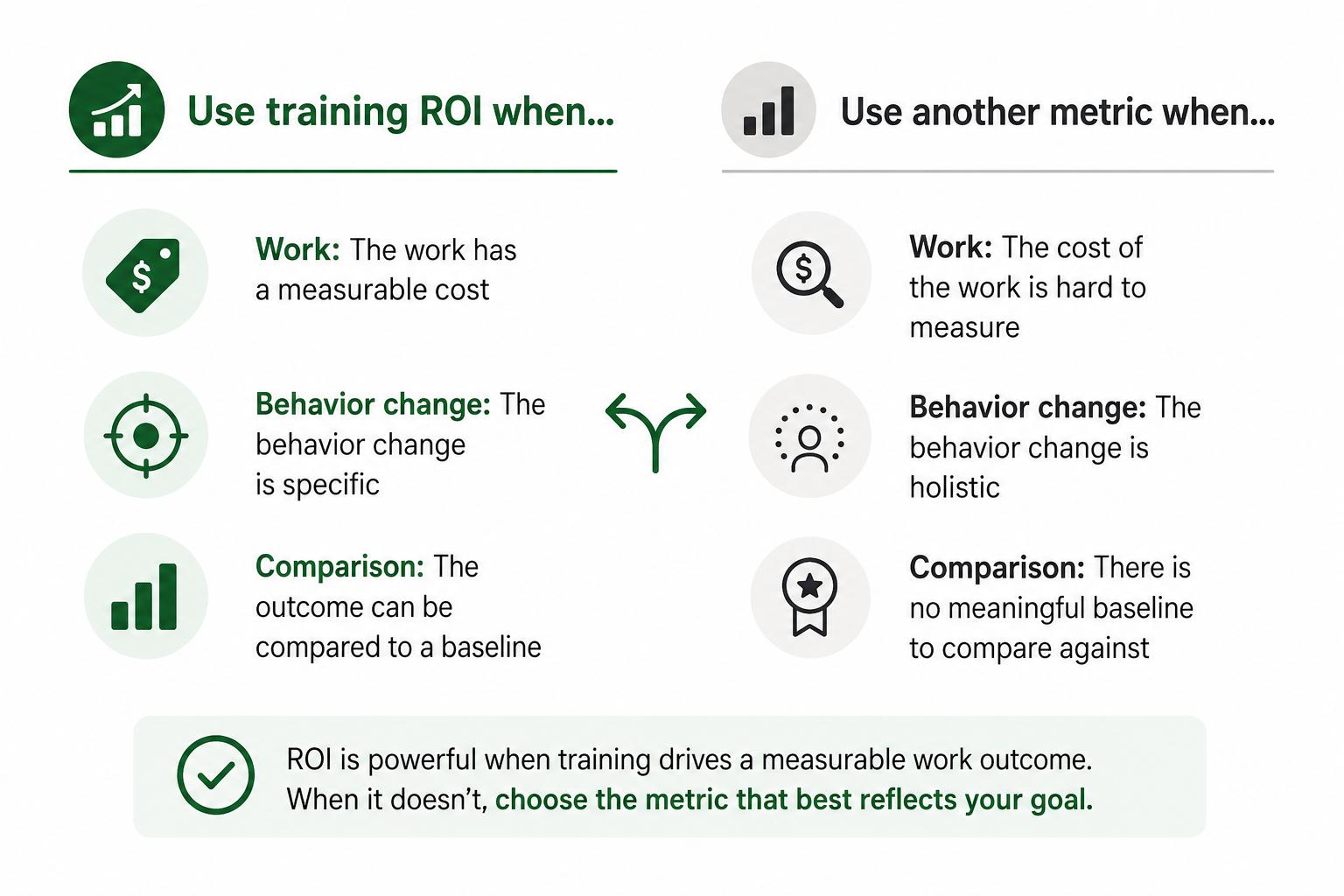
Training ROI works best when training is tied to an observable business problem. A support team may want to reduce escalations. An operations team may want fewer missed process steps. A customer onboarding team may want new hires to reach independent work sooner. In those cases, the training has a measurable target.
It works poorly when the goal is vague. If the promise is simply "improve confidence" or "build awareness," a financial ROI number will usually be padded with assumptions. That does not make the training useless. It means ROI is the wrong primary measure.
Use ROI when the training is meant to change work that already has a cost, time, quality, revenue, risk, or capacity measure attached to it. Use effectiveness or readiness metrics when the goal is learning quality, behavior change, or manager confidence.
How to calculate training ROI
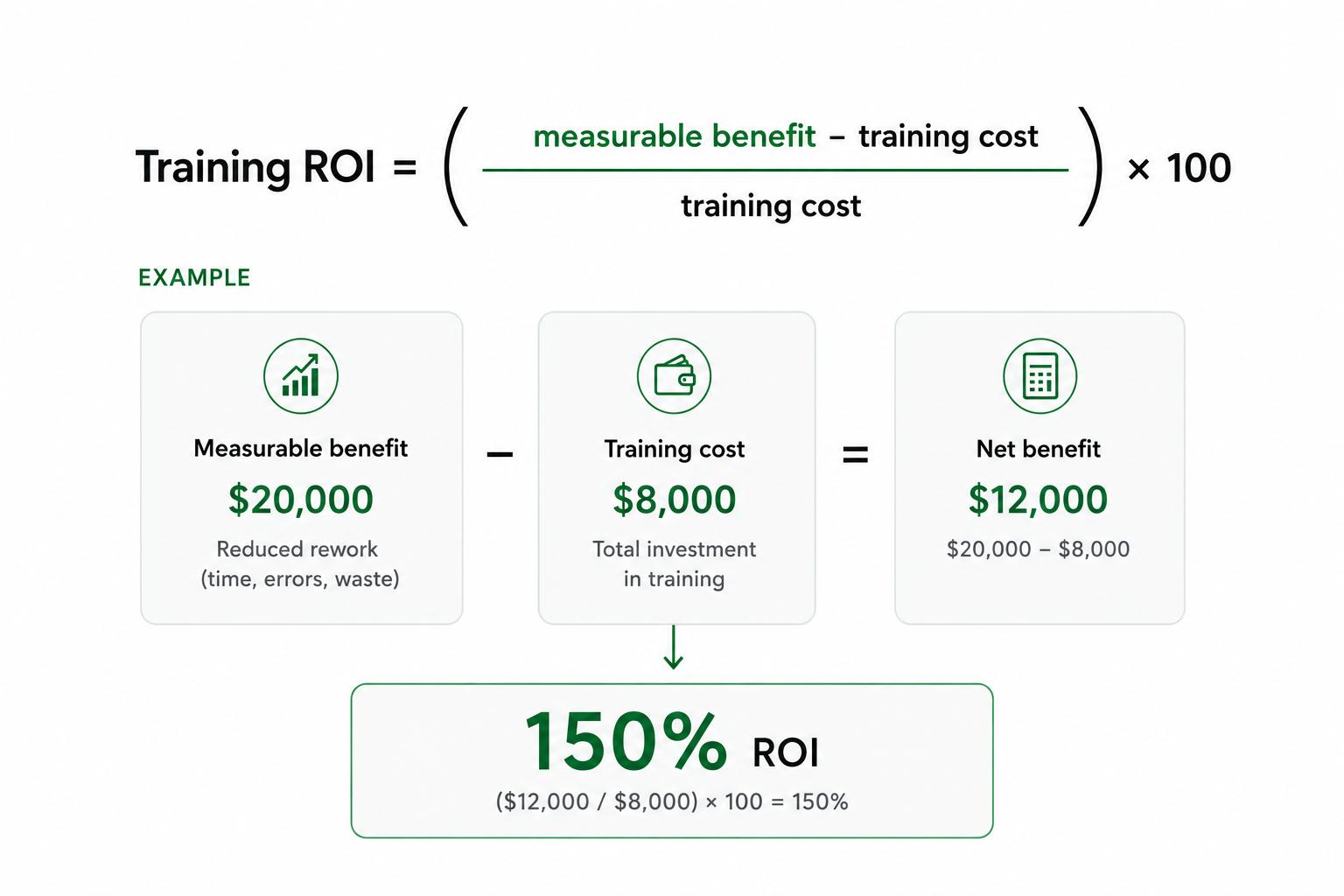
One common formula is: Training ROI = ((measurable benefit - training cost) / training cost) x 100.2
For example, a team might invest in training to reduce billing rework. If the program costs $8,000 and the team can credibly estimate $20,000 in reduced rework over the measurement window, the net benefit is $12,000 and the ROI is 150%.
The formula is the easy part. The harder work is deciding what counts as a benefit and how much of the improvement can fairly be attributed to training. If the process, staffing, and tool all changed at the same time, the ROI story should name those factors instead of giving training all the credit.
What costs belong in the calculation
Training costs often get understated because teams only count the obvious purchase. A realistic estimate includes the visible and hidden costs of making the program work:
- Course, platform, facilitator, or vendor costs.
- Learner time during training.
- Manager, trainer, and subject matter expert time.
- Time spent creating, updating, and reviewing materials.
- Travel, equipment, or environment setup when relevant.
- Ongoing maintenance when the process changes.
The maintenance cost matters more than teams expect. Training that depends on a one-time workshop, outdated screenshots, or tribal knowledge may look cheap at launch and expensive later.
What benefits can be measured
The best benefit measure stays close to the job the training was designed to improve. Course completion may be useful administratively, but it does not prove ROI by itself.3
For onboarding, useful measures might include time to first independent task, manager review quality, or fewer repeated questions. For support training, the measure might be QA score, first-contact resolution, escalation rate, or rework. For operations training, it might be cycle time, error rate, missed steps, or handoff quality.
Good ROI measurement pairs a lagging business result with a leading behavior signal. The business result shows whether the outcome improved. The behavior signal shows whether people changed how they worked.
Common mistakes in training ROI
The most common mistake is treating satisfaction as impact. A training session can be engaging and still fail to change the work. Learner feedback is useful for improving delivery, but it should not carry the whole ROI argument.4
Another mistake is measuring too late or too broadly. If a team waits six months and then looks only at company-level productivity, too many other factors have entered the picture. A tighter measurement window and a process-level metric usually produce a more honest answer.
A third mistake is calculating ROI after the fact. The strongest ROI work starts before training is built. The team agrees on the baseline, target behavior, measurement window, and assumptions while the business problem is still clear.
A practical ROI planning prompt
Use this prompt before building or buying a training program:
## Training ROI Planning Prompt

**Glossary term:** Training ROI
**Source:** Trails Glossary — trails.so/glossary/training-roi

---

### 01. Plan training measurement before the program starts

"We are planning training for [team or role].
The business problem is [slow, inconsistent, risky, costly, or error-prone work].
The behavior we need to change is [specific action or decision].
Current baseline: [metric and current value].
Target outcome: [metric and expected value].
Estimated training cost: [full cost, including learner and manager time].
Expected measurable benefit: [how improvement creates value].
Measurement window: [when we will check results].
Known assumptions or confounding factors: [process, tool, staffing, or seasonality changes].
Recommend whether ROI, effectiveness, or behavior-change metrics should be the primary measure."
This keeps the conversation grounded. If the team cannot fill in the baseline or target behavior, the training probably needs a sharper problem statement before anyone argues about ROI.
Documentation takeaway
Training ROI improves when the trained behavior is easy to repeat after the session ends. That usually requires more than a slide deck. Teams need current process guides, job aids, examples, and manager coaching notes that reflect the way work actually gets done.
Documentation also protects the investment. When the workflow changes, training can be updated from the source instead of recreated from memory.
How Trails helps
Trails helps teams capture a workflow as someone performs it, turn that workflow into a polished step-by-step guide, and create an AI-narrated video version for training or sharing. For ROI-focused training, that gives teams a clearer standard to teach, measure, and maintain as the process changes.
Sources
- 1
Centers for Disease Control and Prevention. Building a Training Evaluation Plan. CDC. www.cdc.gov/training-development/php/about/evaluate-training-building-an-evaluation-plan.html. Accessed June 25, 2026.
- 2
ROI Institute. Measuring ROI: The Process, Current Issues, and Trends. ROI Institute. www.roiinstitute.net/wp-content/uploads/2018/03/Measuring-ROI-The-ProcessCurrent-Issues-and-Trends.pdf. Accessed June 25, 2026.
- 3
Kirkpatrick Partners. The Kirkpatrick Model. Kirkpatrick Partners. www.kirkpatrickpartners.com/the-kirkpatrick-model/. Accessed June 25, 2026.
- 4
Centers for Disease Control and Prevention. Measuring Training Effectiveness. CDC. www.cdc.gov/training-development/php/about/evaluate-training-measuring-effectiveness.html. Accessed June 25, 2026.