
Glossary
Train the Trainer
 ChatGPT
 Perplexity
 Gemini
 Claude
What is train the trainer?
Train the trainer is a model where internal trainers learn how to teach others a process, skill, tool, or program. Instead of relying on one central instructor, the organization prepares trainers who can deliver the same material consistently across teams, locations, shifts, or cohorts.
A systematic review of train-the-trainer programs in nursing found positive effects on trainers' knowledge and learner outcomes, which is why the model is often used when capability has to cascade beyond one central instructor.1
The model works best when trainers learn both the subject matter and how to teach it. Expertise alone is not enough; research on expert blind spots shows that advanced content knowledge can make it harder to judge what novices will find difficult.2
Why train the trainer matters
Train-the-trainer programs help organizations scale learning without turning every rollout into a bottleneck. A product team can prepare regional enablement leads. An operations team can teach shift supervisors how to train a new workflow. A support team can prepare team leads to onboard new agents.
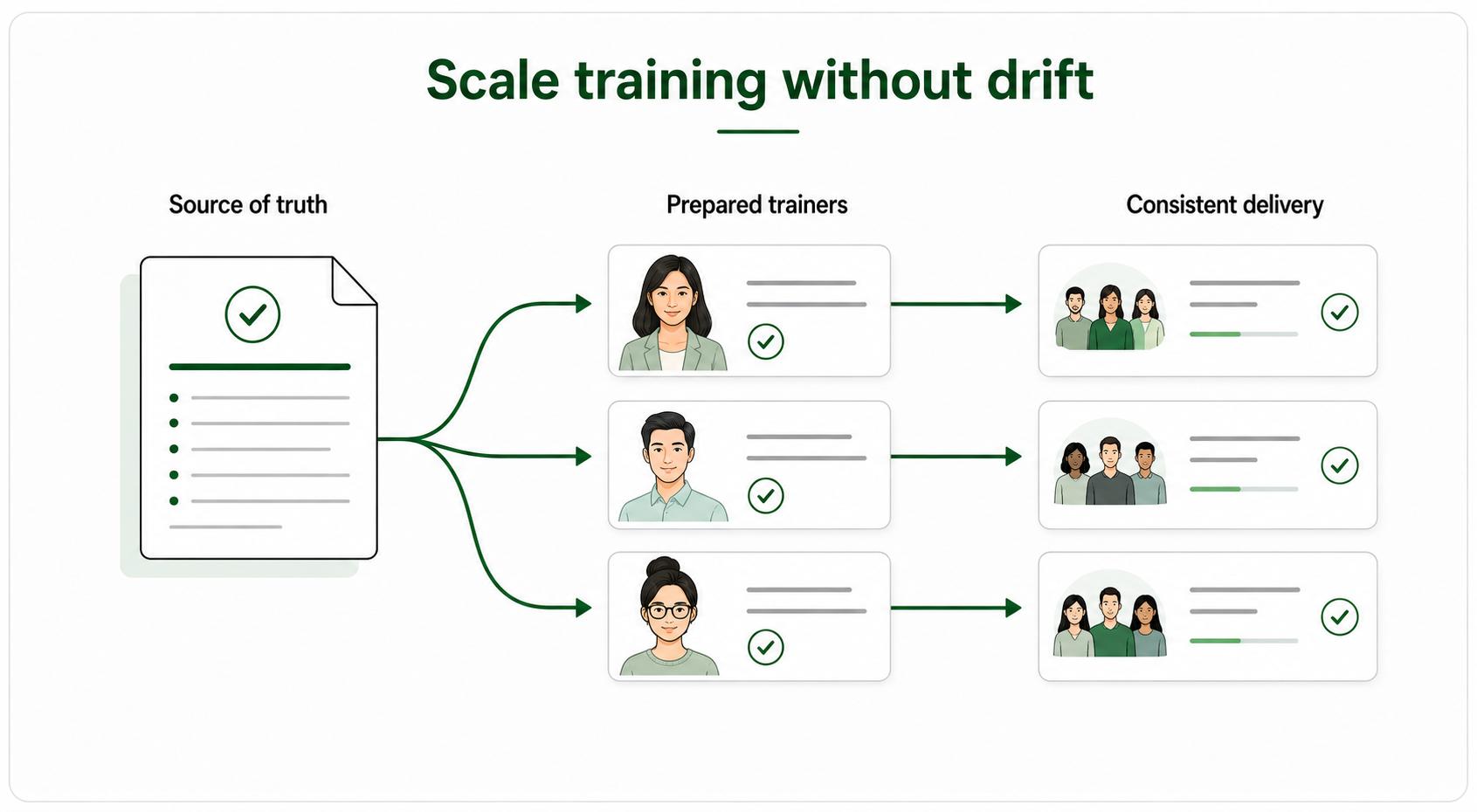
The benefit is reach. The risk is inconsistency. If each trainer explains the material from memory, changes the sequence, skips practice, or invents their own readiness standard, the program can spread variation instead of capability.
A strong train-the-trainer program gives trainers a shared source of truth, a delivery method, practice opportunities, and criteria for deciding whether learners are ready.
How the model works
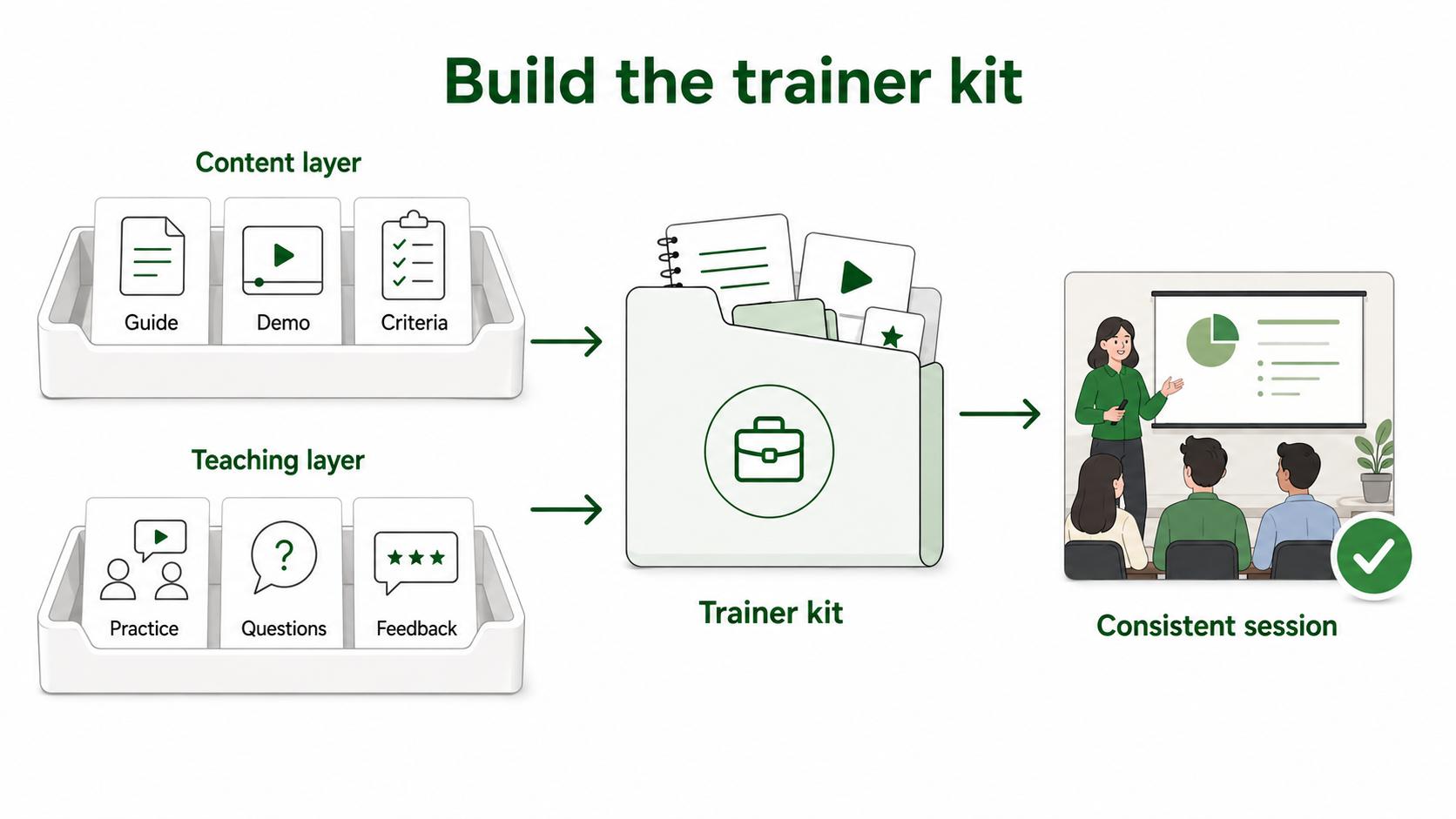
A train-the-trainer program has two layers. First, trainers learn the content: the process, policy, tool, product, or skill they will teach. Second, they learn how to teach it: what to emphasize, where learners struggle, how to run practice, how to answer common questions, and how to assess readiness.
Useful programs usually include:
- A learner-facing guide or manual.
- A trainer-facing facilitator guide.
- Demonstrations of key workflows or behaviors.
- Practice delivery with feedback.3
- Common learner questions and suggested answers.
- Practice scenarios and coaching notes.
- Assessment or sign-off criteria.
- A process for updating materials when the work changes.
That preparation keeps internal trainers from improvising the teaching system every time they run a session.
Train the trainer vs. regular training
Regular training teaches the target learner how to perform a task. Train the trainer teaches a trainer how to teach that task to others.
That changes the design. A learner may need to understand the steps, practice the workflow, and pass a readiness check. A trainer also needs to understand the teaching decisions behind the material: what can be shortened, what should never be skipped, which mistakes are common, which examples work best, and when to escalate a question.
A train-the-trainer session should include the learner content, but it should not stop there. If trainers only receive the same deck learners receive, they are being asked to invent the delivery model.
When to use train the trainer
Use train the trainer when learning needs to spread through people, not just through self-service content. It is useful for standardized processes, onboarding programs, product rollouts, compliance workflows, customer-facing procedures, field operations, and training that needs local reinforcement.
It may be too heavy for a simple announcement or a task that can be learned from a short guide or video. Use the model when the trainer's judgment, coaching, or local presence matters.
A practical rule: if inconsistent delivery would create different versions of the work across teams, consider train the trainer.
Common mistakes
The first mistake is giving trainers a deck and calling the program done. Trainers need delivery guidance, practice, and feedback. A slide deck is a tool, not a trainer preparation program.
The second mistake is assuming subject matter experts are automatically good trainers. Experts may skip beginner context because the work feels obvious. They may also over-explain edge cases before learners understand the core behavior.
The third mistake is allowing too much local customization. Local examples can help, but the core steps, standard, and readiness criteria should stay consistent.
The fourth mistake is failing to maintain the source materials. If the workflow changes and trainers keep using old instructions, the training network spreads outdated practice faster.
Train-the-trainer checklist
Before trainers teach others, confirm they can do five things:
- Teach the standard accurately: Walk through the process, skill, or tool without changing the core sequence or criteria.
- Explain the learner context: Name the audience, their starting point, likely confusion, and the reason the training matters.
- Run practice without taking over: Demonstrate the workflow, let learners try it, and coach without doing the work for them.
- Use readiness criteria consistently: Apply the same assessment, sign-off, or coaching standard across groups.
- Feed problems back to the owner: Report unclear instructions, repeated questions, missing examples, and content issues.
That feedback loop is easy to miss. Trainers are often the first to hear where the material is confusing. The program should use that feedback instead of leaving each trainer to solve the same problem privately. Training-transfer research has found that learner characteristics, the training intervention, and the work environment all shape whether training carries into real performance.4
A train-the-trainer planning prompt
Use this prompt to design the program:
## Train-the-Trainer Planning Prompt

**Glossary term:** Train the Trainer
**Source:** Trails Glossary — trails.so/glossary/train-the-trainer

---

### 01. Design a train-the-trainer program

"Design a train-the-trainer program for [process, skill, product, or workflow].
Future trainers: [roles or teams]
Learners they will train: [audience]
Core behavior learners must perform: [specific task or decision]
Risks of inconsistent delivery: [what could go wrong]
Available source materials: [guides, SOPs, videos, manuals, assessments]

Create:
- Trainer learning objectives
- Required source materials
- Practice delivery plan
- Common learner questions
- Readiness criteria for trainers
- Feedback loop for updating the materials"
This keeps the program focused on trainer readiness, not just content transfer.
Documentation takeaway
Train-the-trainer programs depend on strong documentation. Trainers need a stable source of truth, not a patchwork of personal notes, old decks, and informal explanations.
Useful documentation includes learner-facing guides, trainer-facing facilitator notes, common questions, realistic practice scenarios, assessment criteria, and a clear update path. Without that system, the model scales inconsistency.
How Trails helps
Trails helps teams create workflow documentation that internal trainers can teach from. A subject matter expert can capture a process as they perform it, turn that capture into a polished step-by-step guide, and create an AI-narrated video version for training or sharing.
That gives trainers a concrete, current reference and helps teams teach the same workflow consistently.
- Subject matter expert
- Training SOP
- On the job training
- Training manager
- Training manual
- Training coordinator
- Training materials
- New hire training
Sources
- 1
Magalhaes et al.. The Impact of Train-the-Trainer Programs on Learning Outcomes. BMC Nursing. pmc.ncbi.nlm.nih.gov/articles/PMC10768131/. Accessed July 1, 2026.
- 2
Nathan and Petrosino. Expert Blind Spot Among Preservice Teachers. American Educational Research Journal. journals.sagepub.com/doi/10.3102/00028312040004905. Accessed July 1, 2026.
- 3
National Association of County and City Health Officials. Train-the-Trainer Facilitator Outline. NACCHO. www.naccho.org/uploads/resource-hub-images/DBH-TTTOutline_9.23.15.pdf. Accessed July 1, 2026.
- 4
Blume et al.. Transfer of Training: A Meta-Analytic Review. Journal of Management. journals.sagepub.com/doi/10.1177/0149206309352880. Accessed July 1, 2026.