
Glossary
Purchasing SOP
 ChatGPT
 Perplexity
 Gemini
 Claude
What is a purchasing SOP?
A purchasing SOP is a standard operating procedure that explains how a business requests, approves, orders, receives, and records purchases. It gives employees a repeatable path for buying goods or services without skipping approvals, using the wrong vendor, losing records, or creating avoidable invoice problems. GAO's internal-control framework is a useful reference point because it treats internal control as the system of rules, processes, and procedures used to support operations, reporting, and compliance objectives. 1
A good purchasing SOP should not make every purchase slow. It should make the normal path clear and the exception path controlled. Employees should know what information to provide, managers should know what they are approving, and finance should have enough evidence to match purchases, invoices, and records later.
What a purchasing SOP covers
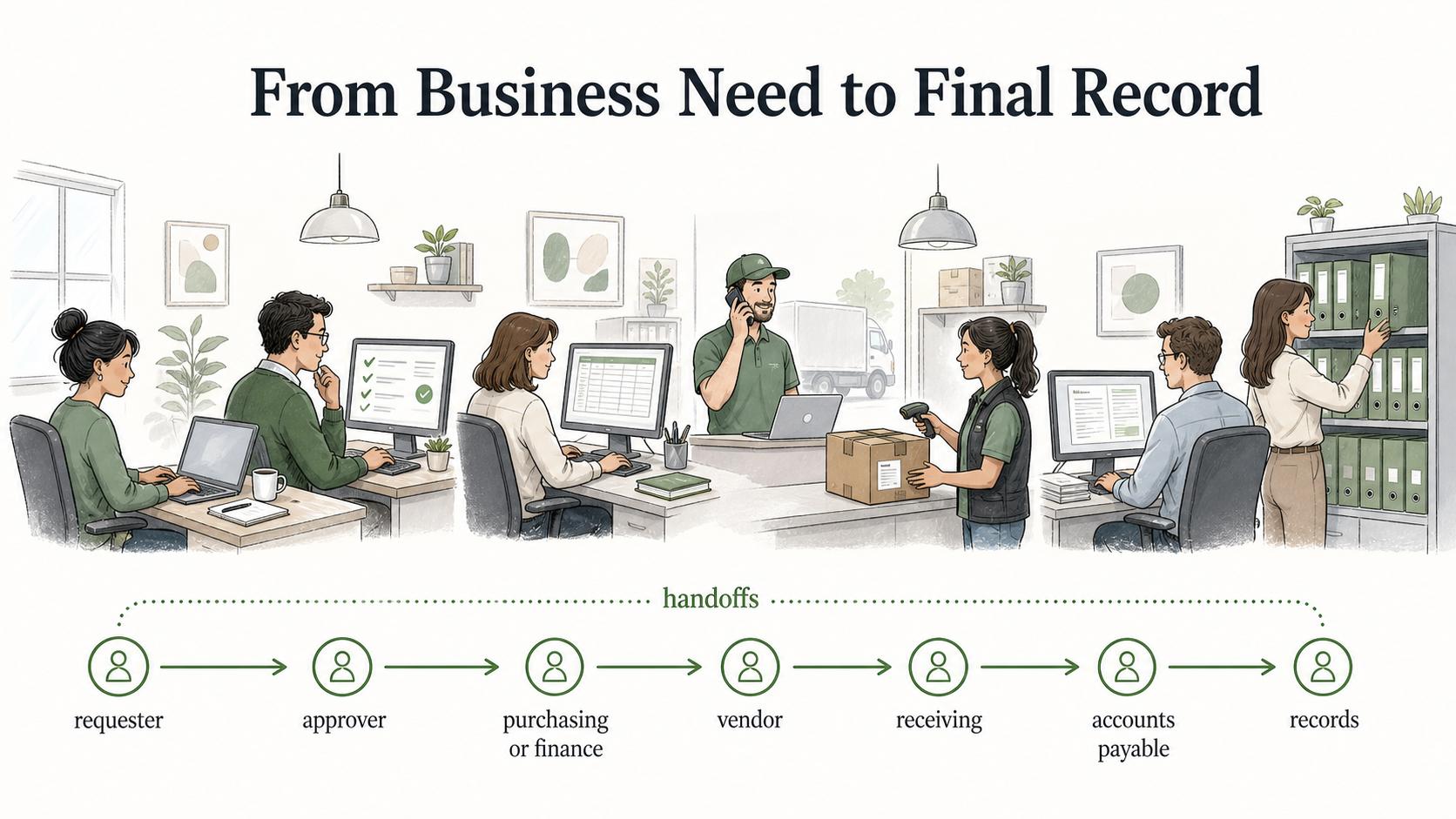
A purchasing SOP spans more than the moment someone clicks "buy." It connects the original business need to the final record.
Common sections include purchase request requirements, approval thresholds, approved vendor rules, quote or bid requirements, purchase order rules, receiving steps, invoice matching, exception handling, record storage, and SOP ownership. For federally funded purchases, 2 CFR 200 is explicit that recipients must maintain and use documented procurement procedures and keep records sufficient to detail the history of each procurement transaction. 2
The exact workflow depends on company size, but the handoffs are usually similar: requester to approver, approver to purchasing or finance, vendor to receiving, receiving to accounts payable, and records back to finance or operations.
The most useful purchasing SOPs name the decision points. Can a team member buy this directly? Does it need manager approval? Does finance need to review the budget first? Is a purchase order required? What changes if the vendor is new, the purchase is urgent, or the invoice arrives before receiving is confirmed?
Purchasing SOP vs. procurement SOP
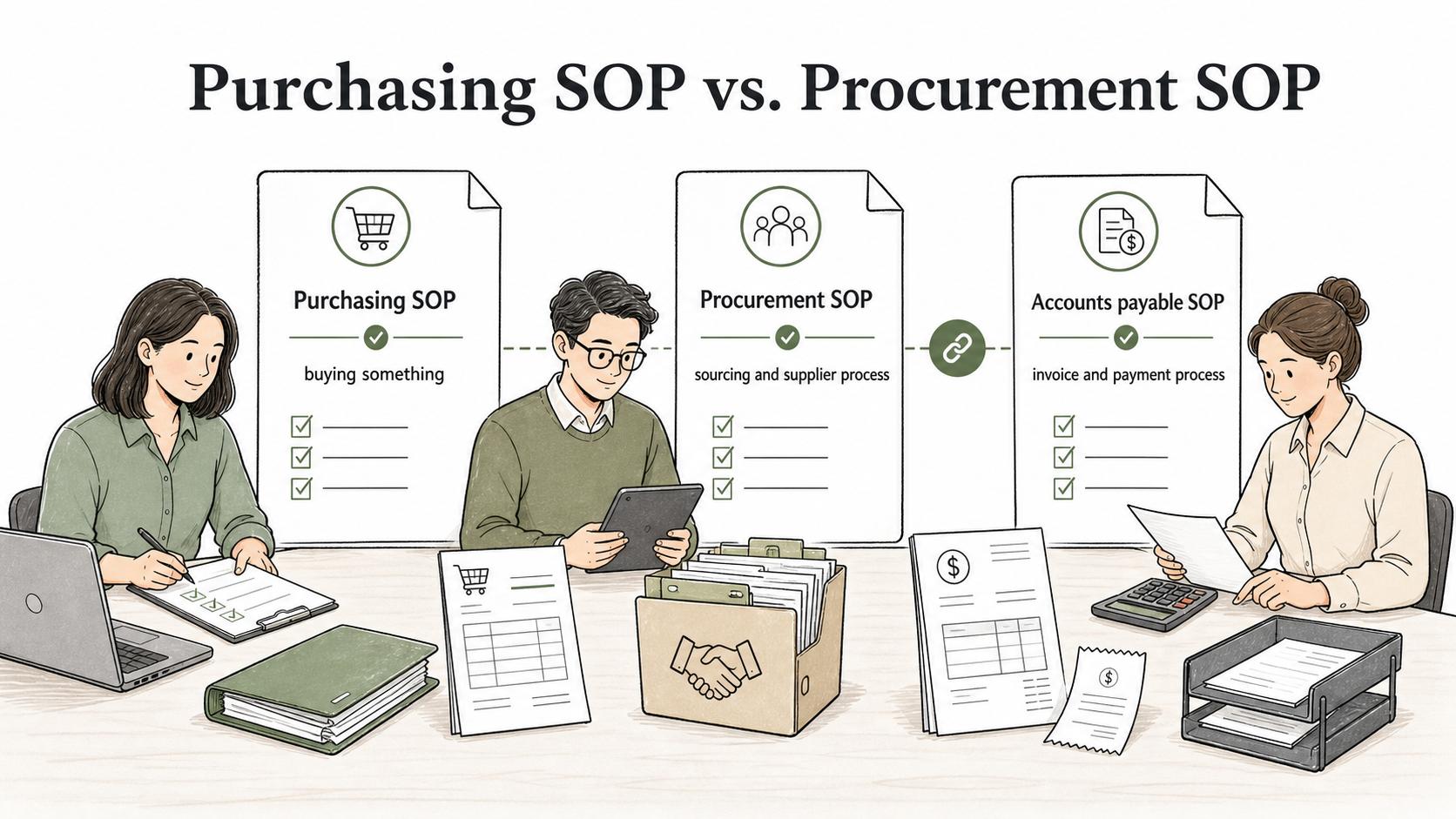
Purchasing and procurement overlap, but they are not always the same scope.
| Document | Typical focus | Example |
|---|---|---|
| Purchasing SOP | The operational steps for buying something | Submit request, approve spend, issue PO, receive item, store record |
| Procurement SOP | The broader sourcing and supplier process | Evaluate vendors, negotiate contracts, manage supplier performance |
| Accounts payable SOP | The invoice and payment process | Match invoice to PO and receipt, approve payment, archive support |
A small business may combine these into one procedure. A larger company may separate them so each team can own its part of the control system. The handoffs still need to be explicit, because purchasing problems often appear between teams rather than inside one step.
What to include in a purchasing SOP
A practical purchasing SOP should answer the questions employees ask while buying, not just the questions finance asks during cleanup.
Include these elements:
- Purpose and scope: what purchases are covered and which purchases follow a different process.
- Roles: requester, approver, purchasing, finance, receiving, accounts payable, and budget owner.
- Spend thresholds: when approval, quotes, budget review, or purchase orders are required.
- Vendor rules: how to use approved vendors and how to request a new vendor, especially when supplier selection affects quality, cost, compliance, or service continuity.
- Request requirements: business reason, item or service details, cost, timing, cost center, vendor, and supporting files.
- Receiving rules: who confirms delivery or service completion and what evidence is required.
- Invoice handoff: how invoices are matched, coded, approved, and routed for payment.
- Exceptions: urgent purchases, one-time vendors, missing PO, rejected goods, contract renewals, and disputed invoices.
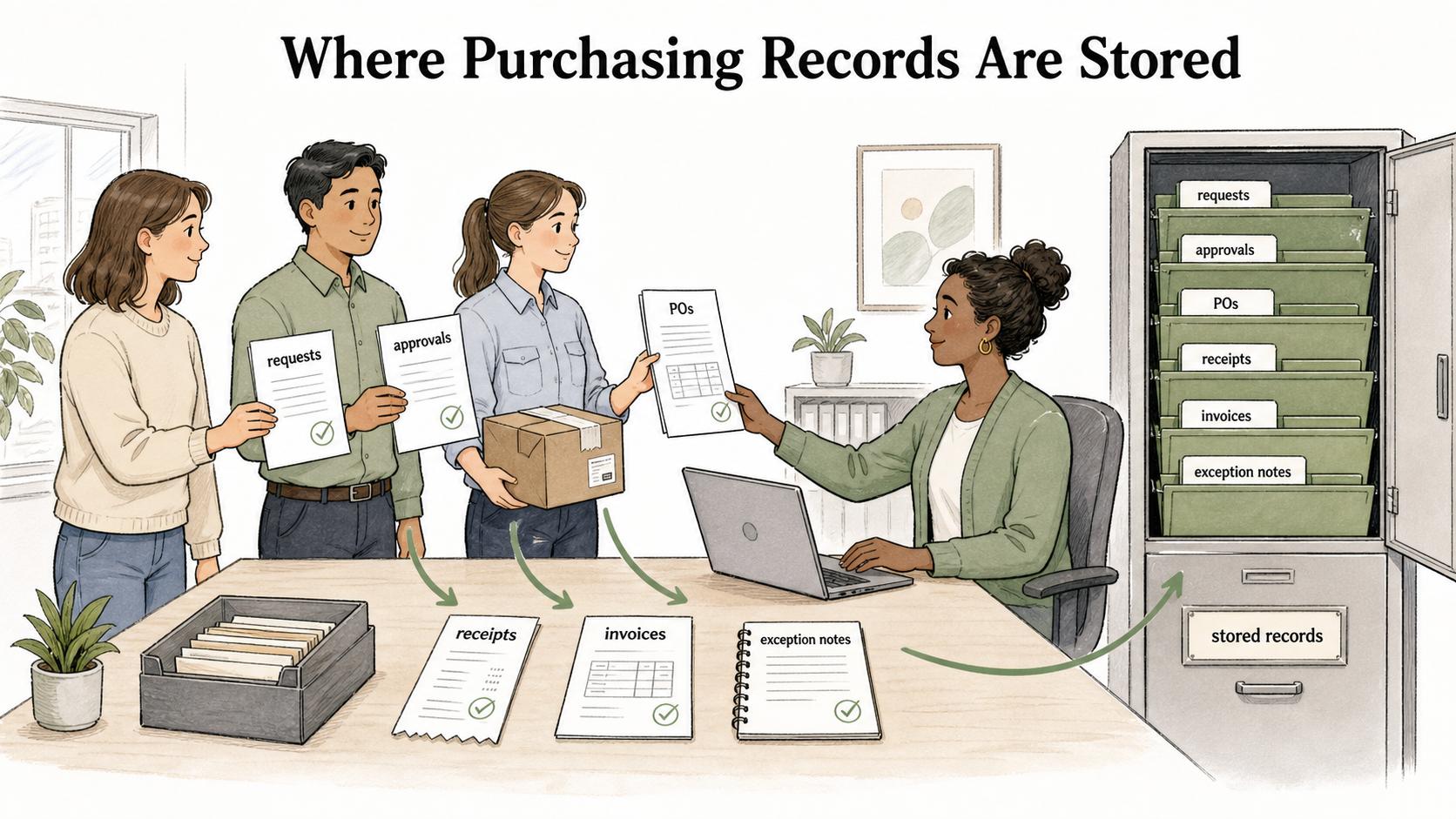
- Records: where requests, approvals, POs, receipts, invoices, and exception notes are stored.
ISO 9001's external-provider controls are one quality-system example of why vendor requirements should be documented. 3
The hidden failure mode is writing the SOP as if every purchase is routine. Exceptions will happen. If the SOP does not define them, employees will create informal paths that are harder to audit and harder to improve.
Example purchasing workflow
A simple purchasing workflow might run like this:
- Employee identifies a business need.
- Employee checks whether an approved vendor or existing contract applies.
- Employee submits a purchase request with cost, business reason, required date, vendor, and budget code.
- Manager approves, rejects, or requests more information.
- Finance or purchasing checks budget, vendor requirements, and threshold rules.
- A purchase order is created if required.
- Goods or services are received and confirmed.
- Invoice is matched to the purchase order and receiving evidence.
- Payment is approved and scheduled.
- Records are stored for finance, audit, tax, and vendor follow-up.
IRS guidance also expects business recordkeeping systems to clearly show income and expenses and retain supporting documents such as paid bills, invoices, and receipts. 4
This workflow can be lighter for low-risk purchases and stricter for high-value, regulated, recurring, or contract-bound purchases. The SOP should make that tiering visible.
AI-ready purchasing SOP template
Use this prompt to draft or tighten a purchasing SOP:
## Purchasing SOP template

**Glossary term:** Purchasing SOP
**Source:** Trails Glossary — trails.so/glossary/purchasing-sop

---

### 01. Create a purchasing SOP

"Create a purchasing SOP for [company/team].

Context:
- Covered purchases: [goods, services, software, equipment, supplies]
- Excluded purchases: [expense reports, payroll, emergency repairs, etc.]
- Tools used: [request form, accounting system, procurement tool, email]
- Approval thresholds: [thresholds]
- Vendor rules: [approved vendors, new vendor process]
- Required records: [request, approval, PO, receipt, invoice]

Return:
1. Purpose and scope
2. Roles and responsibilities
3. Step-by-step purchasing workflow
4. Approval and purchase order rules
5. Exception paths for urgent buys, new vendors, missing POs, and rejected goods
6. Records that must be stored and where they live
7. Review cadence and SOP owner"
Common mistakes
One mistake is making the SOP only about approval. Approval matters, but purchasing also needs vendor rules, receiving confirmation, invoice handoff, exception handling, and record retention.
Another mistake is writing the SOP for finance while ignoring the requester. If the person asking for the purchase cannot tell what information to submit or what happens next, the process will create back-and-forth and shadow work.
A third mistake is leaving software subscriptions out of the process. Subscriptions often look small at first but become recurring spend, security review issues, contract obligations, or renewal surprises.
How Trails helps
Trails helps teams document purchasing workflows by capturing the actual steps employees follow in request forms, finance systems, approval tools, spreadsheets, or procurement software. That captured workflow can become a polished step-by-step guide and, when useful, an AI-narrated training video.
That makes a purchasing SOP easier to train and maintain because the instructions reflect the real screen-by-screen process, not a policy document disconnected from daily work.
For the purchasing-to-payment handoff, explore finance and accounting documentation with Trails to show the system steps that sit behind the purchasing policy.
Sources
- 1
GAO. Standards for Internal Control in the Federal Government. www.gao.gov/products/gao-25-107721. Accessed July 15, 2026.
- 2
eCFR. 2 CFR Part 200 procurement standards. www.ecfr.gov/current/title-2/subtitle-A/chapter-II/part-200/subpart-D/subject-group-ECFR45ddd4419ad436d. Accessed July 15, 2026.
- 3
ISO. ISO 9001:2015 Quality management systems. www.iso.org/standard/62085.html. Accessed July 15, 2026.
- 4
IRS. What kind of records should I keep?. www.irs.gov/businesses/small-businesses-self-employed/what-kind-of-records-should-i-keep. Accessed July 15, 2026.