
Glossary
Legal SOP
 ChatGPT
 Perplexity
 Gemini
 Claude
What is a legal SOP?
A legal SOP is a standard operating procedure for repeatable legal, compliance, or legal-operations work. It explains how a request enters the legal function, what information is required, who reviews it, where approval is recorded, and when the matter needs a qualified legal owner.
A good legal SOP clears the routine fog around intake, routing, access, and records while sending exceptions to the people qualified to make legal judgments.
What makes a legal SOP different
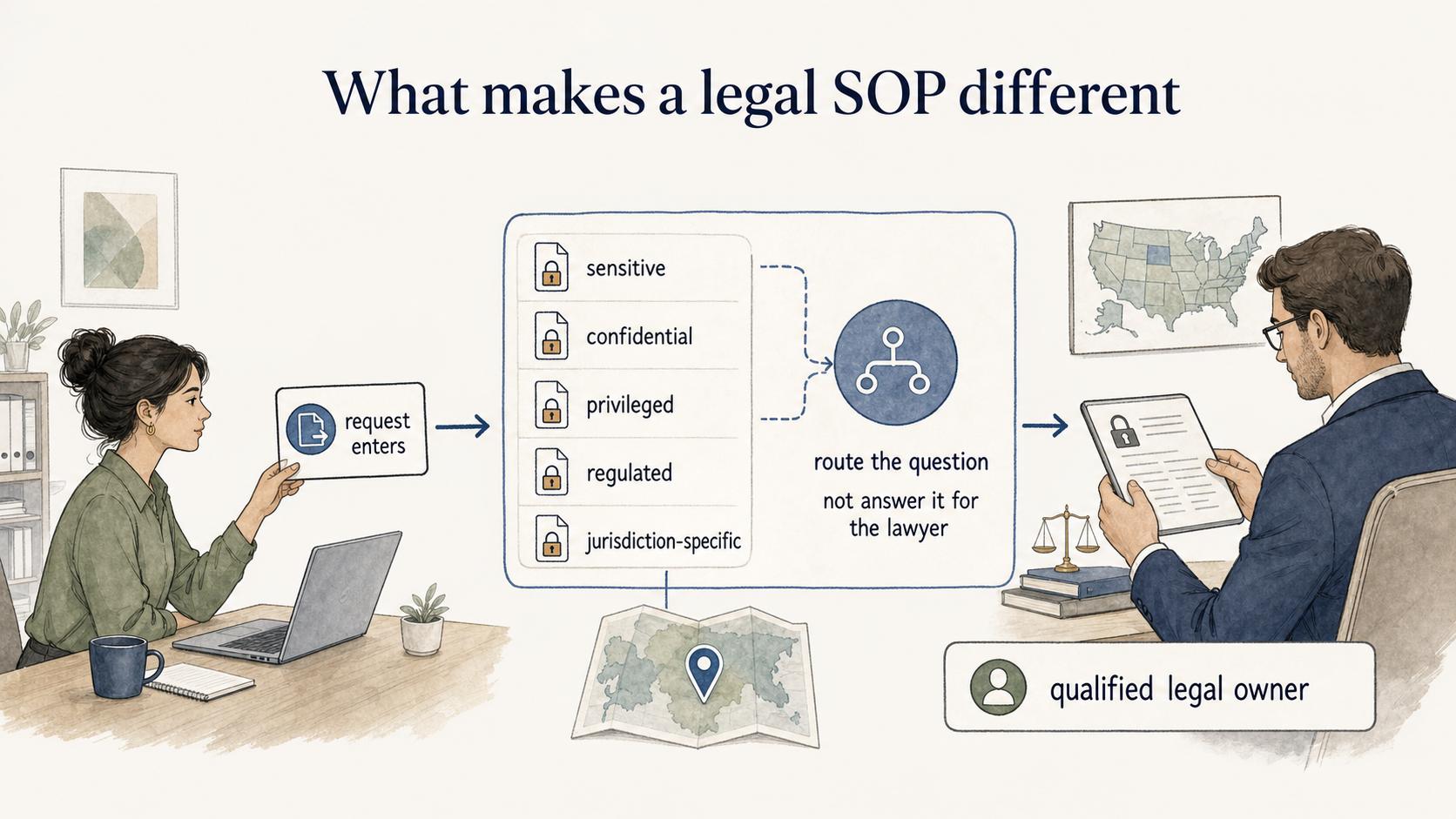
Most SOPs make a task consistent. A legal SOP also has to protect context that may be sensitive, confidential, privileged, regulated, or jurisdiction-specific. That changes the job of the document.
For example, a contract review SOP can tell Sales where to submit an agreement, which facts legal needs before review, which deal sizes require extra approval, and where the approved version belongs. It should not tell a salesperson to decide whether a nonstandard indemnity clause is acceptable. That is the line: the SOP should route the question, not answer it for the lawyer.
This matters because legal workflows often involve non-lawyers. For lawyers and law firms, ABA Model Rule 5.3 addresses supervision of nonlawyer assistance so that the person's conduct stays compatible with the lawyer's professional obligations 1. ABA Model Rule 1.6 also requires reasonable efforts to prevent unauthorized disclosure of, or access to, information relating to client representation 2. A legal SOP is not a substitute for those duties, but it can make the working path respect them.
When a legal SOP is useful
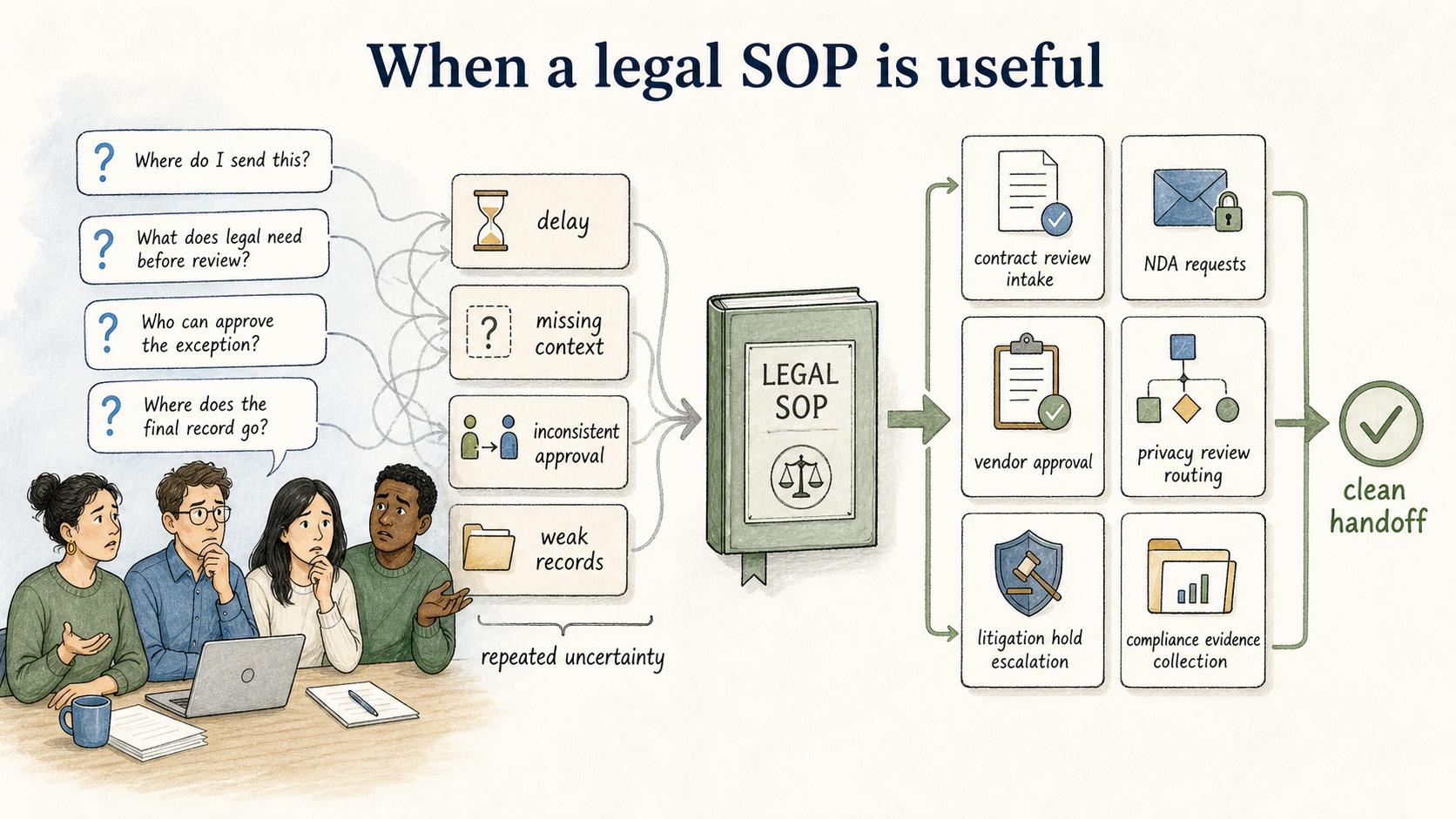
A legal SOP is worth writing when the same request keeps creating delay, missing context, inconsistent approval, or weak records. Complexity is not the threshold. Repeated uncertainty is.
Start where non-legal teams already ask the same questions: “Where do I send this?” “What does legal need before review?” “Who can approve the exception?” “Can I send this version back to the customer?” “Where does the final record go?” If the answer depends on who happens to be online, the workflow is too fragile.
Common candidates include contract review intake, NDA requests, vendor approval, privacy review routing, litigation hold escalation, employment matter escalation, policy exceptions, outside counsel engagement, and compliance evidence collection. The shared pattern is simple: someone outside legal starts the work, legal risk enters the process, and the team needs a clean handoff before anyone acts on incomplete information.
Legal SOP vs policy vs checklist
Legal teams often blur these documents together. That is how a simple procedure turns into a policy memo people stop using.
| Document type | Main job | What it should not do | Example |
|---|---|---|---|
| Legal policy | States the rule, standard, or company position | Explain every operational handoff | Contracts above a defined value require legal review |
| Legal SOP | Shows how work moves from trigger to completion | Replace legal analysis or approval | Submit intake, attach context, route by risk tier, capture approval |
| Checklist | Confirms required items are present | Explain the full process or the reason behind it | Signed NDA, vendor record, approval note, final stored copy |
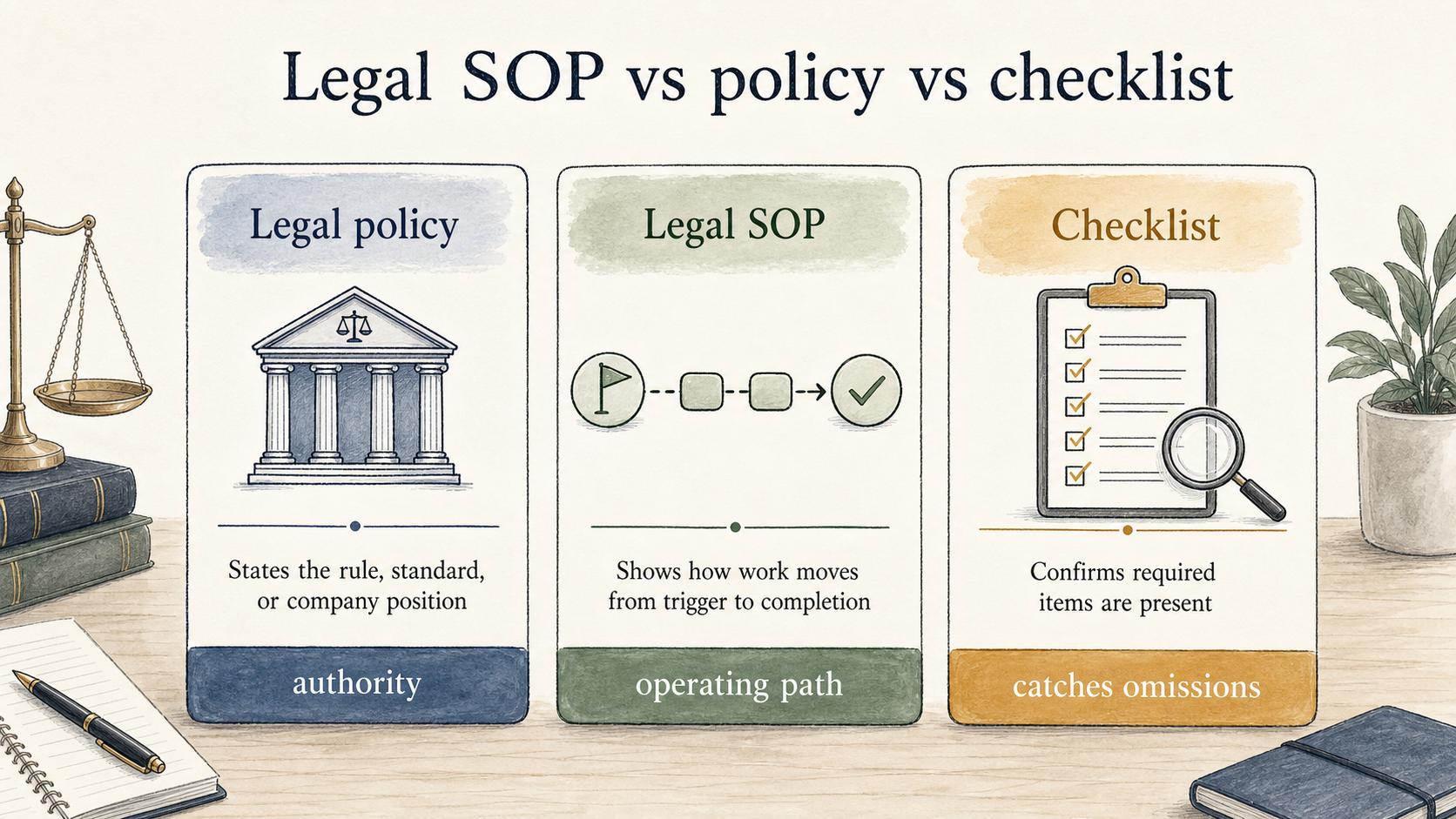
A policy gives authority. A legal SOP gives the operating path. A checklist catches omissions. When one document tries to do all three jobs, it usually becomes too vague for operators and too thin for legal reviewers.
What a legal SOP should include
A strong legal SOP makes the risky parts hard to miss. Include the details that change what someone does next:
- A sharp trigger and scope boundary: name the event that starts the workflow and the cases it does not cover. This keeps the SOP from becoming the default answer to every legal question.
- Required intake before review starts: spell out the facts, documents, deadlines, business context, dollar values, regions, counterparties, and systems legal needs. Many legal workflows stall because the first request arrives half empty.
- Roles and decision rights: identify who requests, reviews, approves, stores the record, and has authority when normal routing breaks.
- Escalation triggers: call out the conditions that stop the standard path, such as unusual terms, urgent deadlines, regulated data, litigation risk, employment sensitivity, or executive approval requirements.
- Evidence and access rules: say where approvals, final documents, version history, and supporting notes live, and who can view or edit them.
The quiet failure mode is a polished SOP that describes the happy path and buries the exception path. In legal work, the exception path is often the point.
A practical rule for writing one
Write the SOP around routing and evidence, not legal conclusions.
The procedure should say: “If the agreement includes nonstandard liability language, route it to the legal owner before sending the next draft.” It should not say: “Accept nonstandard liability language when the business impact seems low.” The first instruction protects the workflow. The second quietly hands legal judgment to whoever is following the doc.
Use stop points instead of vague caution. Tell people when to pause, who to ask, and what to attach. For sensitive matters, tie the access reminder to the approved system instead of writing a generic line like “store securely.” ABA guidance on confidentiality supports the narrow point: lawyers must make reasonable efforts to prevent unauthorized access to information relating to client representation 2.
The same rule applies to tools. If the workflow involves shared drives, intake forms, ticketing systems, contract tools, AI tools, or outside service providers, name the approved path. ABA Model Rule 1.1's competence comment includes staying aware of the benefits and risks of relevant technology 3, so a legal SOP should not leave tool choice to improvisation when confidentiality, access, or record integrity is at stake.
AI-ready legal SOP template
Use this prompt to create a first draft for review by the legal owner:
## Legal SOP Template

**Glossary term:** Legal SOP
**Source:** Trails Glossary — trails.so/glossary/legal-sop

---

### 01. Create a legal SOP

"Create a legal SOP for [workflow] used by [team or audience].

Context:
- Organization/team: [team]
- Workflow trigger: [event that starts the process]
- Scope: [what is included]
- Out of scope: [what is excluded]
- Systems used: [tools, forms, repositories, approval systems]
- Sensitive information involved: [yes/no and type]

Draft the SOP with these sections:
1. Purpose
2. Scope and exclusions
3. Trigger and required intake fields
4. Roles and decision rights
5. Standard procedure from request to completion
6. Escalation triggers and stop points
7. Approval and evidence requirements
8. Storage, access, and recordkeeping rules
9. Exception handling
10. Owner and review cadence

Keep the SOP operational, not legal-advice-oriented. Flag every step that requires attorney, legal operations, compliance, privacy, HR, finance, or leadership review."
How Trails helps
Trails helps teams document legal operations workflows as they are performed. A legal operations owner can capture the intake path, tool steps, approvals, handoffs, and storage process, then turn that workflow into a polished step-by-step guide.
That is useful for legal SOPs because non-legal teams often follow the process while legal owners govern the risk. Trails keeps the routine path easier to document and revise when templates, thresholds, systems, or approval rules change.
- Standard operating procedure
- Compliance SOP
- Records management SOP
- Approval workflow
- Audit trail
- Policy vs procedure
- SOP scope
Sources
- 1
American Bar Association. Model Rule 5.3: Responsibilities Regarding Nonlawyer Assistance. ABA. www.americanbar.org/groups/professional_responsibility/publications/model_rules_of_professional_conduct/rule_5_3_responsibilities_regarding_nonlawyer_assistant/.
- 2
American Bar Association. Model Rule 1.6: Confidentiality of Information. ABA. www.americanbar.org/groups/professional_responsibility/publications/model_rules_of_professional_conduct/rule_1_6_confidentiality_of_information/.
- 3
American Bar Association. Model Rule 1.1 Comment: Maintaining Competence. ABA. www.americanbar.org/groups/professional_responsibility/publications/model_rules_of_professional_conduct/rule_1_1_competence/comment_on_rule_1_1/.