
Glossary
Service Manual
 ChatGPT
 Perplexity
 Gemini
 Claude
What is a service manual?
A service manual is a reference document that explains how to inspect, maintain, troubleshoot, repair, or support a product, system, asset, or service workflow. FDA guidance describes servicing as repair, preventive maintenance, or routine maintenance performed to return a device to its original safety and performance specifications.1 Service manuals are usually written for technicians, support teams, field service staff, internal operators, or administrators who need to keep something working.
A good service manual helps someone diagnose what is happening, choose the right next action, and avoid mistakes that create downtime, safety issues, customer delays, or inconsistent support.
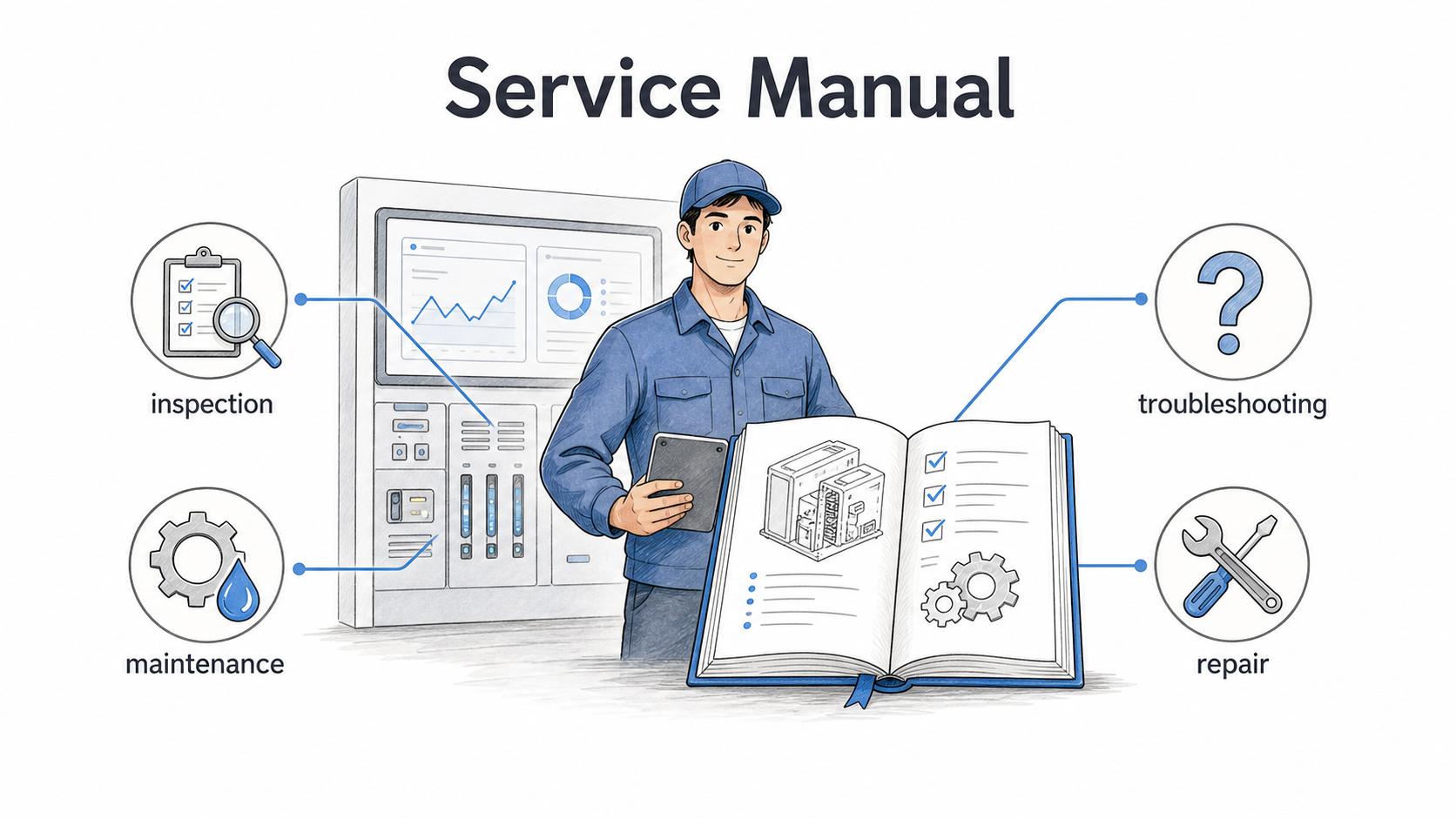
What a service manual includes
The contents depend on the type of service work. A manual for equipment maintenance will look different from a manual for SaaS support or IT administration. The shared pattern is a mix of reference information and action-oriented procedures.
For regulated or high-risk work, service documentation also has to match the records the organization is expected to keep. Current FDA device quality rules include servicing within the quality-management scope and require certain records for servicing activities, including the device serviced, date, service performed, and test or inspection data.2
Common sections include product information, maintenance procedures, repair materials, warranty details, service-agent information, and the practical details a service reader needs to act.3
- Product, system, or service overview.
- Safety, risk, or access prerequisites.
- Required tools, parts, permissions, or systems.
- Routine maintenance or inspection steps.
- Troubleshooting by symptom, error, or scenario.
- Repair, replacement, configuration, or support procedures.
- Escalation rules and owner contacts.
- Diagrams, screenshots, photos, or annotated examples.
- Version history and review cadence.
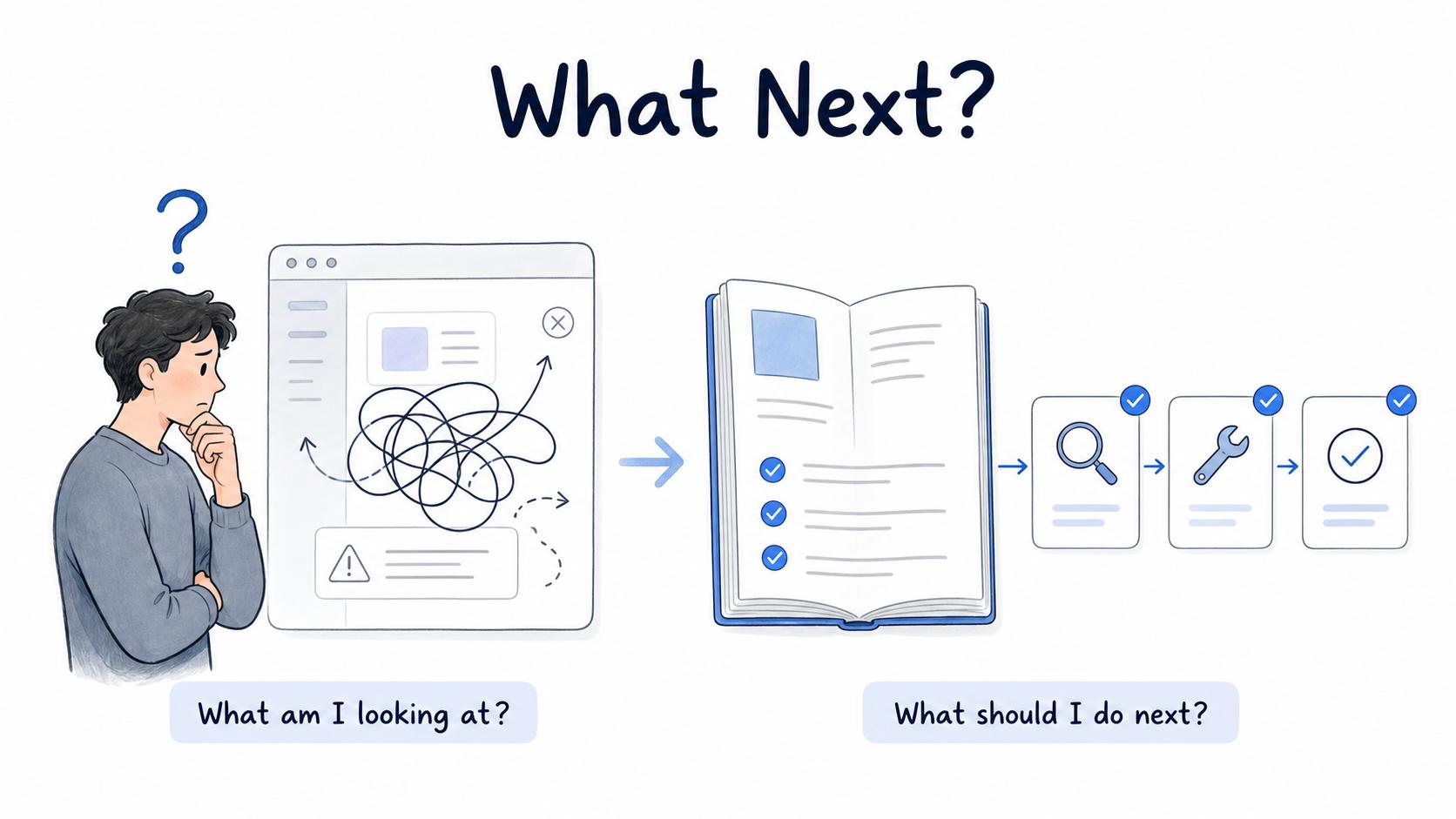
The manual should answer two questions quickly: what am I looking at, and what should I do next?
Service manual vs user manual vs technical manual
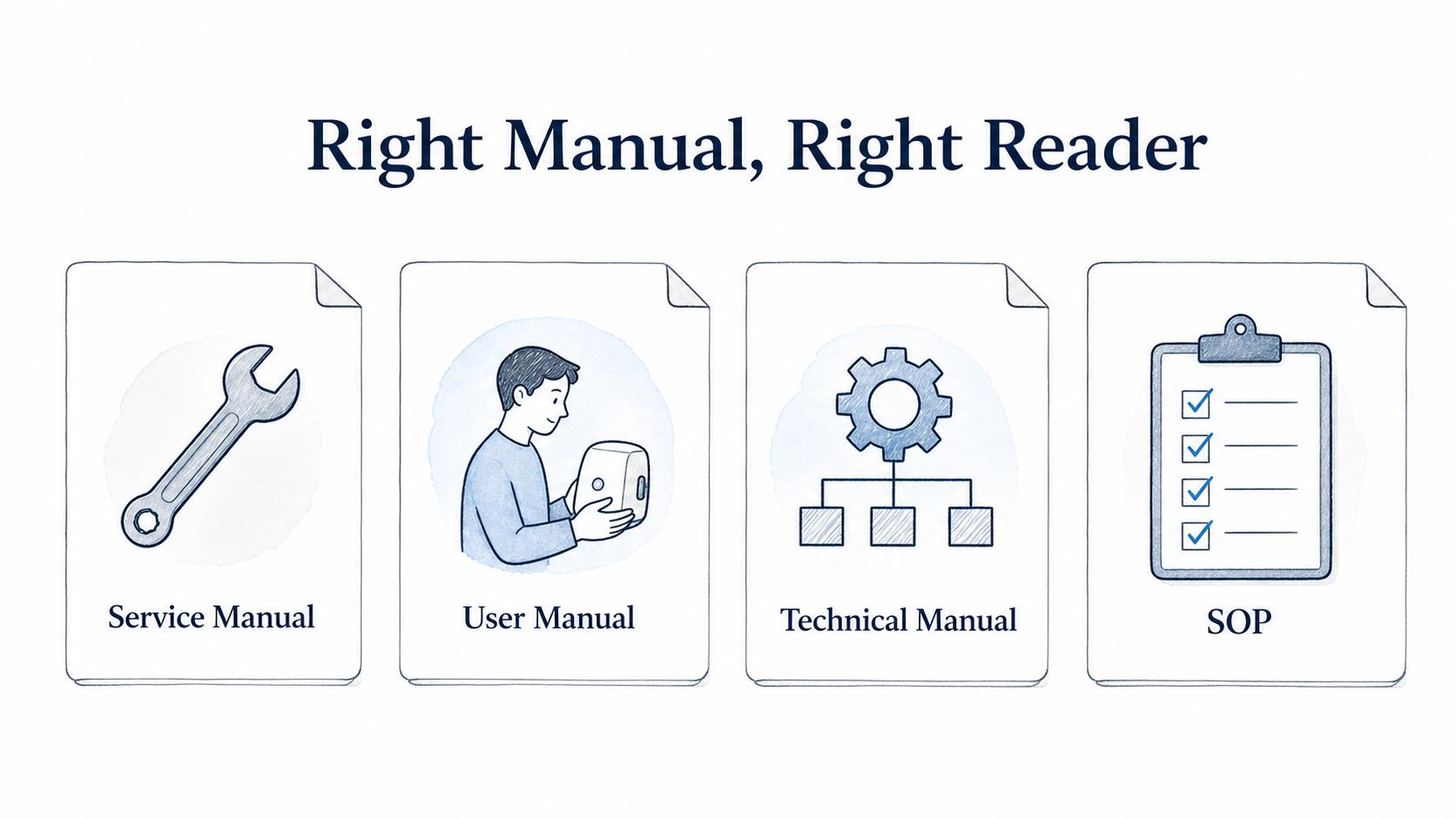
These formats often overlap, but they are not interchangeable.
| Format | Primary audience | Main purpose |
|---|---|---|
| Service manual | Technicians, support teams, maintenance staff, internal operators | Diagnose, maintain, repair, or service a product or system |
| User manual | Customers or end users | Explain how to use a product, feature, or tool |
| Technical manual | Engineers, admins, specialists, or technical staff | Explain technical architecture, configuration, specifications, or operation |
| SOP | Internal teams doing repeatable work | Standardize how a business process should be performed |
The distinction matters because the reader's job is different. A customer using a product needs orientation. A technician servicing it needs symptoms, causes, procedures, and stop conditions. A system admin configuring it needs technical details and permission boundaries.
When a service manual is useful
Create a service manual when the work involves repeatable service decisions, not just one-off instructions. It is especially useful when quality depends on diagnosis, sequence, specialized access, or knowing when to escalate.
Good candidates include customer support troubleshooting, IT help desk workflows, equipment maintenance, field service tasks, facilities procedures, product repair, internal system administration, and support escalation paths.
If the work is simple and low-risk, a checklist may be enough. If the work involves symptoms, decisions, parts, user impact, approvals, or risk, a service manual gives the team a more durable operating reference.
How to structure a service manual
The mistake is structuring the manual around what the creator knows instead of what the service person needs in the moment. Service work is often done under pressure, so the manual should support scanning and decision-making.
A practical structure is:
- Scope and audience: what this manual covers, what it excludes, and who should use it.
- Prerequisites: safety notes, tools, access, permissions, parts, or required context.
- System overview: just enough orientation to understand the service work.
- Troubleshooting index: symptoms, error states, common causes, and first checks.
- Service procedures: step-by-step instructions for maintenance, repair, configuration, or support.
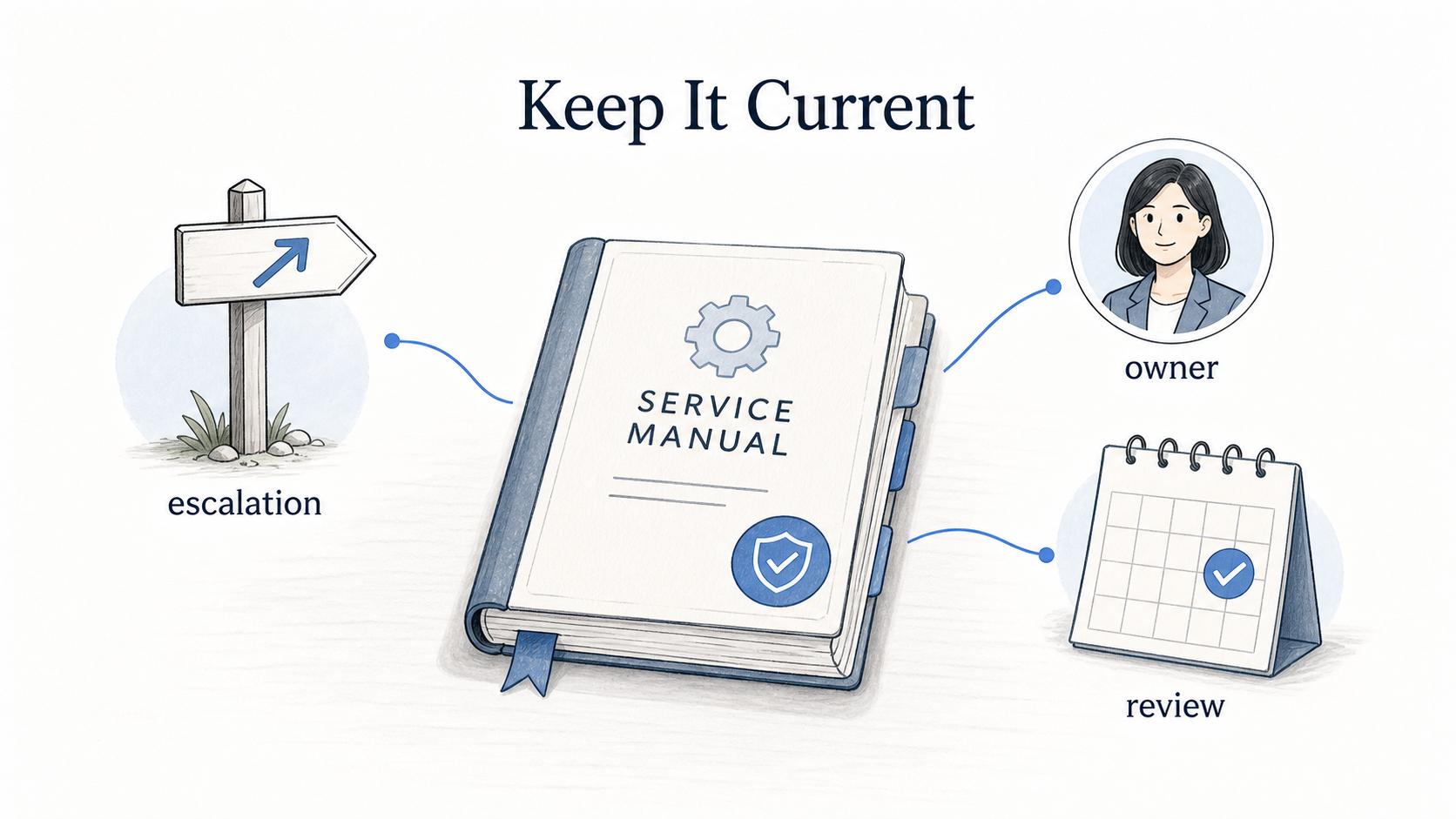
- Escalation rules: when to stop, who to contact, and what evidence to include.
- Ownership: owner, update path, version history, and review cadence.
The escalation rules are not a footnote. They protect the team from improvising past their authority or skill level.
Service manual template
Use this as a starting point:
## Service Manual Template

**Glossary term:** Service Manual
**Source:** Trails Glossary — trails.so/glossary/service-manual

---

### 01. Draft a service manual

"Service manual title: [product/system/workflow]
Audience: [technicians/support/admins/operators]
Purpose: [what service work this manual supports]
Scope: [included systems, versions, locations, or scenarios]
Prerequisites: [tools, parts, permissions, safety notes, access]
System overview: [short context needed before servicing]
Troubleshooting index:
- Symptom/error: [what the person sees]
- Likely causes: [what may be happening]
- First checks: [what to verify before acting]
Service procedures:
1. [procedure name and steps]
2. [procedure name and steps]
Escalation rule: [when to stop and who owns next step]
Owner: [team/person]
Review cadence: [when this manual is checked]"
Keep the template modular. A service manual that is easy to update will age better than one perfect document that nobody wants to touch. ISO 10013 frames documented information as something developed and maintained to support an effective management system, tailored to the organization's needs.4
Common mistakes
The first mistake is burying troubleshooting under background information. Service readers need fast access to symptoms, likely causes, and next actions. Put the diagnosis path where people can find it.
The second mistake is relying only on text when visuals would prevent errors. Screenshots, labels, diagrams, or photos can make a service step much clearer than a paragraph.
The third mistake is leaving ownership vague. A service manual decays when tools change, products change, support policies change, or teams learn better fixes. Someone needs to own those updates.
How Trails helps
Trails can help teams create service documentation by capturing a workflow as someone performs it, then turning that capture into a polished step-by-step guide. For support and internal service teams, that makes it easier to document troubleshooting flows, admin tasks, equipment checks, and repeatable service routines.
Trails can also create an AI-narrated video version, which is useful when service work needs to be shown as well as read.
- Technical manual
- User manual
- Training manual
- Operations manual
- Procedure manual
- Standard operating procedure
- Support documentation
- Service desk SOP
Sources
- 1
U.S. Food and Drug Administration. Remanufacturing and Servicing Medical Devices. FDA. www.fda.gov/medical-devices/quality-and-compliance-medical-devices/remanufacturing-and-servicing-medical-devices. Accessed July 7, 2026.
- 2
Electronic Code of Federal Regulations. 21 CFR Part 820 Quality Management System Regulation. eCFR. www.ecfr.gov/current/title-21/chapter-I/subchapter-H/part-820. Accessed July 7, 2026.
- 3
Dormitory Authority of the State of New York. Operation and Maintenance Manuals specification. DASNY. www.dasny.org/sites/default/files/rfp-documents/2025-10/Section%20017823%20-%20Operation%20and%20Maintainance%20Manuals_0.pdf. Accessed July 7, 2026.
- 4
International Organization for Standardization. ISO 10013:2021 Quality management systems. ISO. www.iso.org/standard/75736.html. Accessed July 7, 2026.