
Glossary
Technical Manual
 ChatGPT
 Perplexity
 Gemini
 Claude
What is a technical manual?
A technical manual is a structured document that explains how to install, operate, maintain, troubleshoot, or understand a technical product, system, tool, or process. It is usually written for people who need accurate instructions for complex work, such as technicians, administrators, support teams, operators, engineers, or advanced users.
A good technical manual does not simply collect expert information. It organizes that information around the reader's task so someone can find the right procedure, understand the requirements, and act without guessing. IEEE/ISO/IEC 26514 describes user documentation work as determining what information users need, how it should be presented, and how it should be maintained across the lifecycle.1
What a technical manual includes
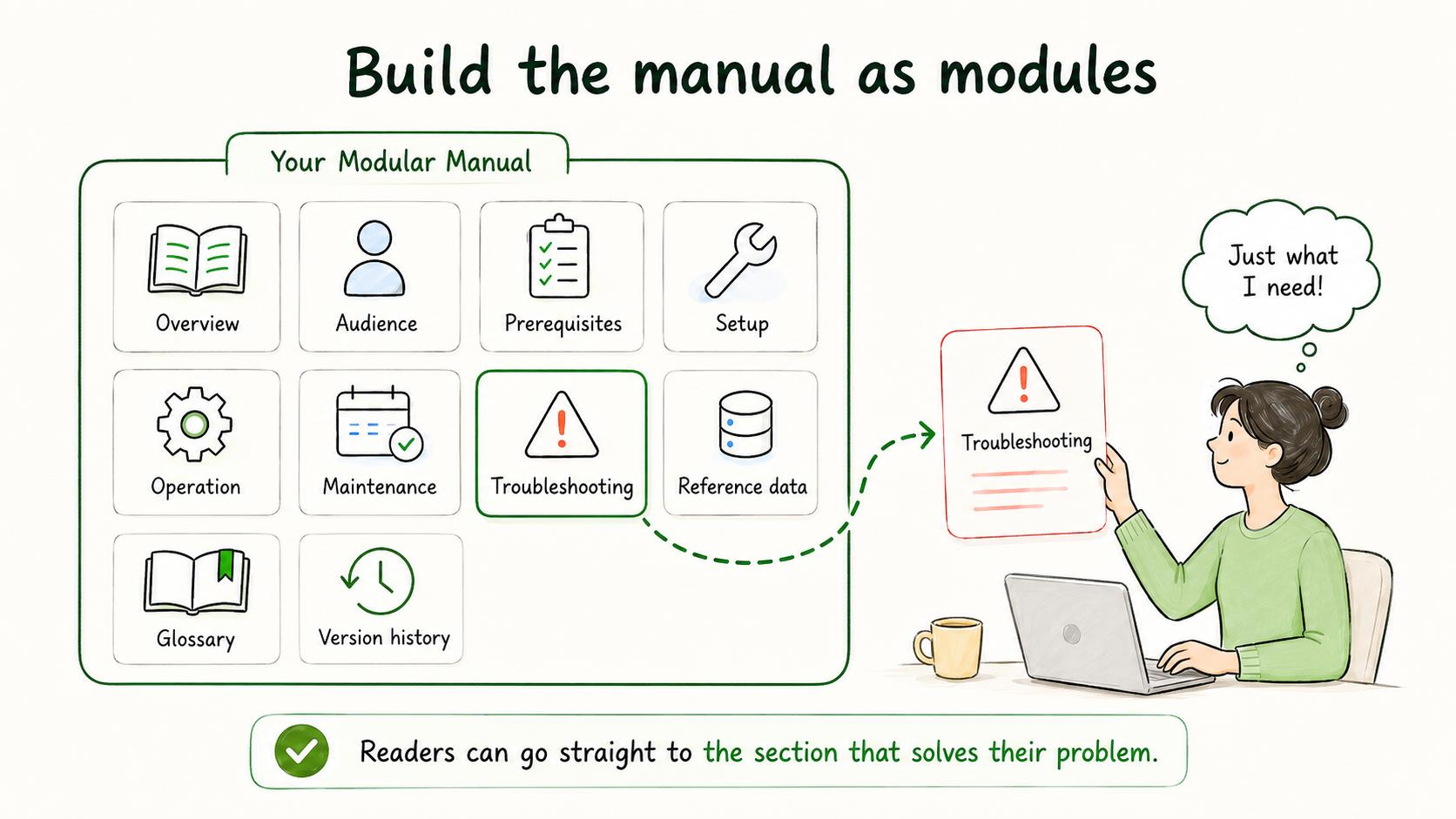
The contents depend on the system or process, but many technical manuals include the same basic categories: overview, audience, prerequisites, setup, operation, maintenance, troubleshooting, reference data, glossary, and version history.
The manual should also say what is out of scope. That boundary matters because technical manuals can expand endlessly. If the manual covers equipment maintenance, it may not also need to teach procurement, training policy, or full product strategy.
The best manuals are modular. Readers should not have to read the whole document to solve one problem. Diataxis separates documentation into tutorials, how-to guides, reference, and explanation because readers have different needs at different moments.2
Technical manual vs. related manuals
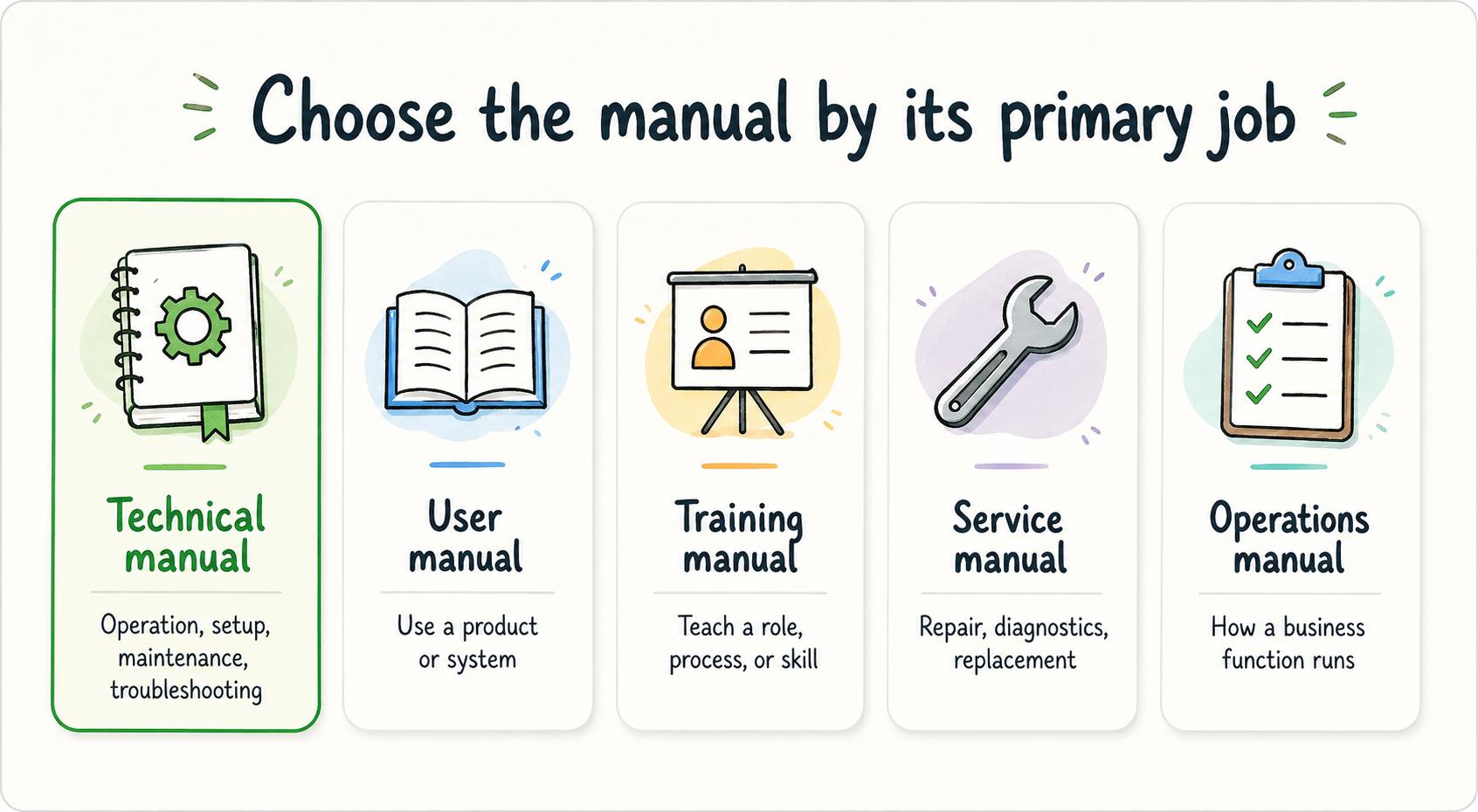
Technical manuals overlap with user manuals, training manuals, service manuals, and operations manuals. The difference is the primary job the document is doing.
| Manual type | Main purpose | Typical reader |
|---|---|---|
| Technical manual | Explain technical operation, setup, maintenance, or troubleshooting | Technicians, admins, support, operators |
| User manual | Help a user understand and use a product or system | Customers or end users |
| Training manual | Teach a role, process, or skill over time | Employees, trainees, managers |
| Service manual | Guide repair, maintenance, diagnostics, or replacement work | Service teams or technicians |
| Operations manual | Explain how a business function or facility runs | Internal operators and managers |
A single document can combine these functions, but the primary purpose should be clear. Otherwise the manual becomes too broad for any one reader to use well.
How to structure a technical manual
Start with the reader's task, not the internal architecture of the system. Nielsen Norman Group's help-and-documentation heuristic recommends that help content be searchable, focused on the user's task, concise, and written as concrete steps.3
Experts often think in components. Readers usually think in moments: install this, configure that, diagnose this symptom, restore access, replace this part, verify the result.
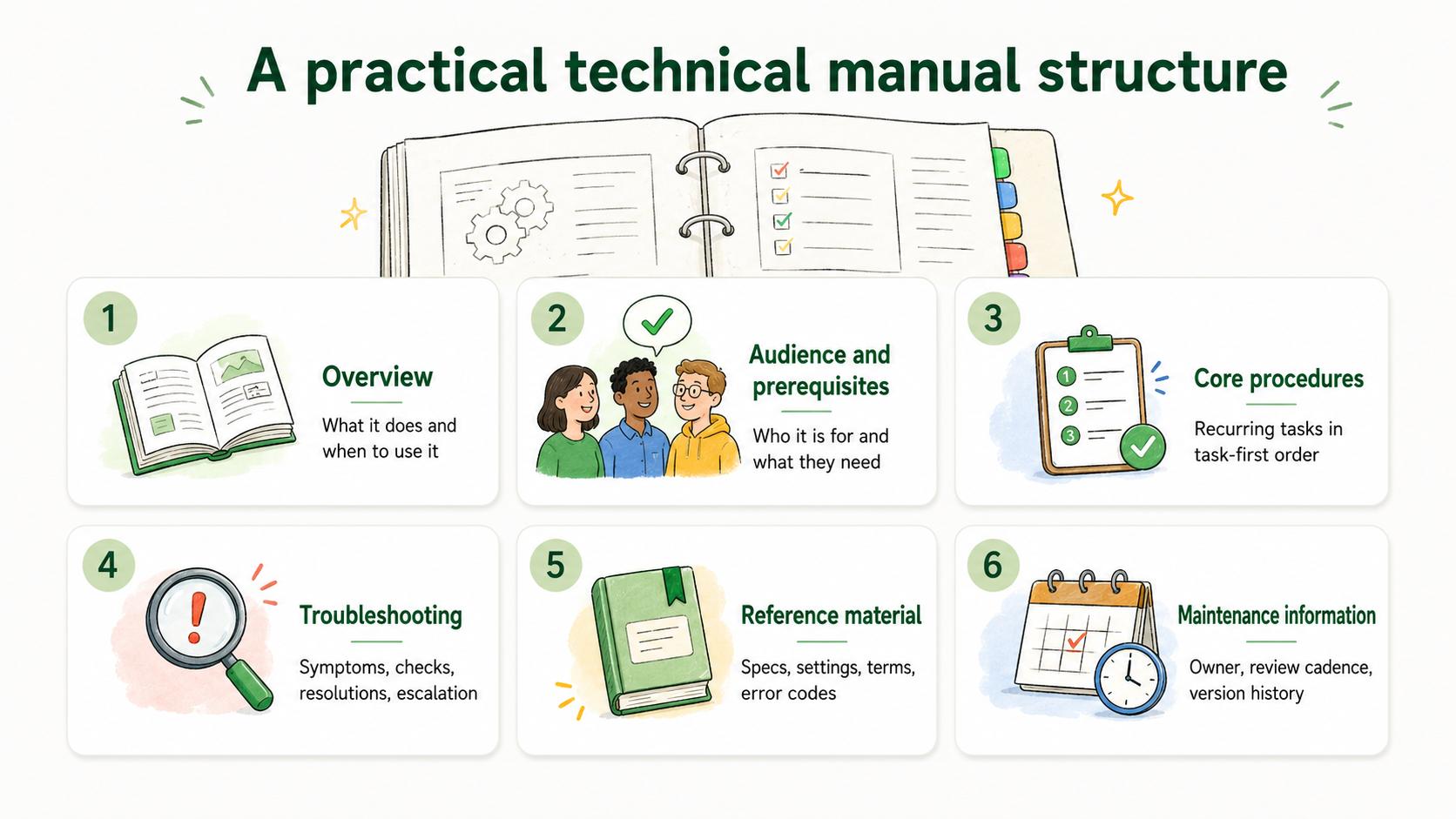
A practical technical manual structure is:
- Overview: what the product, system, or process does and when to use the manual.
- Audience and prerequisites: who the manual is for, what readers should already know, what tools or access they need, and any safety or security constraints.
- Core procedures: the recurring tasks readers must perform, written in a task-first sequence.
- Troubleshooting: symptoms, likely causes, diagnostic checks, resolutions, and escalation paths.
- Reference material: specifications, settings, terminology, diagrams, error codes, or configuration tables.
- Maintenance information: owner, review cadence, version history, and how readers can report problems.
For complex manuals, separate explanations from procedures. A conceptual overview can help readers understand how a system works, but it should not interrupt a procedure that someone is following under time pressure.
Example of a technical manual
Imagine an internal IT team documenting a device provisioning process. A weak manual might list every tool in the environment, every policy reference, and every possible exception before the first procedure. It is complete, but hard to use.
A stronger manual starts with the audience and scope, then gives procedures such as "Provision a laptop for a new hire," "Reassign a returned device," "Troubleshoot enrollment failure," and "Escalate a missing asset record." Reference details live later in the document, where people can find them without blocking the main task.
That structure helps the manual serve real work instead of becoming a technical encyclopedia.
Technical manual template
Use this prompt to draft a technical manual outline:
## Technical Manual Template

**Glossary term:** Technical Manual
**Source:** Trails Glossary — trails.so/glossary/technical-manual

---

### 01. Draft a technical manual outline

"Create a technical manual for [product, system, equipment, or process].
Audience: [reader group]
Reader tasks: [install, operate, maintain, troubleshoot, configure, verify]
Prerequisites: [tools, access, safety, security, knowledge]
Scope: [what this manual covers]
Out of scope: [what it does not cover]
Core procedures: [main recurring tasks]
Troubleshooting needs: [symptoms, errors, diagnostics, escalation]
Reference material: [settings, terms, specs, diagrams, examples]
Maintenance owner: [person or team]
Review cadence: [how often it should be checked]"
The prompt should produce an outline first. Fill the manual only after the team confirms the real tasks and the right reviewers.
Common mistakes
The first mistake is writing for experts instead of readers. Expert completeness can bury the answer. The manual should preserve accuracy while making the next action easy to find.
The second mistake is treating troubleshooting as an afterthought. Troubleshooting is often where readers arrive under pressure. It should be organized by symptom, error, or decision point, not as a pile of notes at the end.
The third mistake is failing to maintain the manual. Technical manuals decay when tools, screens, permissions, system behavior, or policies change. Document-control guidance for ISO 9001 emphasizes review, version control, access control, and lifecycle management for documented information.4 Assign an owner and review cadence before publication, not after the first stale page is reported.
Documentation takeaway
A technical manual is a living reference for complex work. It should be accurate, searchable, task-oriented, and owned. If readers repeatedly ask experts the same questions, the manual is either missing information, hard to navigate, or not trusted.
Good manuals reduce repeated questions, make onboarding easier, and keep technical knowledge from living only in expert memory.
How Trails helps
Trails helps teams capture technical workflows as they happen and turn them into polished step-by-step guides. It can also create AI-narrated video versions for training or sharing.
That is useful when a technical manual depends on exact screen-based steps or repeatable internal procedures. Trails gives writers and experts a concrete workflow capture to refine into durable manual content.
- Technical documentation
- Technical writer
- User manual
- Training manual
- Technical documentation software
- Service manual
- Operations manual
Sources
- 1
IEEE. IEEE/ISO/IEC 26514-2021. IEEE Standards Association. standards.ieee.org/ieee/26514/7467/. Accessed July 2, 2026.
- 2
Daniele Procida. Diataxis Documentation Framework. Diataxis. diataxis.fr/. Accessed July 2, 2026.
- 3
Nielsen Norman Group. Help and Documentation. Nielsen Norman Group. www.nngroup.com/articles/help-and-documentation/. Accessed July 2, 2026.
- 4
ISMS Online. ISO 9001 Clause 7.5: Documented Information. ISMS Online. www.isms.online/iso-9001/clause-7-5-documented-information/. Accessed July 2, 2026.