
Glossary
Scrum Documentation
 ChatGPT
 Perplexity
 Gemini
 Claude
What is Scrum documentation?
Scrum documentation is the written context a Scrum team keeps so work, decisions, quality expectations, and handoffs stay visible. It includes lightweight records such as backlog items, acceptance criteria, Sprint Goals, Definition of Done notes, release notes, technical decisions, and support handoff details.1
The useful test is whether the team can inspect, adapt, release, support, and explain what changed without relying on memory.2 If the document does not change how someone builds, tests, ships, supports, or learns from the work, it probably does not belong in the Sprint workflow.
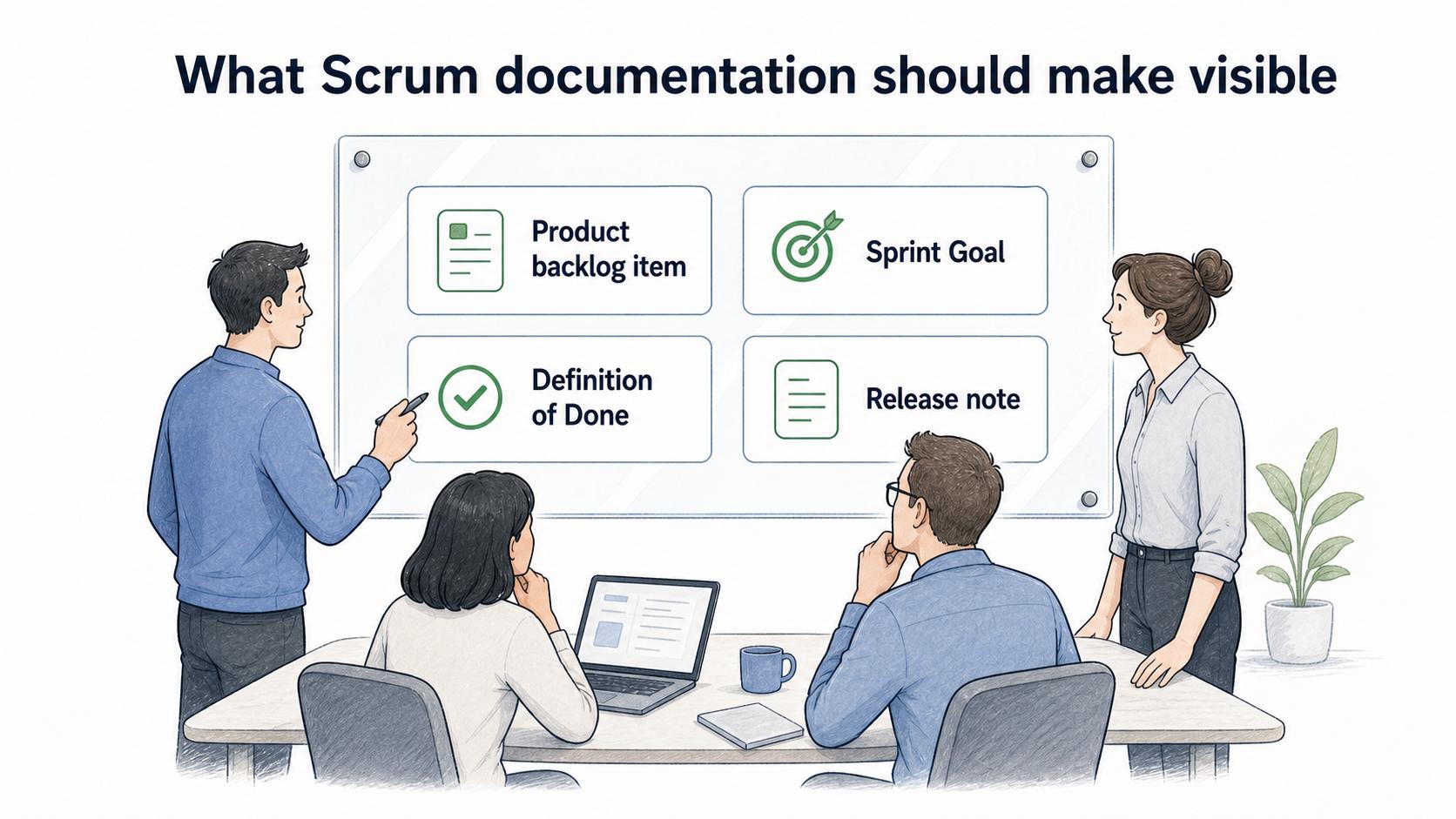
What Scrum documentation should make visible
Useful Scrum documentation answers the questions that otherwise come back in planning, review, QA, support, or customer conversations. It should make the team's current understanding visible: what problem is being solved, what success looks like, what tradeoffs were accepted, and what must happen before work is considered done.
That visibility matters because Scrum teams work in short learning cycles. A refinement decision can affect acceptance criteria. A testing detail can affect release notes. A change in the Definition of Done can affect every future Sprint. If those details live only in a meeting or comment thread, the team creates hidden work for later.
The best Scrum documentation is small, current, and attached to the artifact or workflow it supports. It should feel like a working aid, not a separate reporting ritual.
What belongs in Scrum documentation
Scrum teams do not need to document every conversation. They do need to capture the information that changes how someone will build, test, release, support, or improve the product.
| Documentation item | What it preserves | Why it matters |
|---|---|---|
| Product backlog item | User need, scope, and acceptance criteria | Prevents vague work from entering a Sprint |
| Sprint Goal | The shared outcome for the Sprint | Keeps the team aligned when scope changes |
| Definition of Done | The quality bar for completed work | Prevents documentation, QA, or release tasks from becoming afterthoughts |
| Decision note | A tradeoff, constraint, or rejected option | Helps future teammates understand why the product works this way |
| Release note | What changed and who is affected | Helps support, customers, and internal teams prepare |
| Support handoff | Known questions, edge cases, or troubleshooting steps | Reduces confusion after shipping |
The pattern is simple: if a missing note would cause rework, customer confusion, support escalation, or a repeated debate, it probably deserves documentation.
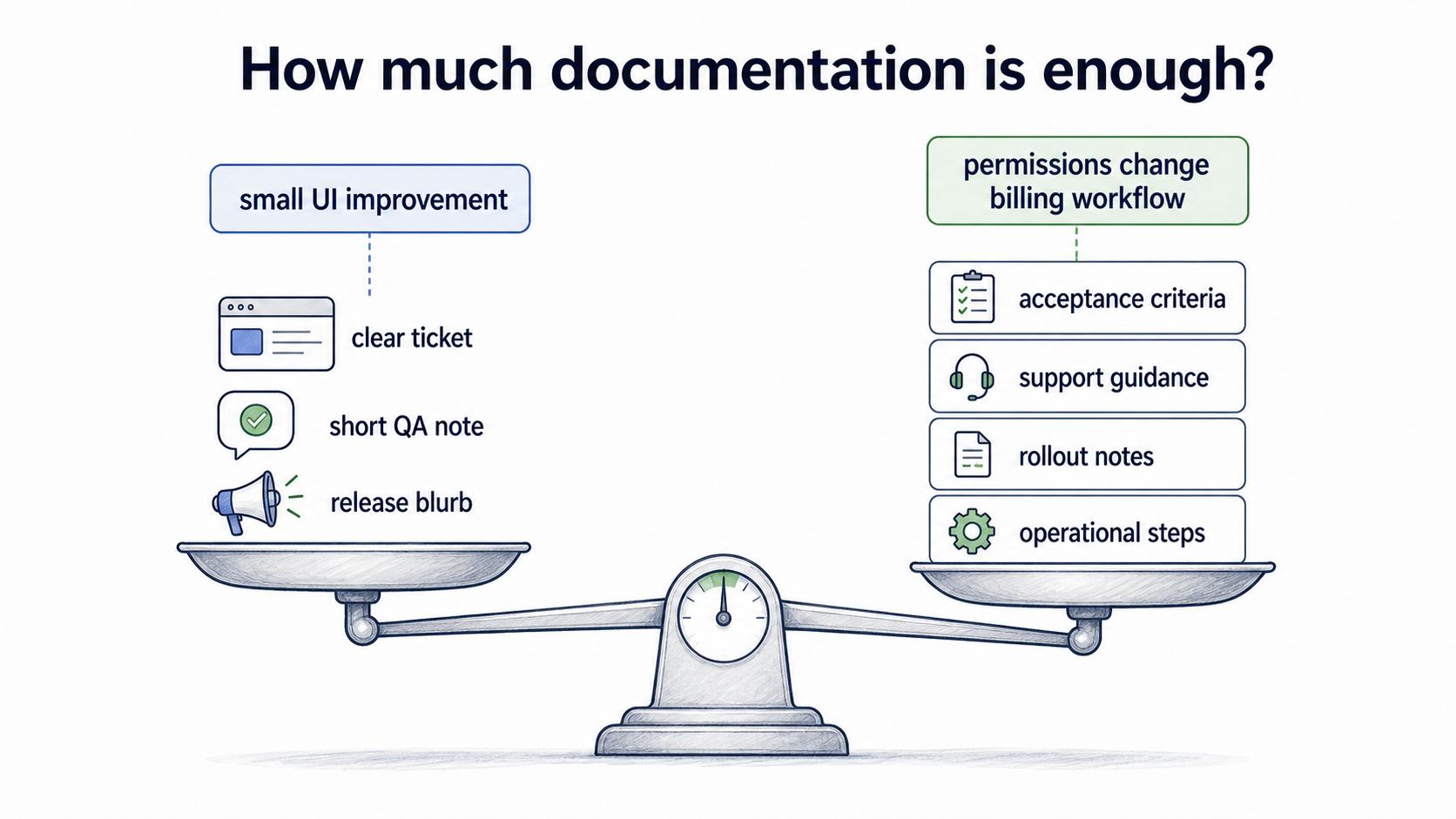
How much documentation is enough?
The right amount depends on risk. A small UI improvement may need a clear ticket, a short QA note, and a release blurb.3 A permissions change, billing workflow, migration, or customer-facing process may need more explicit acceptance criteria, support guidance, rollout notes, and operational steps.
A useful test is whether someone outside the original conversation could continue the work responsibly. They do not need a transcript of every discussion, but they should be able to answer the practical questions: what are we trying to accomplish, what changed, what is done, what should be tested, and what should customers or support know?
Scrum documentation becomes wasteful when it is written for imagined completeness. It becomes risky when it is skipped because the team assumes everyone will remember. Let consequences set the size: capture what changes decisions, behavior, release readiness, or future maintenance.
A practical decision rule
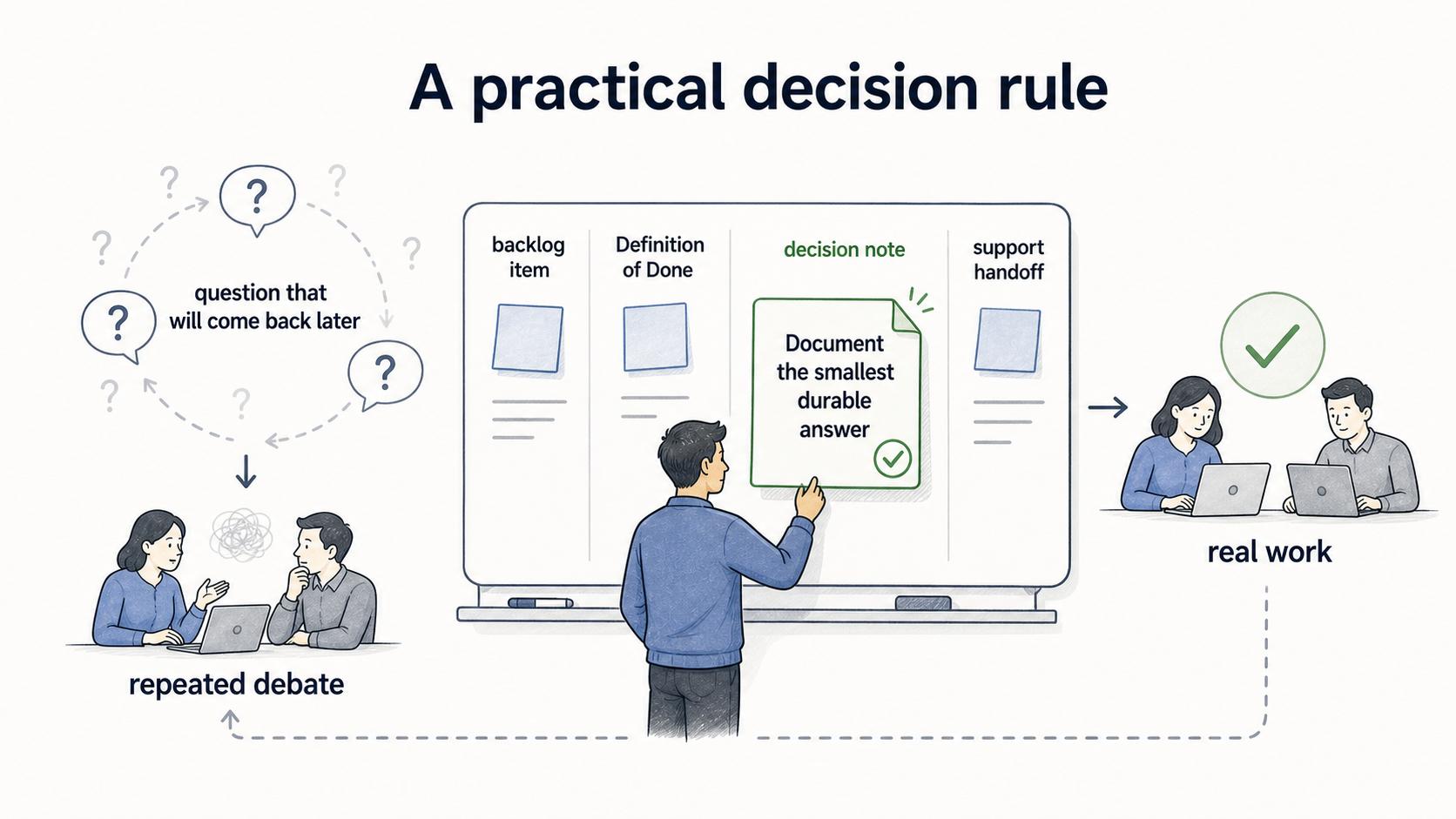
Use this rule during refinement, planning, review, or release prep:
Document the smallest durable answer to the question that will come back later.
If the question is "What problem are we solving?" the durable answer may be a stronger backlog item. If the question is "How do we know this is done?" it belongs in acceptance criteria or the Definition of Done. If the question is "Why did we choose this approach?" write a decision note. If the question is "What will Support need after launch?" create a support handoff or workflow guide.
This keeps documentation tied to real work. It also prevents the common failure mode where teams write polished documents disconnected from the Sprint while the important details stay buried in chat, pull requests, or meeting memory.
Common mistakes
The first mistake is treating "agile" as permission to avoid documentation.4 That works until a teammate rotates off, a customer asks why behavior changed, or the same decision has to be reopened three Sprints later.
The second mistake is documenting too late. If release notes, support steps, or customer education are always written after the Sprint, documentation becomes cleanup work instead of part of delivery. For recurring needs, make the documentation expectation visible in the Definition of Done.
The third mistake is splitting context across too many tools without links. A backlog item may say what to build, a pull request may explain the technical choice, and a support doc may explain the customer impact. Those records can live in different places, but they should point to each other when one changes the meaning of another.
How Trails helps
Trails helps when Scrum documentation needs to explain a workflow, handoff, or product behavior rather than only store a decision. A teammate can capture a process as they perform it, turn that workflow into a polished step-by-step guide, and create an AI-narrated video version for training, QA, support, or customer education.
That makes Trails a useful fit for Scrum documentation near release readiness: support handoffs, internal workflow changes, onboarding guides, customer-facing walkthroughs, and repeatable QA or operations procedures.
Sources
- 1
Ken Schwaber and Jeff Sutherland. The 2020 Scrum Guide. Scrum Guides, 2020. scrumguides.org/scrum-guide.html. Accessed July 8, 2026.
- 2
Scrum.org. Three Pillars of Empiricism in Scrum. Scrum.org. www.scrum.org/resources/blog/three-pillars-empiricism-scrum. Accessed July 8, 2026.
- 3
International Organization for Standardization. ISO/IEC/IEEE 26515:2018. ISO, 2018. www.iso.org/obp/ui/. Accessed July 8, 2026.
- 4
Kent Beck et al.. Manifesto for Agile Software Development. Agile Manifesto, 2001. agilemanifesto.org/. Accessed July 8, 2026.