
Glossary
Retail SOP
 ChatGPT
 Perplexity
 Gemini
 Claude
What is a retail SOP?
A retail SOP is a standard operating procedure for a repeatable store task, such as opening a location, processing returns, receiving inventory, closing a cash drawer, or setting up a promotion. It tells employees how the work should be done, who owns each step, what standard must be met, and when to escalate an exception.
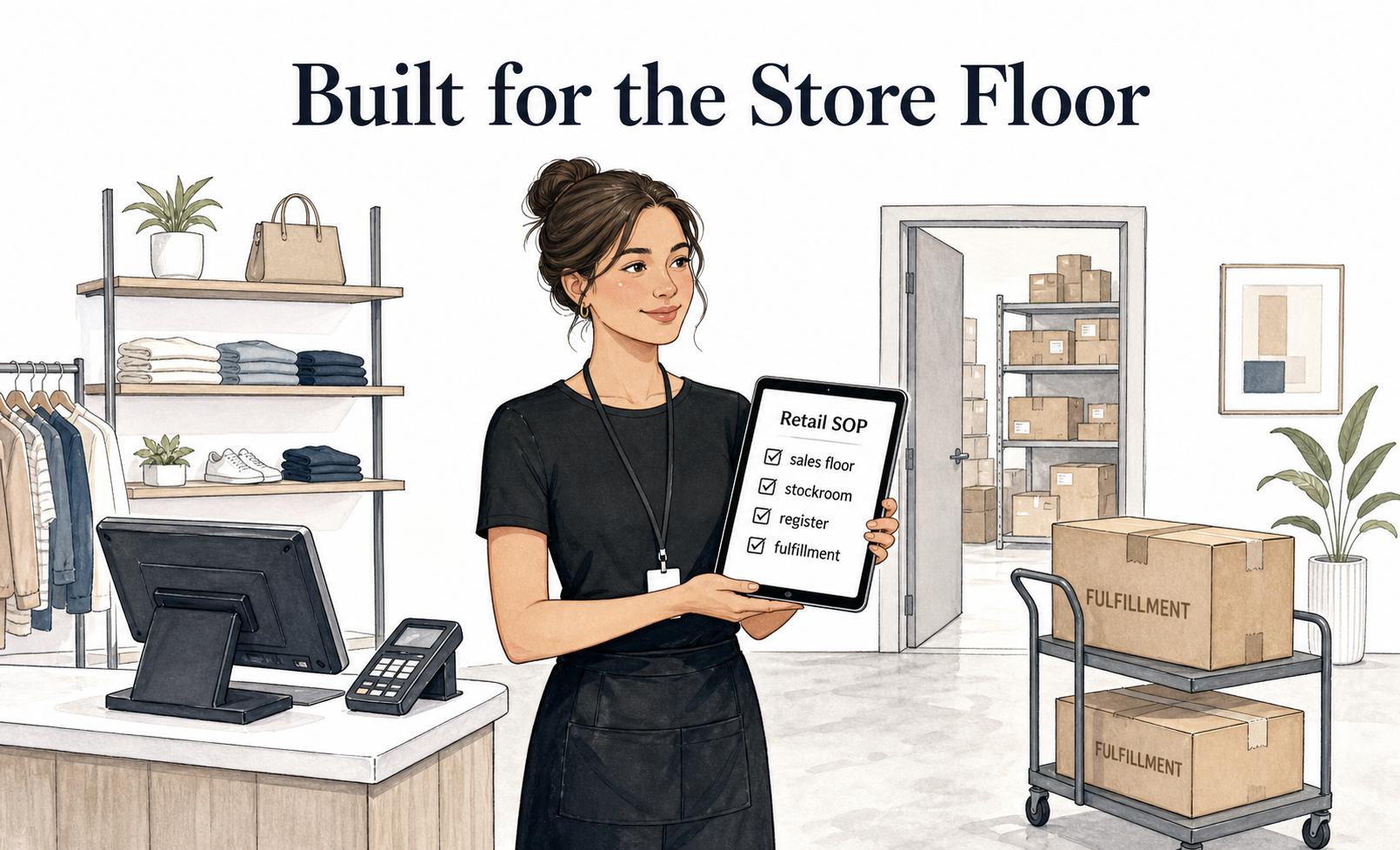
The important word is retail. Store teams work in front of customers, across shifts, and under time pressure. A retail SOP has to work on the sales floor, in the stockroom, at the register, or in fulfillment, not only in a policy folder.
Why retail SOPs matter
Retail work looks simple from a distance because the tasks repeat every day. The hard part is making those tasks repeat the same way when traffic, staffing, products, promotions, and exceptions keep changing.
A good retail SOP reduces variation in the moments that affect customer experience, cash accuracy, safety, inventory, and brand presentation. OSHA's retail grocery guidance treats store safety practices as adaptable programs rather than one-time instructions.1 The same operating principle applies beyond grocery: a store procedure has to fit the place where employees actually use it.
The best retail SOPs are written for normal pressure, not perfect conditions. They help employees handle a customer without a receipt, a late truck, a register shortage, a missing size label, a display that does not match the planogram, or a manager who is not immediately available.
What a retail SOP should include
A retail SOP should cover one real workflow. If it tries to cover an entire department, it usually becomes too vague to use during a shift.
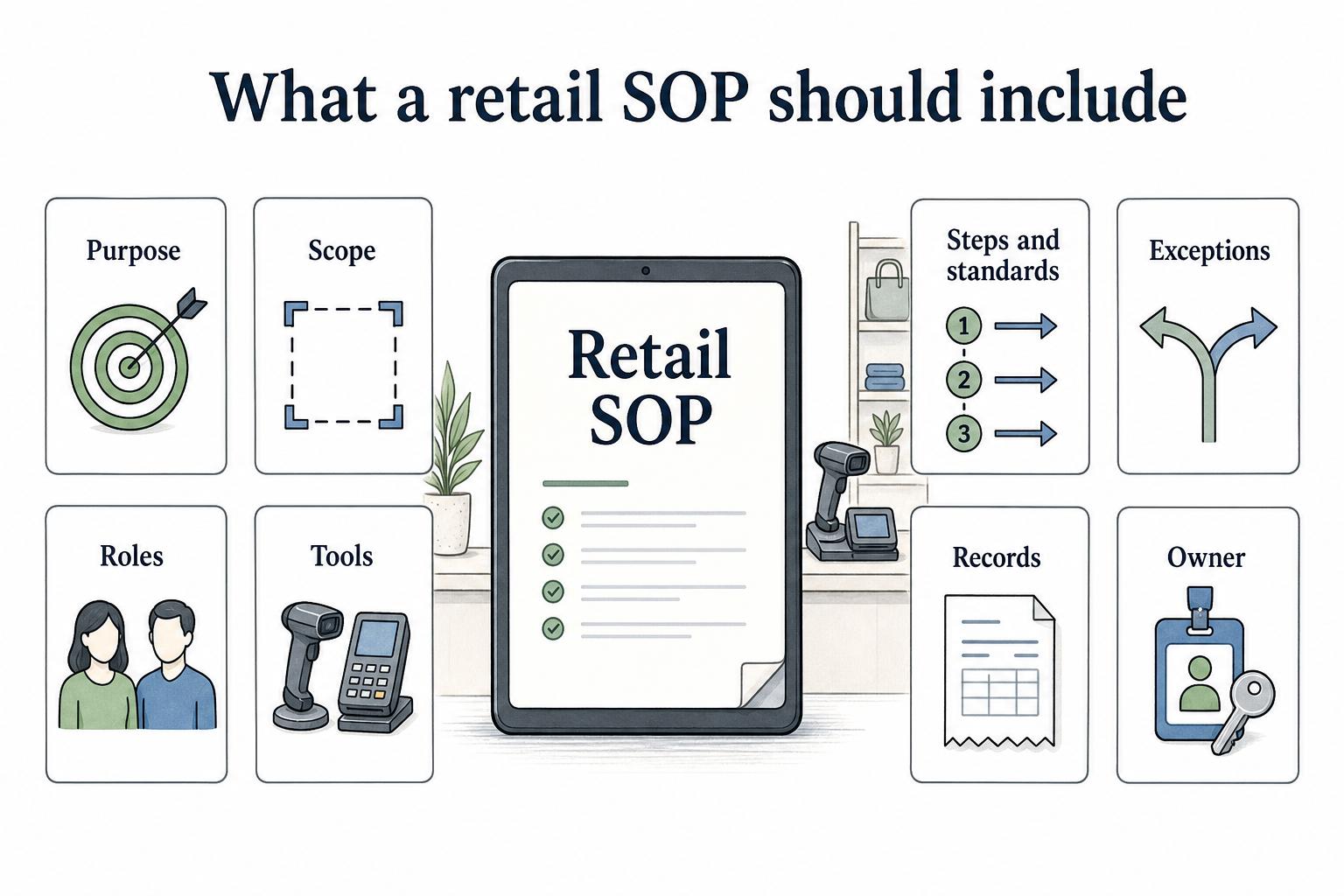
Useful retail SOPs usually include:
- Purpose: the risk, customer moment, or operational standard the procedure controls.
- Scope: the store, channel, role, shift, or scenario the SOP covers.
- Roles: who performs the work, who approves exceptions, and who reviews results.
- Tools: POS, inventory system, scanner, checklist, keys, forms, equipment, or labels.
- Steps and standards: the sequence employees follow, plus timing, service, display, safety, security, or quality expectations.
- Exceptions: what to do when the normal path breaks.
- Records: counts, receipts, photos, notes, tickets, signatures, or logs.
- Owner: the role responsible for keeping the SOP current.
The owner matters more than teams usually expect. Retail procedures drift quickly when products, systems, layouts, staffing models, and policies change. If no one owns the document, the store floor eventually stops trusting it.
Retail SOP examples
Retail SOPs are most useful for workflows that are frequent, risky, easy to perform inconsistently, or important for training.
| Retail workflow | Why it needs an SOP | What the SOP should clarify |
|---|---|---|
| Store opening | Sets the day up for safety, service, and readiness | Alarm, lights, cash setup, floor walk, signage, staffing checks |
| Store closing | Protects cash, inventory, and the facility | Register closeout, safe drop, recovery, lockup, exception notes |
| Returns and exchanges | Affects customers, shrink, and policy consistency | Receipt rules, item inspection, POS steps, manager approval |
| Inventory receiving | Controls stock accuracy and vendor issues | Count method, damage handling, discrepancies, system updates |
| Promotion setup | Protects pricing and brand presentation | Signage, display placement, start/end dates, approval checks |
| Customer escalation | Gives employees a calm path under pressure | When to resolve, when to involve a manager, what to document |
Returns, exchanges, and inventory workflows are especially worth standardizing because they affect shrink, customer-facing risk, stock accuracy, and customer experience.23
A retail SOP does not need to document every possible detail. It needs to remove the ambiguity that creates mistakes.
Retail SOP vs checklist vs policy
Retail teams often blur SOPs, checklists, and policies together. That creates documents that are too thin to teach the work and too long to use during a daily check.
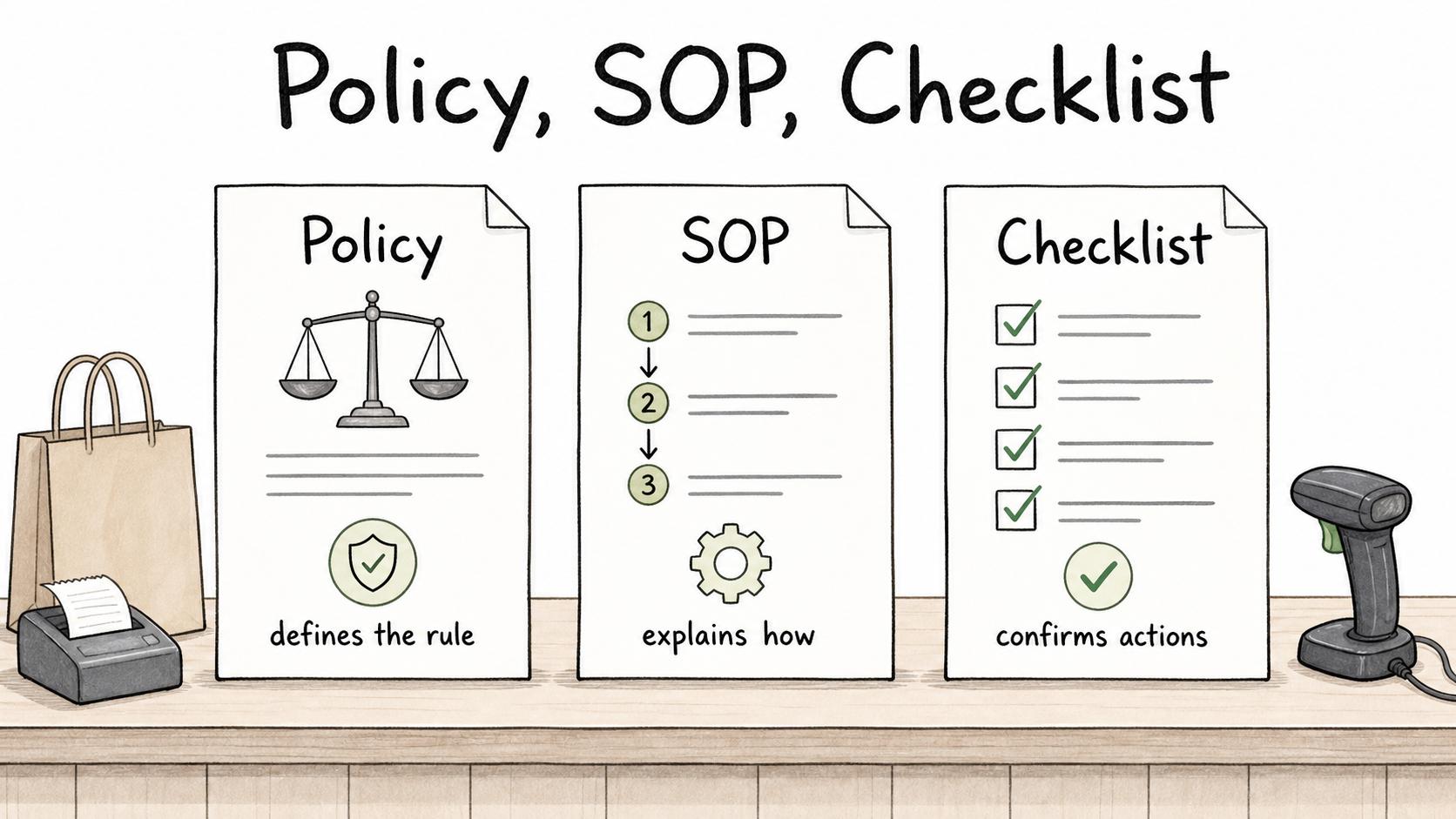
A policy defines the rule. For example: customers can return eligible items within a defined return window.
A retail SOP explains how employees apply that rule. For example: verify the receipt, inspect the item, choose the right POS flow, handle exceptions, and record the transaction.
A checklist confirms that required actions were completed. For example: all closing tasks are done before the final manager leaves.
Use the SOP when people need judgment, sequence, or context. Use the checklist when people need fast confirmation. Use the policy when people need the boundary.
How to write a retail SOP employees will actually use
Start by observing the workflow where it happens. Retail SOPs written away from the floor often miss the workarounds, handoffs, interruptions, and physical details that make the process succeed or fail.
Use this compact prompt to turn a real workflow into a first draft:
## Retail SOP Draft Prompt

**Glossary term:** Retail SOP
**Source:** Trails Glossary — trails.so/glossary/retail-sop

---

### 01. Create a retail SOP draft

"Create a retail SOP for [workflow] used by [role/team] in [store/channel].
Include the purpose, scope, roles, tools, step-by-step procedure, quality or service standards, exception rules, required records, and review owner.
Write it for an employee who may be new, busy, or working during customer traffic.
Call out the three most likely failure points and how the employee should handle them."
Then pressure-test the draft with someone who performs the work. Ask where the procedure is vague, where it assumes local knowledge, and where it breaks during a rush. Those answers are usually more valuable than adding more steps.
Common mistakes
"Ensure proper merchandising" is not a step. "Place the shelf talker on the left side of each sale item and confirm the price matches the POS promotion" is much closer to usable.
Another mistake is leaving out exception paths. A retail SOP that only works when the receipt is present, the scanner works, the product is undamaged, and the manager is available is unfinished. Employees need to know what to do when a common failure path appears, especially in workflows tied to shrink, returns, and customer conflict.2
A third mistake is treating every store exactly the same when the workflow has local constraints. Standardization is useful, but the SOP should be clear about what is fixed and what can vary by layout, region, staffing, or channel.
How Trails helps
Trails helps teams capture a workflow as someone performs it and turn that workflow into a polished step-by-step guide. For retail teams, that can make it easier to document store opening, closing, returns, receiving, merchandising, and training procedures without asking managers to write every step from memory.
Trails can also create an AI-narrated video version of a workflow, which is useful when employees need to see a process before performing it on shift.
Sources
- 1
Occupational Safety and Health Administration. Guidelines for Retail Grocery Stores. OSHA. www.osha.gov/sites/default/files/publications/OSHA3192.pdf. Accessed July 10, 2026.
- 2
National Retail Federation. The Impact of Retail Theft & Violence 2024. National Retail Federation. nrf.com/research/the-impact-of-retail-theft-violence-2024. Accessed July 10, 2026.
- 3
National Retail Federation. How RFID Is Helping Transform the Retail Customer Experience. National Retail Federation. nrf.com/blog/how-rfid-is-helping-transform-the-retail-customer-experience. Accessed July 10, 2026.