
Glossary
Restaurant SOP
 ChatGPT
 Perplexity
 Gemini
 Claude
What is a restaurant SOP?
A restaurant SOP is a standard operating procedure for a repeated restaurant task, such as opening the kitchen, receiving ingredients, preparing a station, checking temperatures, cleaning equipment, or closing the dining room. It tells staff what to do, what standard to meet, what to record, and when to escalate.
Restaurant SOPs are different from generic business procedures because the work happens around guests, food, equipment, time pressure, and shift handoffs. The document has to support real service conditions, not describe an ideal process from a manager's office.
Why restaurant SOPs matter
Restaurants depend on consistency in an environment that rarely stays still. New employees join, vendors change, ticket volume spikes, equipment fails, menus rotate, and managers cannot personally watch every task. SOPs give the team a shared operating standard when attention is divided.
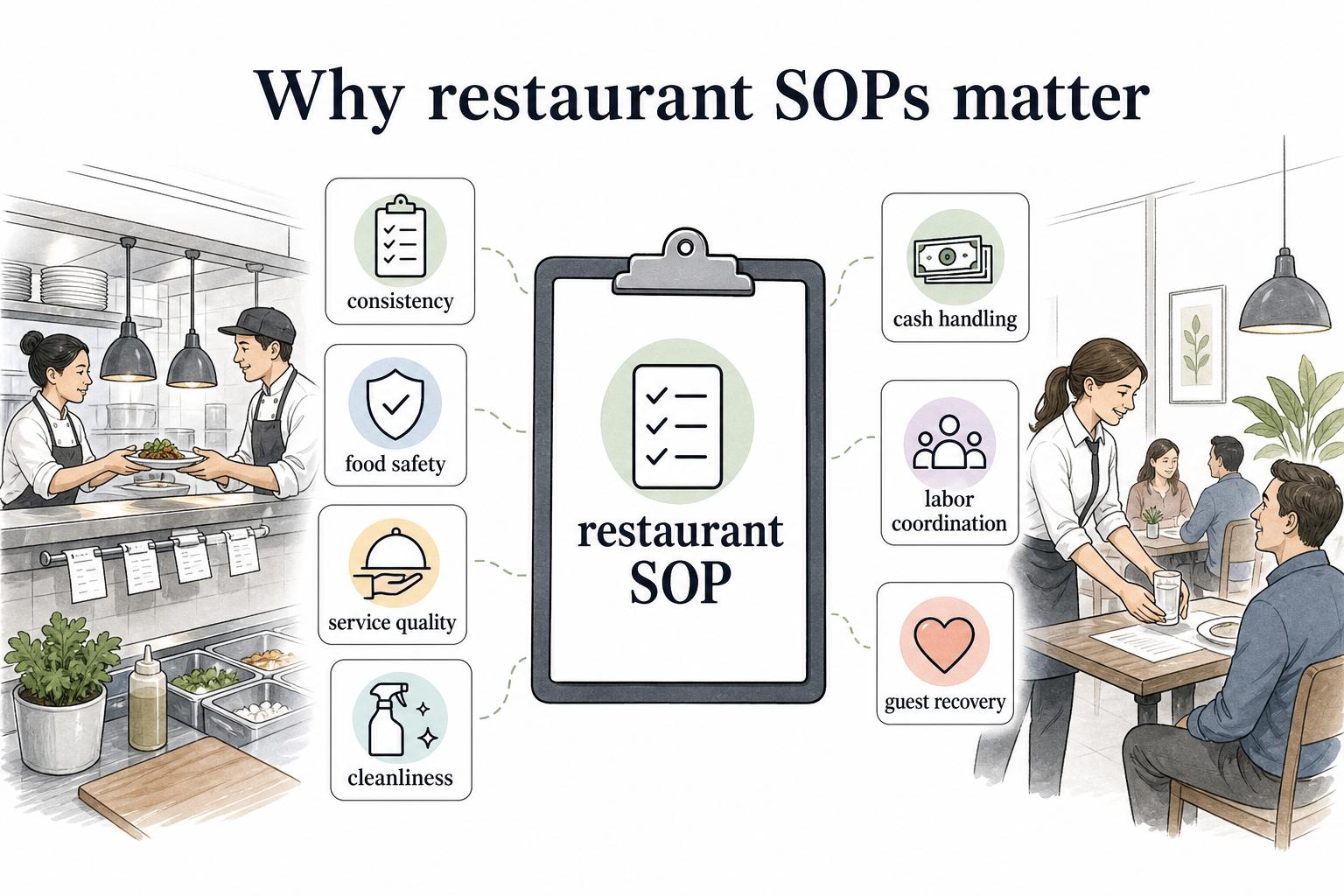
The value is bigger than training. A strong restaurant SOP protects food safety, service quality, cleanliness, cash handling, labor coordination, and guest recovery. CDC food-safety guidance shows why controls have to reach daily behavior, not stay in policy language.1 SOPs also make inspections and internal reviews easier because the restaurant can point to a defined process instead of verbal habit.
The useful test is simple: if two capable employees would perform the same task differently and that difference could affect safety, cost, speed, or guest experience, the task probably needs an SOP.
What a restaurant SOP should include
"Kitchen operations" is too broad. "How to receive, inspect, label, and store a chilled delivery" is specific enough to guide action.
Include the pieces that change employee behavior:
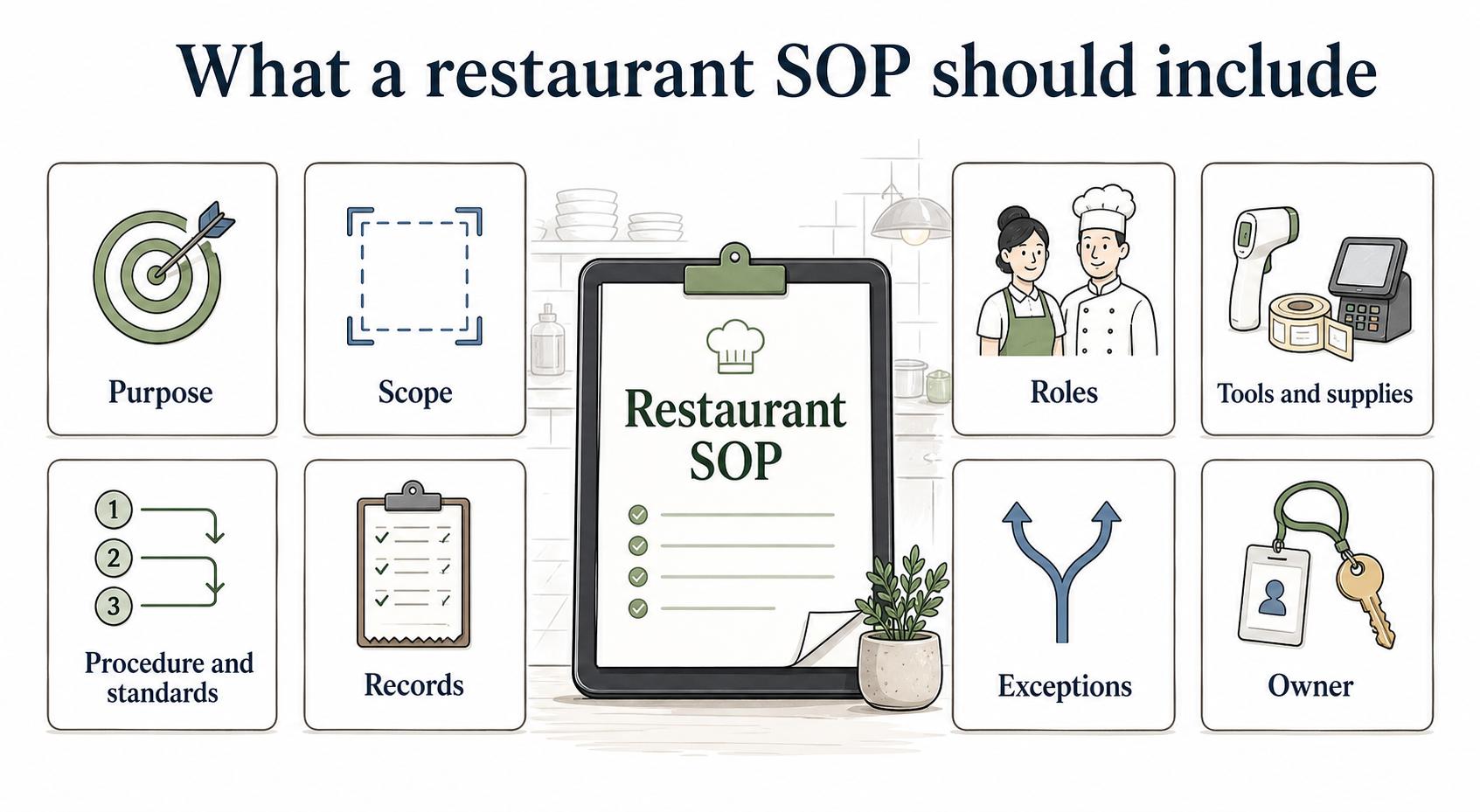
- Purpose: what the procedure protects, such as food safety, guest experience, accuracy, or speed.
- Scope: the location, station, shift, role, or scenario covered.
- Roles: who performs the task, who verifies it, and who handles exceptions.
- Tools and supplies: equipment, forms, labels, PPE, cleaning materials, thermometers, or systems.
- Procedure and standards: the steps in order, plus temperatures, timing, hygiene controls, presentation standards, or service rules.
- Records: logs, tickets, photos, counts, signatures, or manager notes.
- Exceptions: what to do when the normal process breaks.
- Owner: who updates the SOP when the menu, equipment, layout, vendor, or rule changes.
The owner is not administrative trivia. In restaurants, a new menu item, storage area, or cleaning chemical can make an old instruction unsafe or unusable.
Restaurant SOP examples
Restaurant SOPs are most useful where consistency matters and mistakes have consequences.
| Workflow | Why it needs an SOP | What the procedure should make explicit |
|---|---|---|
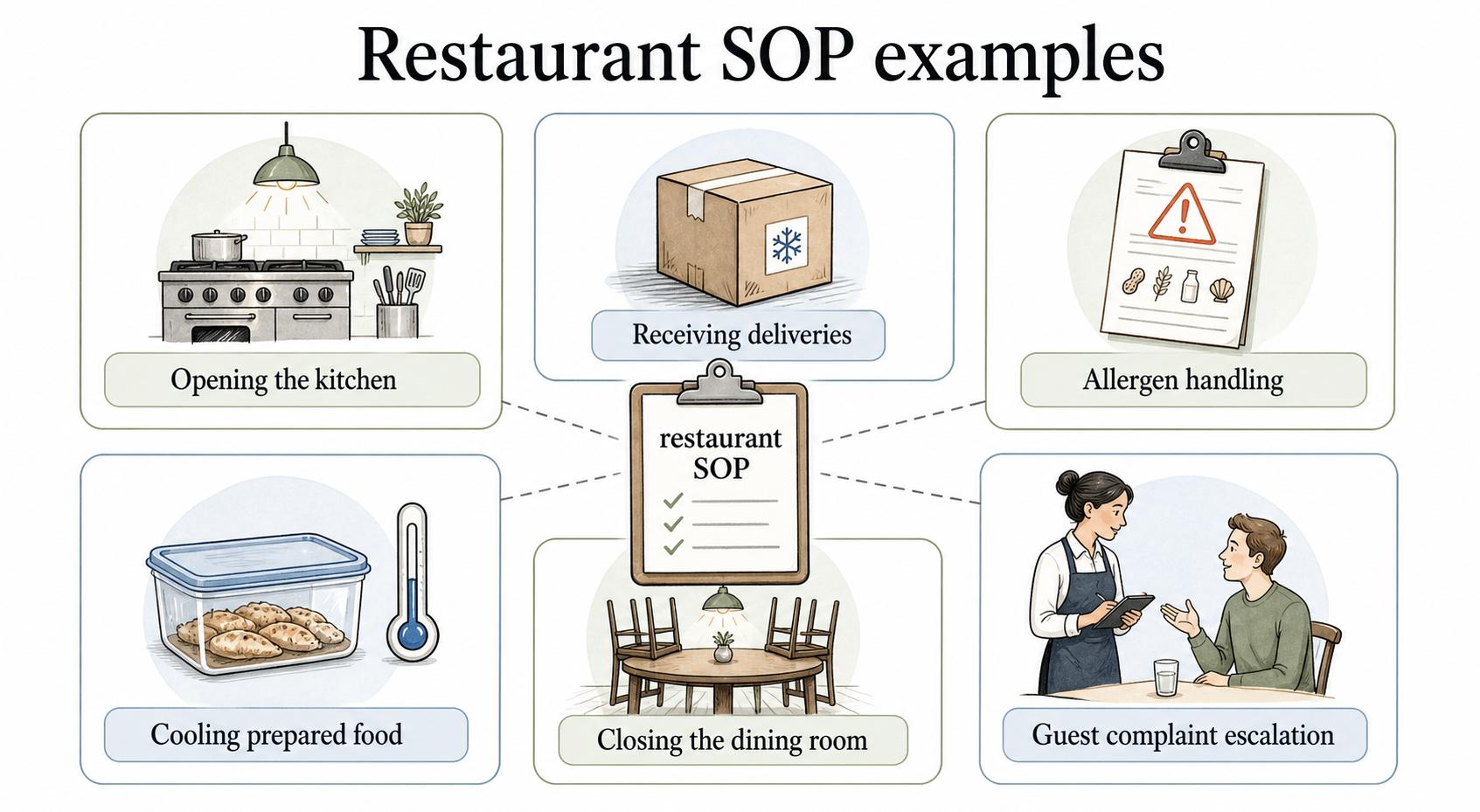
| Opening the kitchen | Sets up safe and efficient service | Equipment checks, station setup, prep status, sanitation checks |
| Receiving deliveries | Protects quality and traceability | Inspection, temperature checks, labeling, rejected items, storage |
| Allergen handling | Reduces cross-contact risk | Order flagging, handoff language, prep controls, manager review |
| Cooling prepared food | Controls a high-risk transition | Container choice, timing, temperature checks, logs, discard rules |
| Closing the dining room | Protects guest experience and cash accuracy | Cleaning, restock, deposits, lost items, security steps |
| Guest complaint escalation | Keeps recovery consistent | What staff can resolve, when managers step in, what gets documented |
A checklist may be enough for a simple confirmation task. An SOP is better when staff need context, judgment, exception rules, or training support.
Food safety and compliance considerations
Restaurant SOPs should translate food-safety expectations into daily behavior. The FDA Food Code is a model used for retail and food-service safety, but local requirements can vary by jurisdiction.2 Restaurant SOPs should be checked against the applicable local rules, internal food-safety program, equipment, and menu.
For food-related workflows, keep the critical control visible at the moment of action. A receiving SOP should say what to check before accepting a delivery. A prep SOP should say how to prevent cross-contact. A cleaning SOP should say which surface, chemical, concentration, timing, and record matter. Federal food-safety guidance organizes basic prevention around cleaning, separating, cooking, and chilling; an SOP should turn those principles into task-level instructions.3
"Follow food safety standards" is not enough. The SOP should tell the employee what to inspect, measure, clean, separate, label, discard, log, or escalate.
A practical restaurant SOP template
Use this as a starting point for one workflow, not as a giant manual page.
## Restaurant SOP Template

**Glossary term:** Restaurant SOP
**Source:** Trails Glossary — trails.so/glossary/restaurant-sop

---

### 01. Create a restaurant SOP draft

"Restaurant SOP template
Title: [workflow name]
Purpose: [what this protects or standardizes]
Scope: [station, shift, role, location, or scenario]
Owner: [role responsible for updates]
Roles: [who performs, verifies, approves, or escalates]
Tools and supplies: [equipment, labels, forms, PPE, ingredients, systems]
Critical controls: [temperature, timing, hygiene, separation, quality, service]
Procedure:
1. [first action]
2. [next action]
3. [next action]
Records required: [logs, tickets, photos, counts, notes]
Exception rules: [when to pause, discard, remake, call a manager, or document]
Review trigger: [menu change, equipment change, inspection finding, incident, schedule]"
After drafting, test the SOP during a real shift. If a new employee cannot find the next action quickly, or if an experienced employee says, "that is not how it works when we are busy," revise it.
Common mistakes
One mistake is using SOPs as training lectures. A restaurant employee may be reading the procedure between tickets, during prep, or right before a handoff. Keep background short and make the action visible.
Another mistake is skipping exception paths. Restaurants run on exceptions: late deliveries, missing labels, allergy flags, broken equipment, guest complaints, short staffing, and product substitutions. The SOP should say which exceptions staff can handle and which require manager approval.
A third mistake is separating the SOP from the record. If the task requires a temperature log, cleaning log, prep sheet, incident note, or cash count, the SOP should name where the record goes and who reviews it. Otherwise, the process may happen but leave no proof.
How Trails helps
Trails helps teams capture a workflow as someone performs it and turn that workflow into a polished step-by-step guide. For restaurants, that can help managers document opening routines, station setup, delivery receiving, cleaning tasks, service standards, and shift handoffs without writing everything from memory.
Trails can also create an AI-narrated video version of a guide, which is useful when new staff need to see the work before performing it in a live service environment.
Sources
- 1
Centers for Disease Control and Prevention. Food Safety Basics. CDC. www.cdc.gov/food-safety/about/index.html. Accessed July 10, 2026.
- 2
U.S. Food and Drug Administration. FDA Food Code. FDA. www.fda.gov/food/retail-food-protection/fda-food-code. Accessed July 10, 2026.
- 3
FoodSafety.gov. 4 Steps to Food Safety. FoodSafety.gov. www.foodsafety.gov/keep-food-safe/4-steps-to-food-safety. Accessed July 10, 2026.