
Glossary
Value Stream
 ChatGPT
 Perplexity
 Gemini
 Claude
What is a value stream?
A value stream is the full path of work, decisions, handoffs, information, and waiting required to deliver value to a customer, employee, or end user. It starts when demand appears and ends when the recipient gets the intended outcome.1
The idea comes from lean process improvement, but it applies wherever work crosses teams.2
A value stream might be customer onboarding from signed contract to first successful use, or a support issue from ticket creation to resolution.
What counts as a value stream
A value stream is bigger than one team's checklist. It follows the outcome across ownership changes, delayed information, queues, and rework. The useful boundary is the recipient's experience, not the org chart.
Examples include:
- A support ticket from submission to resolution.
- A new hire from accepted offer to first productive week.
- A feature request from customer feedback to shipped improvement.
- A purchase request from employee need to paid vendor invoice.
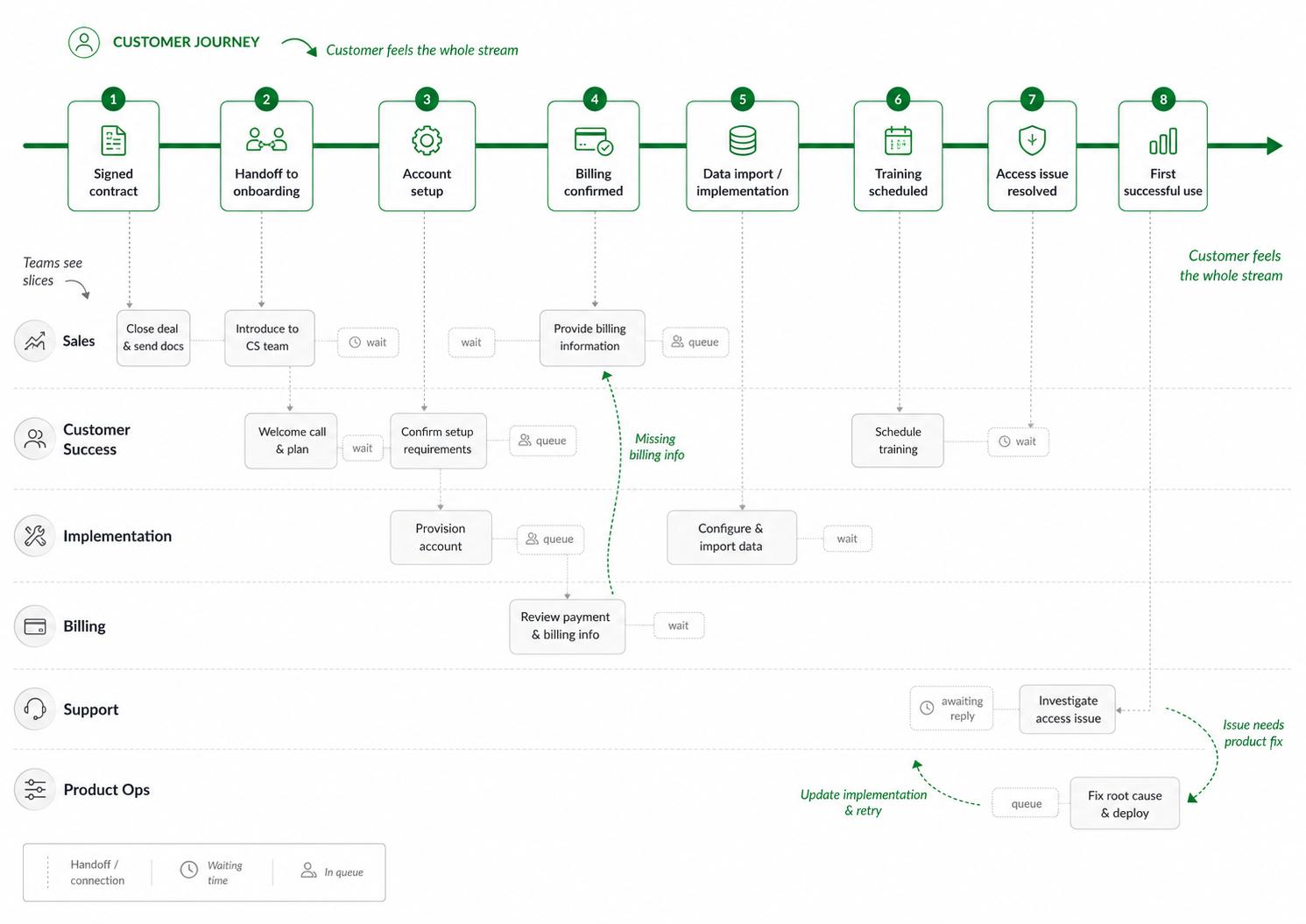
If the work creates something someone values and needs multiple steps or handoffs to get there, there is probably a value stream behind it. A sales team, implementation team, support team, and billing team may each own a slice of customer onboarding; the customer feels the whole stream.
Value stream vs process vs workflow
Value streams, processes, and workflows overlap, but they focus attention differently.
A process is repeatable work that produces an outcome. A workflow is how tasks, decisions, and handoffs move through that process. A value stream widens the lens to the full path from demand to delivered value, including queues, waiting, rework, and cross-team coordination.3
For example, approve a refund may be a process. The workflow defines who reviews the request, which system gets updated, and where the approval goes next. The value stream may include the complaint, ticket triage, refund approval, billing adjustment, customer communication, and final customer outcome.
This matters because teams often improve the wrong unit. One step can get faster while the customer still waits in the next queue.
Why value streams matter
Value stream thinking forces teams to judge work by the outcome, not by local activity.
Without that wider view, teams can create local wins that do not improve the result. Support closes tickets faster, but billing still waits on missing account data. HR sends onboarding forms earlier, but the new hire still cannot access key systems.
A value stream makes those gaps visible. The useful questions are simple:
- Where does work wait?
- Where does context arrive late or incomplete?
- Where does rework happen?
- Which handoffs create confusion?
- Which delays sit outside the step owner's control?
The practical benefit is less blame and better diagnosis. When people see the whole stream, another team is slow often turns into a more fixable problem: the system is asking every team to work around missing context.
How to identify a value stream
Start with the recipient and the outcome, not with the team that owns the work. A department-first boundary usually cuts the stream too small. A useful value stream has a clear start point, a clear end point, and a reason the outcome matters.
Use this template:
## Value Stream Identification Template

**Glossary term:** Value Stream
**Source:** Trails Glossary — trails.so/glossary/value-stream

---

### 01. Identify a value stream

"Value stream name: [outcome or service]
Recipient: [customer, employee, partner, or internal team]
Start point: [event that creates demand]
End point: [observable valuable outcome]
Teams involved: [roles or departments]
Systems involved: [tools, queues, forms, databases]
Major handoffs: [where ownership changes]
Known delays: [where work waits]
Common rework: [what gets corrected or repeated]
Primary measure: [lead time, quality, effort, cost, or experience]"
For a customer onboarding value stream, the start point might be a signed contract and the end point might be the customer completing their first successful workflow. The stream may include sales, customer success, implementation, billing, support, and product operations.
Value stream mapping
Value stream mapping is the activity of visualizing and analyzing a value stream. The value stream is the thing being studied. The map is the diagnostic tool.
This distinction matters because a team can have a value stream even if it has never mapped it. The work is already flowing through people, systems, and queues. Mapping simply makes the flow visible enough to improve.
A good value stream map usually shows current-state flow, delays, information movement, rework, and a future-state design. But the map is not the goal. The goal is a better way of delivering value.4
Documentation takeaway
A value stream should shape what a team chooses to document. Not every step needs the same level of detail. The highest-leverage docs often sit where work changes hands: intake rules, decision points, quality checks, exception paths, and repeatable tasks that affect lead time or customer experience.
When a team improves a value stream, the documentation has to catch up. Updated SOPs, guides, checklists, and training materials are what turn an improvement idea into normal operating behavior.
FAQ
Is a value stream the same as a process?
No. A process describes repeatable work. A value stream follows the full path from demand to delivered value, including handoffs, waiting, rework, and cross-team coordination.
Can service teams have value streams?
Yes. Support, customer success, HR, finance, IT, and operations teams all have value streams when they deliver outcomes through repeatable work.
What is the difference between a value stream and a value stream map?
The value stream is the actual flow of work and information. The value stream map is a visual tool used to study and improve that flow.
- Value stream mapping
- Workflow
- Business process
- Process improvement
- Process mapping
- Lean manufacturing
- Waste elimination
- Lead time
Sources
- 1
U.S. Environmental Protection Agency. Lean & Environment Toolkit Appendix A. EPA. 19january2017snapshot.epa.gov/lean/lean-environment-toolkit-appendix_.html. Accessed June 25, 2026.
- 2
U.S. Environmental Protection Agency. Environmental Professional's Guide to Lean and Six Sigma. EPA. 19january2021snapshot.epa.gov/sustainability/environmental-professionals-guide-lean-and-six-sigma-chapter-2_.html. Accessed June 25, 2026.
- 3
Lean Enterprise Institute. Value-Stream Mapping. Lean Enterprise Institute. www.lean.org/lexicon-terms/value-stream-mapping/. Accessed June 25, 2026.
- 4
Lean Enterprise Institute. Understanding the Fundamentals of Value-Stream Mapping. Lean Enterprise Institute. www.lean.org/the-lean-post/articles/understanding-the-fundamentals-of-value-stream-mapping/. Accessed June 25, 2026.