
Glossary
Six Sigma Documentation
 ChatGPT
 Perplexity
 Gemini
 Claude
What is Six Sigma documentation?
Six Sigma documentation is the set of project records, process maps, data definitions, analyses, decisions, procedures, and control plans created during a Six Sigma improvement project. It shows what problem the team addressed, how the process was measured, what root causes were found, what changed, and how the improvement will be sustained.
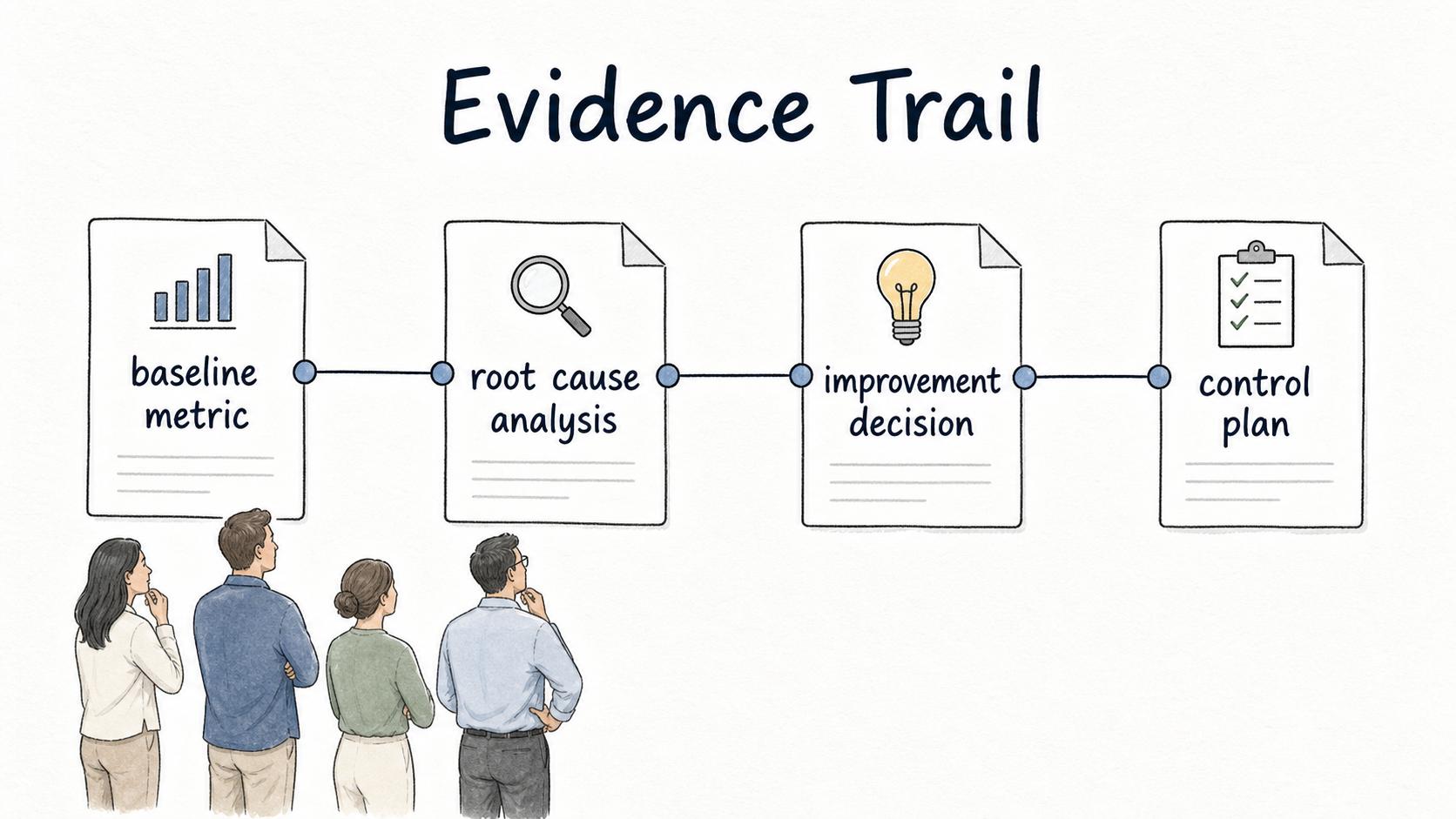
Good documentation matters because Six Sigma is evidence-driven. ASQ describes DMAIC as a structured, data-driven approach for improving existing processes that miss performance standards or customer expectations.1 If the team cannot explain the baseline, analysis, chosen improvement, or control method, the project becomes a story instead of a reliable operating change.
What Six Sigma documentation includes
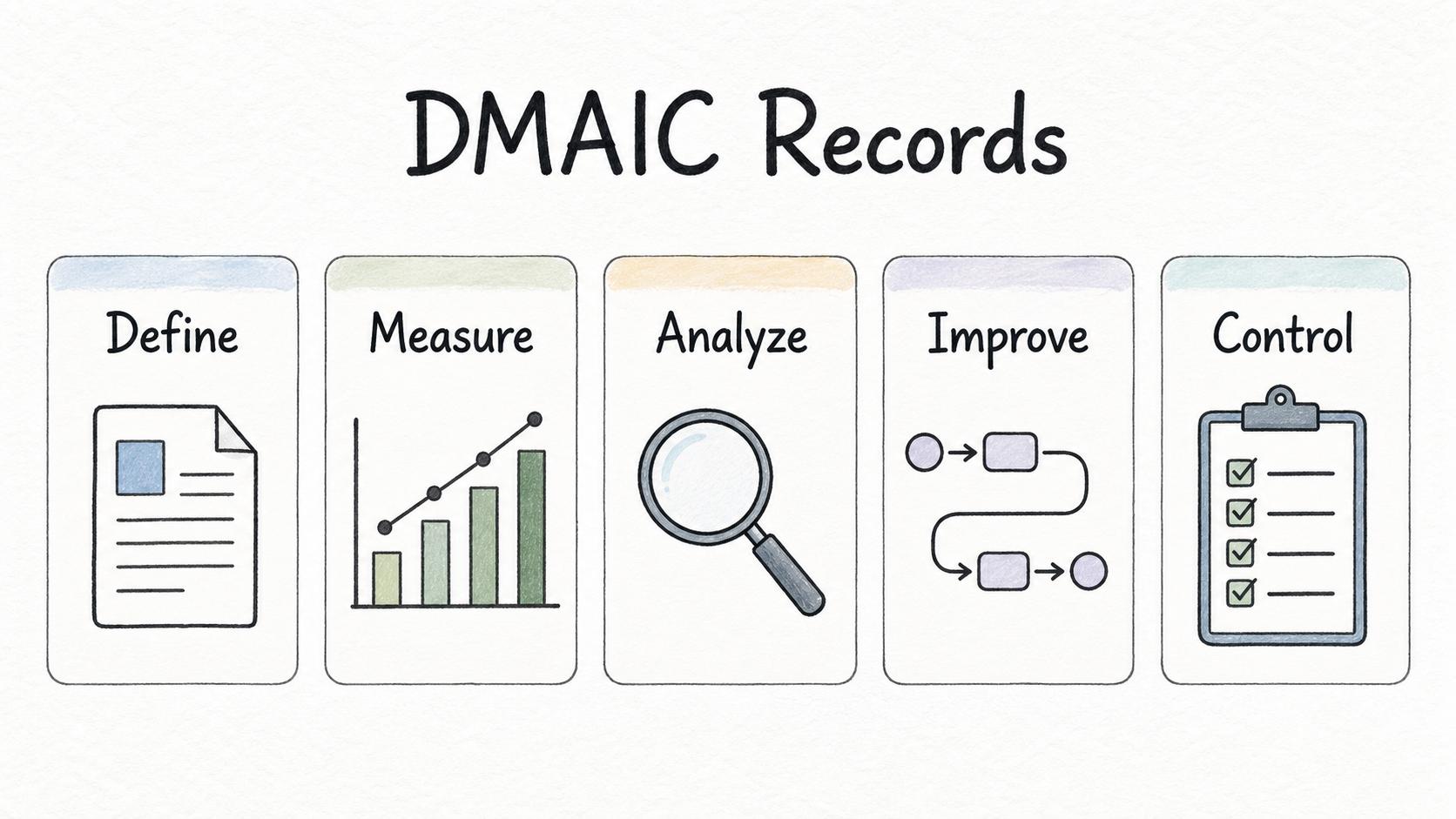
Six Sigma projects often follow DMAIC: define, measure, analyze, improve, and control. ASQ's Six Sigma tools reference also describes DMAIC as a data-driven quality strategy and part of Six Sigma improvement work.2 Documentation should follow the same logic.
| DMAIC phase | Documentation to capture | Why it matters |
|---|---|---|
| Define | Problem statement, project charter, customers, scope, goals | Aligns the team on the problem and boundaries |
| Measure | Current process map, data collection plan, baseline metrics | Shows how the process performs before changes |
| Analyze | Root cause analysis, charts, findings, assumptions | Connects evidence to the selected causes |
| Improve | Tested solutions, pilot notes, updated workflow, decisions | Explains what changed and why |
| Control | Control plan, SOP updates, owner, monitoring cadence | Helps the improvement last after the project ends |
The exact documents vary by organization and project size. A small operational improvement may need a compact charter, map, metric, test notes, and updated SOP. A high-risk manufacturing or regulated process may need formal records, approvals, and retention rules.
Why documentation matters in Six Sigma projects
Six Sigma documentation keeps improvement work from depending on memory. It helps the team see which decisions were evidence-based, which assumptions were tested, and what should happen after the project closes.
It also helps new team members understand the improvement later. Without documentation, someone may see only the final procedure and miss the reason behind it. That matters because process changes often have tradeoffs. NIST's lean process-improvement guidance highlights value stream mapping as a way to uncover waste, diagnose process problems, and decide where to improve.3 A team may reduce cycle time only under certain staffing conditions. A team may reduce defects only if a new inspection step is followed.
Documentation also supports handoff. Six Sigma projects often involve quality, operations, frontline employees, managers, analysts, and process owners. A clear record lets the process owner maintain the new standard without needing the project team in every future conversation.
Six Sigma documentation vs. SOP documentation
Six Sigma documentation and SOP documentation overlap, but they answer different questions.
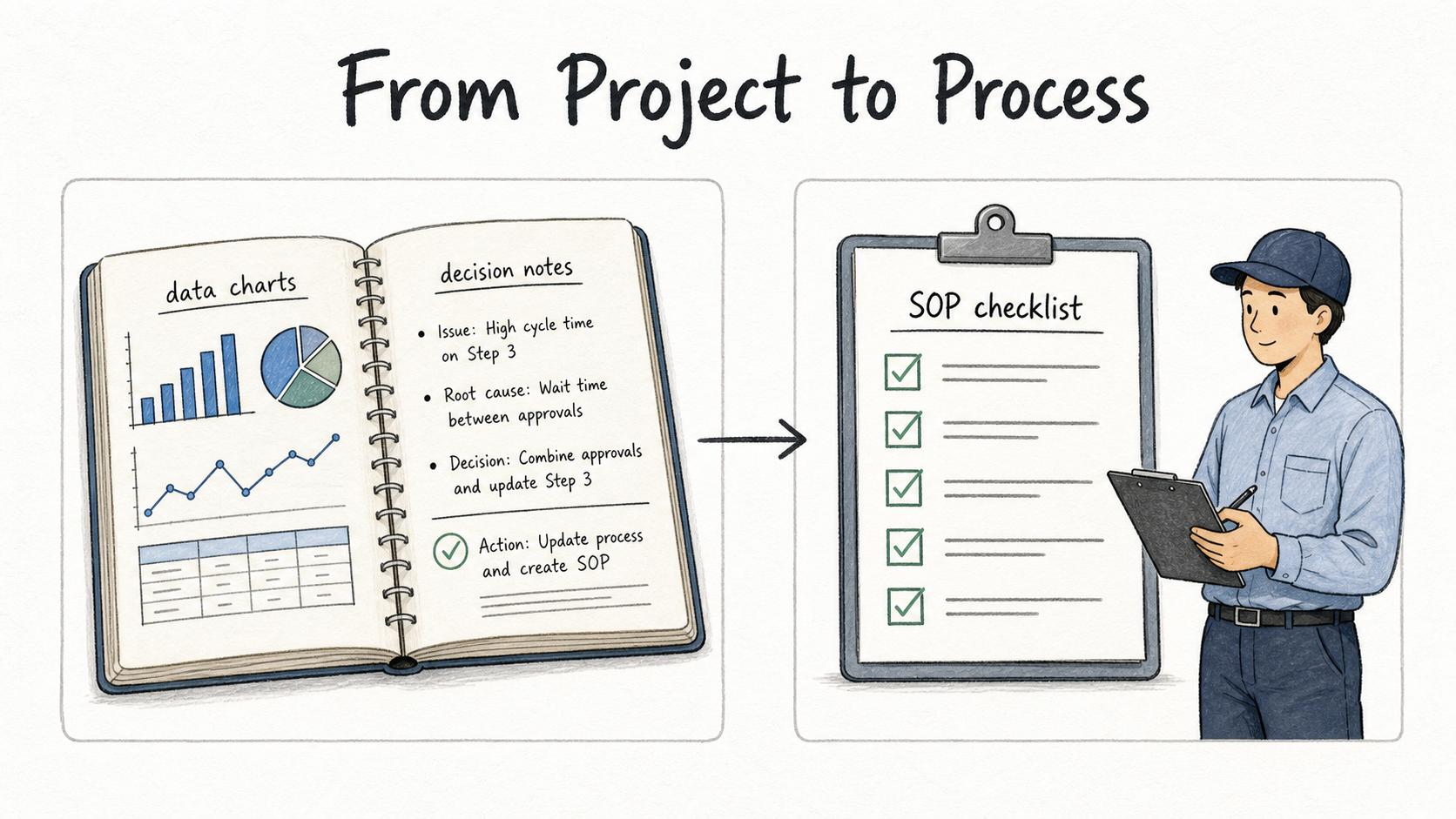
Six Sigma documentation explains the improvement journey: the problem, data, root causes, experiments, decisions, and control plan. SOP documentation explains the approved way to perform the improved process going forward.
For example, a Six Sigma project may find that order errors happen because two teams enter customer data differently. The project documentation captures the baseline defect rate, analysis, test results, and selected fix. The SOP documents the new standard process for entering, checking, and handing off customer data.
Both records matter. The Six Sigma file explains why the change happened. The SOP tells the team how to keep doing the improved work.
What to document without overdoing it
The risk with Six Sigma documentation is turning the project into paperwork. Capture enough evidence to make the work understandable and repeatable, but avoid creating documents nobody will use.
Prioritize five groups of records:
- Problem and scope: project charter, customer impact, boundaries, and target outcome.
- Measurement: baseline metric, data source, data definition, and current-state process map.
- Analysis: root cause evidence, assumptions tested, charts, and decision notes.
- Improvement: options considered, pilot results, selected change, and updated workflow.
- Control: control plan, process owner, review cadence, updated SOPs or work instructions, and reaction plan.
Skip decorative slide decks unless they help decision-making. The strongest documentation is close to the work: real data, workflow captures, clear decisions, and updated operating procedures.
Six Sigma documentation template
Use this template to keep a Six Sigma project record close to the work:
## Six Sigma Documentation Template

**Glossary term:** Six Sigma Documentation
**Source:** Trails Glossary — trails.so/glossary/six-sigma-documentation

---

### 01. Document a Six Sigma project

"Project name: [process or problem]
Business problem: [what is going wrong]
Scope: [start point, end point, included/excluded teams]
Customer or stakeholder impact: [who is affected]
Baseline metric: [current performance and data source]
Goal: [target outcome]
Current process: [map or step summary]
Root causes tested: [hypotheses and evidence]
Improvement selected: [what changed and why]
Pilot results: [before/after or test findings]
New standard process: [link to SOP or work instruction]
Control plan: [metric, owner, review cadence, reaction plan]
Lessons learned: [what future teams should know]"
The most important field is the link to the new standard process. A project file is useful only if it changes daily work and leaves someone accountable for the control plan.
Common mistakes
The most common mistake is documenting the project but not the new way of working. A team may finish a strong analysis and then leave the final process buried in a slide deck. That makes adoption fragile.
Another mistake is collecting data without defining it clearly. If people cannot tell how a metric was measured, the baseline and results become hard to trust.
A third mistake is failing to update training materials. If the improvement changes how people work, SOPs, job aids, onboarding, and performance checks may need to change too.
How Trails helps
Trails can help teams document the practical side of Six Sigma improvements. When a process changes, a teammate can capture the new workflow as it is performed, turn it into a step-by-step guide, and create an AI-narrated video for training or rollout.
That is useful during the control phase, where the improved process needs to become the new standard instead of staying inside a project file.
- Six Sigma
- DMAIC
- SIPOC
- Process improvement
- Quality control
- Root cause analysis
- Control plan
Sources
- 1
American Society for Quality. DMAIC Process: Define, Measure, Analyze, Improve, Control. ASQ. asq.org/quality-resources/dmaic. Accessed July 7, 2026.
- 2
American Society for Quality. Six Sigma Tools. ASQ. asq.org/quality-resources/sixsigma/tools. Accessed July 7, 2026.
- 3
National Institute of Standards and Technology. Lean and Process Improvement. NIST MEP. www.nist.gov/mep/lean-and-process-improvement. Accessed July 7, 2026.